Recommended resources
The freely available resources this lesson will direct you to.
Introduction
Welcome back. In our last lesson, you learned to cut through the noise of a long to-do list by using the Eisenhower Matrix. By sorting tasks into what is urgent versus what is important (based on your own values), you created a strategic filter for your Next Actions list. The key insight was that your most critical long-term goals—the Quadrant 2 items—often get ignored because they lack urgency. The solution we identified was to schedule them, making them a concrete commitment.
Today, we will build directly on that principle. Knowing what to do is only half the battle; the other half is knowing when you'll do it. This lesson will teach you how to use time-blocking to assign tasks to specific calendar slots, accounting for ADHD-related time blindness. This is where your prioritized list transforms into a practical, day-to-day action plan, a crucial skill for managing your demanding roles as a CIO and musician.
Why Standard Time-Blocking Often Fails
You may have tried time-blocking before. Perhaps you've created a perfectly color-coded, minute-by-minute schedule, only to see it fall apart by 10 AM. This is a common and frustrating experience for those with ADHD. It's not a failure of willpower; it's a mismatch between the tool and the brain's "operating system."
Rigid, traditional time-blocking often fails because it clashes with the ADHD brain's need for flexibility and its variable levels of energy and focus, which are tied to dopamine regulation. When a schedule is too restrictive, it can feel suffocating and trigger resistance.
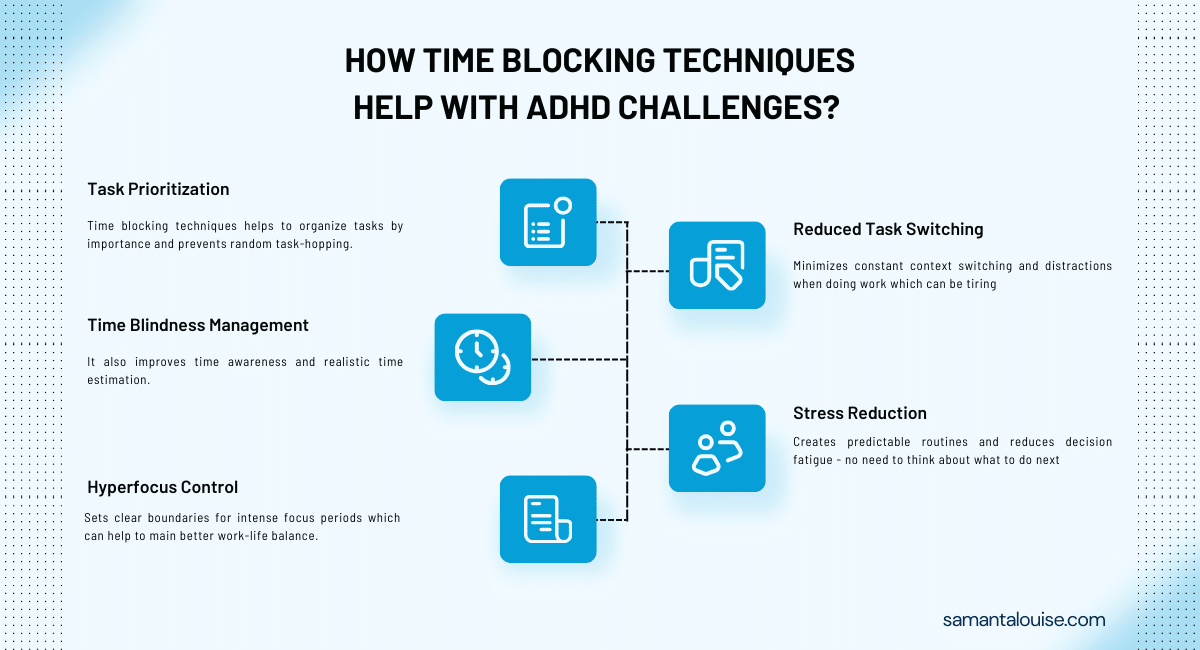
The key isn't to abandon time-blocking, but to adapt it. We need a system that provides structure without being a straitjacket.
Understanding the Core Challenge: Time Blindness
The biggest obstacle to effective planning for ADHD is "time blindness," a concept explicitly mentioned in our learning outcome. It's the persistent difficulty in perceiving the passage of time, estimating how long a task will take, and sensing the approach of future deadlines.
Your brain's time perception isn't linear. It operates on a "Now" and "Not Now" basis. This isn't a character flaw; it's a neurological reality linked to the brain's executive functions.
ADHD Time Blindness: Why Timers Fail and What Works
To appreciate why adapted strategies are so necessary, it's helpful to understand the mechanics of time blindness. The article 'ADHD Time Blindness: Why Timers Fail and What Works' provides a clear, science-backed explanation.
Please read the sections titled 'The Neurological Basis', 'The “Now and Not Now” Model', and 'How Time Blindness Shows Up'. This will give you a solid framework for understanding your own experience with time.
This difficulty with time perception manifests in three main ways:
- Prospective Time Blindness: Underestimating how long future tasks will take (e.g., "This report will only take 30 minutes" when it really takes 90).
- Retrospective Time Blindness: Inaccurately judging how much time has passed (e.g., getting lost in hyperfocus and losing hours).
- Present-Moment Time Blindness: Not sensing the passage of time as it happens, leading to being late for the next thing.
Our goal with time-blocking is to create an external, visible sense of time to compensate for the internal clock's unreliability.
ADHD-Friendly Time-Blocking: The Core Principles
Adapting time-blocking involves shifting from a rigid set of rules to a flexible set of principles. Here’s how.
1. Embrace Flexibility: Blocks, Not Handcuffs
Instead of scheduling every minute, think in terms of broader, more flexible blocks. This gives you the structure to guide your day but the autonomy to adapt to your energy levels.
ADHD and Time-Blocking: How does it work?!
The YouTube video 'ADHD and Time-Blocking: How does it work?!' offers a fantastic alternative to rigid scheduling. It introduces the idea of assigning tasks to general parts of the day.
Watch the segment from 13:18 to 15:46. Pay close attention to the concept of assigning tasks to broad categories like 'morning,' 'afternoon,' and 'evening' rather than precise time slots. This simple shift creates structure while preserving flexibility.
This approach allows you to decide in the moment which "afternoon" task you have the most energy for, reducing initiation friction.
2. Build Your External Clock: A Hybrid System
To make time visible, we externalize it. Many find a hybrid system highly effective:
- A digital calendar for "hard landscape" items: meetings, appointments, and deadlines. These are your non-negotiables.
- A paper planner or notebook for daily time-blocking of your flexible tasks.

The physical act of writing tasks into blocks on paper can increase your commitment and encoding of the plan. It also keeps you away from the digital distractions of your calendar app when you're in planning mode.
3. Compensate for Time Blindness: Add Buffers
This is perhaps the most critical adaptation. Since you're likely to underestimate how long tasks take, build in buffer time.
ADHD and Time Blocking: Neuropsychologist explains what really works
In this next video, neuropsychologist Dr. Tiffany Shelton explains practical strategies to compensate for time blindness, with a focus on buffers.
Watch from 04:22 to 06:15. Dr. Shelton provides a concrete recommendation for adding 'buffer blocks' to your day to account for tasks running long or unexpected issues. This is your built-in contingency plan.
A good starting point is to add two 30-minute buffer blocks to your day. You can use this time to finish a task that ran over, transition between activities, or simply take a break if you're ahead.
A Practical Workflow for Time-Blocking Your Day
Here is a step-by-step process to combine these principles into a daily planning habit.
Step 1: Set Your Anchors
First, block out your non-negotiable commitments. These are the fixed points around which your day will be built. This includes meetings, appointments, and any hard deadlines you must meet.
Time Blocking For ADHD: Manage Your Day With Less Stress
The article 'Time Blocking For ADHD' walks through this foundational step clearly.
Read the sections 'Brain Dump: The First Step' and 'Scheduling Fixed Commitments'. This reinforces the process of getting tasks out of your head and then placing your non-negotiables on the calendar first.
Step 2: Schedule Your Priorities
Look at the prioritized list you created with the Eisenhower Matrix.
- Quadrant 1 (Urgent & Important): Block out time to complete these tasks, usually early in the day.
- Quadrant 2 (Important & Not Urgent): This is the crucial step. Take these goals (e.g., "Practice a new mixing technique," "Review long-term portfolio strategy") and assign them to specific, generous time blocks on your calendar. This act transforms an abstract goal into a concrete appointment with yourself.
Step 3: Batch Similar Tasks
As a musician and recording engineer, you know the efficiency of setting up a microphone once to record multiple takes. The same principle, called "task batching," applies here. Grouping similar tasks saves the mental energy that's lost when switching contexts.
- Create an "email block" to handle all your correspondence at once.
- Create a "financial admin block" for paying bills and reviewing accounts.
- Create a "calls block" for making all necessary phone calls.
Step 4: Review and Adjust with "Back-Planning"
A plan is a hypothesis. The data comes from what actually happens. At the end of the day, take five minutes to review your time-blocked schedule. This is called back-planning.
ADHD and Time Blocking: Neuropsychologist explains what really works
Let's return to Dr. Shelton's video, where she explains the powerful concept of 'back-planning'.
Watch from 19:52 to 21:04. Back-planning involves marking what you actually did and how long it took. This isn't about judgment; it's about collecting data to make your future time estimates more accurate.
This feedback loop is invaluable. If you see that you consistently budget 30 minutes for a task that always takes 60, you can adjust your future blocks accordingly. This practice is how you slowly but surely get better at estimating time.
Conclusion
Today, you've moved from prioritizing your tasks to giving them a home in your schedule. You've learned that effective time-blocking for ADHD is not about creating a rigid, perfect schedule. It's about creating a flexible, visual guide that respects your brain's wiring.
Key Takeaways:
- Standard, rigid time-blocking often fails because it clashes with the ADHD brain's need for flexibility and fluctuating energy.
- The primary goal of ADHD-friendly time-blocking is to create an external, visual system to combat internal time blindness.
- Key adaptations include:
- Flexibility: Using broad time categories (morning/afternoon) instead of minute-by-minute scheduling.
- Buffers: Intentionally scheduling extra time for transitions and overruns.
- A Hybrid System: Using a digital calendar for fixed appointments and a paper planner for daily task blocking.
- Back-planning—reviewing what actually happened versus what you planned—is a critical feedback loop for improving your time estimation skills.
Preview of the Next Lesson:
Your time-blocked plan gives you a roadmap for the day. But how do you close out the day successfully, especially if things didn't go exactly as planned? The practice of back-planning is a perfect bridge to our next topic. In the next lesson, we will formalize this end-of-day process by learning how to implement a daily shutdown routine to clear your mind and prepare for the next day. This routine is the final piece of the daily planning puzzle, ensuring each day ends with clarity and sets you up for a fresh start.