Recommended resources
The freely available resources this lesson will direct you to.
Hello! Welcome back to your course on economics.
In our last lesson, we established the fundamental problem of economics: scarcity. We saw that because resources are limited and wants are unlimited, we are forced to make choices, which always involve trade-offs and an opportunity cost—the value of the next-best alternative we give up.
That lesson answered why we must choose. Today, we address the logical next question: how do we make the best possible choice? This lesson is dedicated to explaining the core decision-making tool in economics: marginal analysis. By the end of our session, you'll be able to explain this concept and its central role in economic decision-making.
1. Thinking at the Margin
Most decisions in life are not "all or nothing." You don't decide between studying for an exam for 24 hours a day or not studying at all. Instead, you decide whether to study for one more hour. You don't decide between eating an entire cake or fasting; you decide whether to have one more slice.
Economists call these incremental adjustments marginal changes. The process of analyzing these small, step-by-step decisions is called marginal analysis. It involves breaking down a "how much?" question into a series of simple "yes or no" questions.
Marginal Benefits and Marginal Costs
To start, let's watch a brief clip from a video by Dan O'Neill that introduces this idea of 'thinking at the margin.'
Watch the segment from 02:02 to 02:44. Focus on how it defines marginal changes as small, incremental adjustments to an existing plan.
As the video states, rational decision-making involves comparing the incremental benefits and incremental costs of an action. Let's define these two key terms.
2. Marginal Benefit and Marginal Cost
To use marginal analysis, we need to compare two things for each additional unit of an activity:
- Marginal Benefit (MB): The additional benefit, satisfaction, or utility you gain from consuming one more unit of a good or service.
- Marginal Cost (MC): The additional cost you incur from producing or consuming one more unit of a good or service.
A common pattern with these is that marginal benefit tends to decrease, while marginal cost tends to increase.
Marginal Benefits and Marginal Costs
The same video provides clear explanations for both of these concepts, along with two important 'laws' associated with them.
Please watch from 03:43 to 06:15. As you watch, pay attention to: The Law of Diminishing Marginal Utility (Benefit): Why does the satisfaction from each extra slice of cake decrease? The Law of Increasing Marginal Cost: Why does the cost of producing more crops or adding more cooks eventually rise per unit?
This makes intuitive sense. The first slice of pizza when you're hungry is fantastic (high MB). The tenth slice? Not so much (low MB). For a business, the first few units may be cheap to make, but to produce more, they might need to pay workers overtime or use less efficient machinery, increasing the marginal cost.
3. The Golden Rule of Marginal Analysis
Now we can put these concepts together to form a powerful and simple decision-making rule. To decide whether to do something one more time, you just compare its marginal benefit to its marginal cost.
- If MB > MC, the action is worth it. The extra benefit you get is greater than the extra cost you pay. Do it.
- If MB < MC, the action is not worth it. The extra cost outweighs the extra benefit. Don't do it.
So, what's the optimal number of units? You should continue the activity right up to the point where MB = MC. This is where you have maximized your net benefit (Total Benefit - Total Cost). Going any further would mean adding more costs than benefits, which would reduce your overall net gain.
Let's see this rule in action.
Graphical Representation
A graph is an excellent way to visualize the optimal decision. The point where the marginal benefit and marginal cost curves intersect is the optimal quantity.

Marginal Benefits and Marginal Costs
The video on marginal benefits and costs concludes by illustrating this exact point using the studying example.
Watch the final part of the video from 06:15 to 07:20. Notice how the optimal number of hours to study is exactly where the two lines cross.
Quantitative Example: Using a Table
Your analytical background will appreciate seeing how this works with concrete numbers. We can calculate the marginal values from total values and apply the rule.
Microeconomics: Marginal Analysis
This video from DiagKNOWstics Learning walks through a great quantitative example involving trick-or-treating. It clearly demonstrates how to calculate marginal benefit and cost from a table of total values.
Watch from 01:42 to 06:26. Pay close attention to two things: How the 'marginal' value is simply the change in the 'total' value from one unit to the next. How the decision rule (MB > MC) is applied step-by-step to find the optimal number of houses to visit.
To solidify this, take a look at the table below, which applies the same logic to a business hiring decision. Can you determine the optimal number of employees to hire?
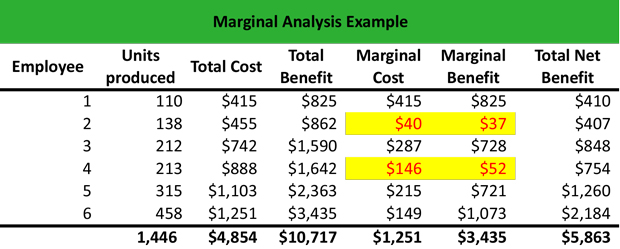
You should find that the firm should hire 4 employees. The 4th employee adds a marginal benefit of $900 at a marginal cost of $800 (MB > MC). However, the 5th employee adds a marginal benefit of only $750 at a marginal cost of $800 (MB < MC). Therefore, hiring the 5th employee would decrease the company's total net benefit. The optimal point is 4 employees.
4. Putting It All Together
Marginal analysis is a cornerstone of microeconomics, forming the basis for understanding consumer choice, firm production, and market outcomes.
Let's use one final resource to review the concepts and introduce some important terminology.
1.3 Marginal Analysis – Principles of Microeconomics
This webpage from a Principles of Microeconomics textbook provides a concise summary of marginal analysis using a simple example of buying drinks.
Read the sections 'Marginal Analysis' and 'Net Benefit'. This will reinforce the step-by-step process and show you how marginal analysis leads to the maximization of net benefit. The glossary at the end provides clear definitions.
As you'll see in later modules, this same logic applies when firms decide how much to produce. For a firm, "marginal benefit" is called marginal revenue (MR)—the extra revenue from selling one more unit. The profit-maximization rule for a firm is to produce up to the point where MR = MC. This is just a specific application of the general principle we've learned today.
Conclusion
Today, we've added a crucial tool to your economic toolkit. Let's summarize the key takeaways:
- Marginal Analysis is the process of breaking down "how much" decisions by comparing the additional benefits and additional costs of each incremental step.
- The Law of Diminishing Marginal Benefit states that the satisfaction gained from each additional unit of an activity tends to decrease.
- The Optimal Quantity of any activity is found where Marginal Benefit = Marginal Cost (MB = MC). This is the point where total net benefit is maximized.
- This principle is universal in economics, applying to individual consumer choices (MB vs. MC) and firm production decisions (Marginal Revenue vs. Marginal Cost).
In our next lesson, we will introduce a famous economic model: the Production Possibilities Frontier (PPF). This graph will allow us to visually represent the concepts of scarcity, trade-offs, and opportunity cost that we discussed in our first lesson. You will see how an economy operating efficiently is making choices at the margin to get the most out of its limited resources.