Recommended resources
The freely available resources this lesson will direct you to.
Introduction
In our last lesson, we transformed your LinkedIn profile into a powerful, optimized foundation for your professional brand. With a keyword-rich headline and impact-driven experience section, you've set the stage. Now, it's time to build upon that static foundation with dynamic content that actively demonstrates your expertise. A great profile gets you found, but great content gets you recognized as a leader.
This lesson is about structuring your LinkedIn posts using a "build-in-public" content strategy. This approach is about documenting your work, learning, and problem-solving journey in real-time. For a developer aiming for seniority, it is one of the most effective ways to showcase technical depth, consistency, and the thought process that goes beyond just writing code. You'll learn a strategic framework for your content, the anatomy of a compelling post, and how to build a system to stay consistent.
1. The "Build in Public" Philosophy
At its core, "building in public" means turning your daily work and learning into a narrative that provides value to others. It's not about sharing proprietary code, but about sharing the process: the challenges you face, the solutions you discover, and the lessons you learn. This transparency builds trust and establishes you as a genuine practitioner.
The article "How to Build in Public as a Tech Professional" on DEV Community provides an excellent introduction to this mindset, written from a developer's perspective.
How to Build in Public as a Tech Professional
This article will help you grasp the core concept of building in public and why it's so valuable for career growth.
Please read the introduction, starting from the beginning, to understand the author's personal story of how building in public created opportunities. Then, read the section Define your Purpose, as this connects directly back to the brand statement you crafted in our first lesson.
For you, the purpose is clear: to demonstrate the competence and thought leadership of a Senior Developer. Every technical hurdle you overcome or new pattern you implement is a potential piece of content that proves your value.
2. A Content Strategy for Authority
Randomly posting about your day won't build your brand effectively. You need a strategy. A common approach is the "Top of Funnel, Middle of Funnel, Bottom of Funnel" (ToFu-MoFu-BoFu) model, which starts with broad, relatable content to attract a large audience. However, for building technical authority, a more direct approach is better.
In the following video, content strategist Pierre Herubel introduces the "Authority First Framework," which is perfectly suited to your goals. It prioritizes demonstrating expertise from the very beginning.
LinkedIn Content Strategy Framework 2026 - How to Get Started
This video explains a powerful content strategy that flips the traditional model on its head to focus on building credibility first.
Please watch these key segments to understand the framework: First, watch the explanation of the traditional 'ToFu-MoFu-BoFu' model and its drawbacks for specialists. Next, see the introduction to the Authority First Framework. Pay close attention to the breakdown of Industry Content (70%) and Personal Stories (15%). This is where your "build-in-public" content will live. Finally, listen to the summary of who this framework is for. You'll see it aligns perfectly with your objectives.
The Authority First Framework gives you a clear ratio for your content mix:
- 70% Authority Content: This is the core of your "build-in-public" strategy. Share technical insights, how you solved a tricky bug, your analysis of a new framework, or a step-by-step guide for a process you've mastered (e.g., refactoring a legacy component).
- 15% Personal Story Content: Share your career journey, reflections on challenges like imposter syndrome, or progress on personal projects (like your bilingual children's book). This humanizes your technical expertise.
- 15% Offer/Conversion Content: For now, this can be a "soft" offer, like inviting collaboration on an open-source project or sharing a link to your GitHub.
3. The Anatomy of an Algorithm-Friendly Post
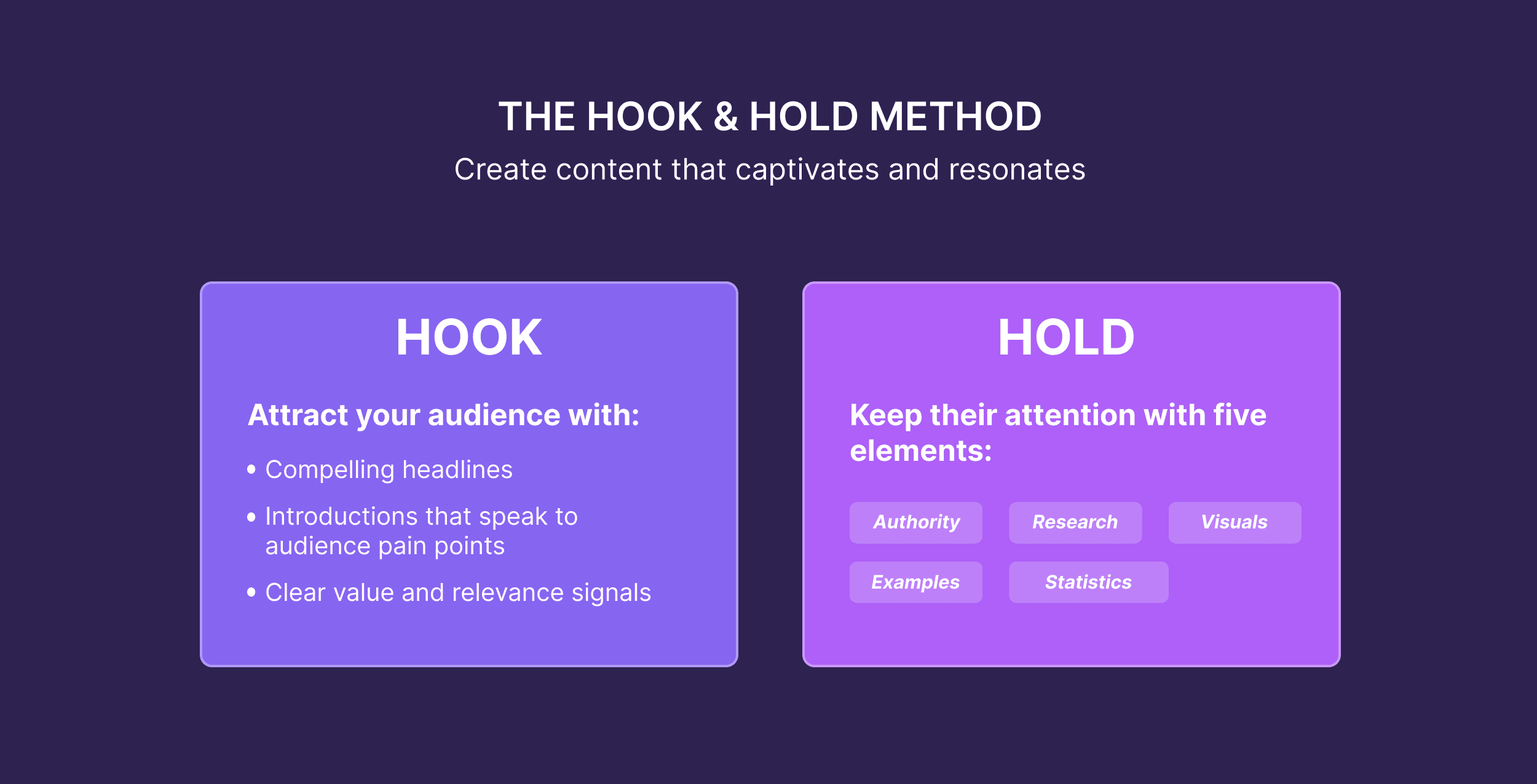
Now that you have a strategy, let's focus on execution. A successful LinkedIn post is engineered for both human readability and algorithm visibility. It has three main parts: the Hook, the Body, and the Call-to-Action.
The Hook: The First Two Lines
You have less than three seconds to stop someone from scrolling. The first one or two lines of your post are the most critical. You need a powerful hook.
The collection of expert advice in the LinkedIn post "Setting Up a Content System" offers several battle-tested copywriting formulas.
Setting Up a Content System with Notion Agent in 15 Minutes
This resource contains a comment by Ahsan Idrees that provides five powerful formulas for writing engaging content.
In the comments section, find the long comment from Ahsan Idrees. Read his breakdown of five formulas, particularly focusing on the Problem-Agitate-Solution (PAS), Before-After-Bridge, and Contrarian Statement frameworks. These are excellent for creating hooks.
Examples for you:
- PAS Hook: "My Spring Boot application was taking 5 seconds to start. That's an eternity in development. The culprit was..."
- Contrarian Hook: "Everyone says you should use microservices for scalability. They're wrong. Here's why a well-structured monolith was the right choice for my project..."
The Body: Delivering Value with Structure
Once you've hooked the reader, you must deliver value quickly and clearly. Long, dense paragraphs are death on LinkedIn.
- Keep paragraphs short (1-2 sentences).
- Use bullet points or numbered lists for clarity.
- Strategically use emojis to break up text and add visual interest.
For structuring the content itself, the SLAY framework (Story, Lesson, Actionable advice, You) is exceptionally effective for "build-in-public" posts. It connects your personal experience to a universal lesson.
The Algorithm-Proof LinkedIn Strategy Blowing Up Personal Brands in 2026
In this video, marketing expert Lara Acosta breaks down how to turn a single story into multiple high-performing posts and introduces a simple, powerful framework for writing them.
First, watch the section on four different content angles from a single story. This shows how one technical challenge can generate multiple posts. Then, watch the detailed explanation of the SLAY framework. This will be your go-to structure for technical, story-led posts.
Here's how you can apply the SLAY framework to a technical topic:
- Story: "This week I spent hours debugging a React component that wouldn't re-render. I thought I understood the
useEffecthook, but I was missing a key detail." - Lesson: "The lesson was that dependency arrays in
useEffectaren't just for performance; they are fundamental to the component's lifecycle and data consistency." - Actionable Advice: "My new rule: Before you write a
useEffecthook, answer these two questions: 1. What event should trigger this effect? 2. What state does this effect depend on?" - You (The CTA): "What's the trickiest bug you've solved with
useEffect?"
This structure is powerful because it showcases your real-world problem-solving skills (Story), your ability to learn and abstract (Lesson), your capacity to guide others (Actionable Advice), and invites engagement (You).
4. Practical Application: Your First "Build-in-Public" Post
Let's put this all together. Your task is to plan and draft your first technical "build-in-public" post.
1. Choose a Topic (5 mins)
Open your "Second Brain" in Notion or Obsidian. Think about your last work week. Identify one specific, small technical challenge you solved or a concept you learned.
- Example Idea 1: You optimized a slow SQL query.
- Example Idea 2: You figured out how to correctly mock a dependency in a JUnit test.
- Example Idea 3: You learned a new feature in Java 17 that simplified your code.
2. Draft the Post Using the SLAY Framework (20 mins)
Write a draft of a LinkedIn post based on your chosen topic. Follow the structure precisely:
- Draft a Hook: Start with a PAS or Contrarian hook.
- Example Hook: "My SQL query was timing out after 30 seconds. A simple
JOINwas bringing the entire database to its knees. Here’s the one-line change that made it run in 200ms."
- Example Hook: "My SQL query was timing out after 30 seconds. A simple
- Write the Story: Briefly describe the problem and the context.
- State the Lesson: What was the key insight or principle you learned?
- Give Actionable Advice: Provide 2-3 concrete steps or a checklist that someone else could use.
- Write a "You" Question: End with an open-ended question to encourage comments.
3. Refine and Format (10 mins)
- Read your draft aloud. Does it sound like you? Is the language clear? (Remember your ESL focus: clarity over complex vocabulary is key).
- Break up long paragraphs. Add bullet points.
- Add 2-3 relevant hashtags (e.g., #Java, #SoftwareDevelopment, #CleanCode). As noted in the resources, hashtags are less about discovery now, but they still provide context.
4. Showcase Your Best Work
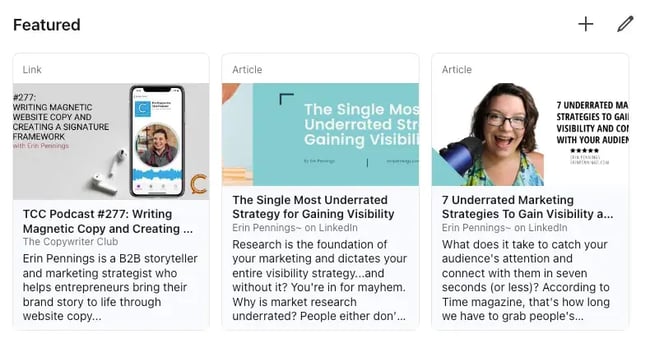
Once you start publishing, your best posts—especially technical deep dives or articles—can be showcased permanently on your profile. The "Featured" section is perfect for this. It acts as a mini-portfolio of your thought leadership.
Conclusion
You've now moved from having a static, optimized profile to understanding how to actively build your professional brand. Creating content is the engine of visibility and authority.
Here are the key takeaways from this lesson:
- "Build in Public" is about documenting your journey to provide value and prove your expertise.
- The Authority First Framework (70% expertise, 15% personal, 15% offer) is the ideal content strategy for establishing yourself as a technical expert.
- Every effective post has a strong Hook, a value-driven Body, and a clear Call-to-Action.
- The SLAY framework (Story, Lesson, Actionable Advice, You) is a simple, repeatable formula for creating compelling technical posts.
Your optimized profile is your business card, but your content is your keynote speech. In our next lesson, we'll cover the other side of the equation: how to engage strategically with senior developers and industry leaders through insightful commenting to expand your professional network. This will amplify the reach of your own content and build crucial relationships.