Recommended resources
The freely available resources this lesson will direct you to.
Hello! Welcome back.
In our last module, we focused on designing the cinematic world, culminating in our previous lesson on selecting lens focal lengths and depth of field. We established how these technical choices are fundamental artistic tools for conveying emotion and perspective. We've been operating at the level of creative vision—the "what" and "why."
Now, we move into the "how." This lesson marks the start of our new module, Pre-Production and Practical Planning. This is where we translate your artistic concepts into a concrete, executable plan. Our first step is to learn how to create script breakdown sheets to identify key production elements for each scene.
This may sound like a purely administrative task, but for a director, it's a deep creative analysis. It's the process of meticulously combing through the script to ensure that every visual, auditory, and narrative detail you envision has a logistical path to the screen. For you, with your background in design, this is where you ensure your specific ideas for costumes, props, and environments are formally identified and communicated to your future team.
1. What is a Script Breakdown and Why Is It Your Job?
A script breakdown is the process of dissecting a screenplay scene by scene to identify and categorize every single element required for production. It’s the foundational document for creating a realistic budget and an efficient shooting schedule.
While this task is often performed by a First Assistant Director (1st AD), it is an invaluable exercise for the director. Completing a breakdown forces you to know your script inside and out and to think through the practical implications of your creative choices.
To start, let's watch a short introduction that explains the importance of this process for a director.
The video 'Script Breakdown 101' from RocketJump Film School explains why breaking down a script is a critical task for any director who wants to communicate their vision effectively.
Please watch the first 48 seconds of this video (00:00 - 00:48). Pay attention to how it frames the breakdown as a way to bridge the gap between what's on the page, what's in your head, and what your team needs to know.
As the video states, the breakdown process transforms abstract ideas into a concrete plan, ensuring every department—from props to wardrobe to special effects—is on the same page.
2. The Process: From Script Page to Element List
The breakdown process generally involves two main stages:
- Marking up the script: Reading through each scene and highlighting different production elements using a standardized color-coding system.
- Creating breakdown sheets: Transferring the highlighted information for each scene onto a separate sheet, which becomes a master list of requirements for that scene.
First, let's look at the "markup" stage. A key part of this is measuring scene length in "eighths of a page." A standard script page is about one minute of screen time. Dividing it into eighths (about 1-inch segments) allows for a more precise estimation of how long a scene will take to shoot. For example, a scene that is one full page and a quarter of the next page would be written as "1 and 2/8 pages."
The core of the markup is color-coding. Here is a common industry-standard color guide for different elements:

Now, let's see this process in action. The following video gives a practical, step-by-step demonstration of marking up a script.
This clip from 'Script Breakdown 101' provides a clear, hands-on demonstration of identifying and color-coding elements like cast, props, wardrobe, and even potential stunts directly on the script pages.
Please watch from 00:48 to 11:21. You don't need to memorize every color, but focus on the thought process: Measuring Eighths (00:48 - 03:20): See how scene length is measured. Identifying Elements (03:20 - 08:05): Notice how a single line like "She reaches into her pocket for a flask" generates multiple elements: a costume note (the garment needs a pocket) and a prop (the flask). Complex Elements (08:05 - 11:21): Observe how descriptions of action can imply the need for stunts (face in soup), special effects (blood gags), and specialized props like prop weapons.
After marking up, your script page might look something like this, with notes and highlights indicating everything needed to bring the scene to life.
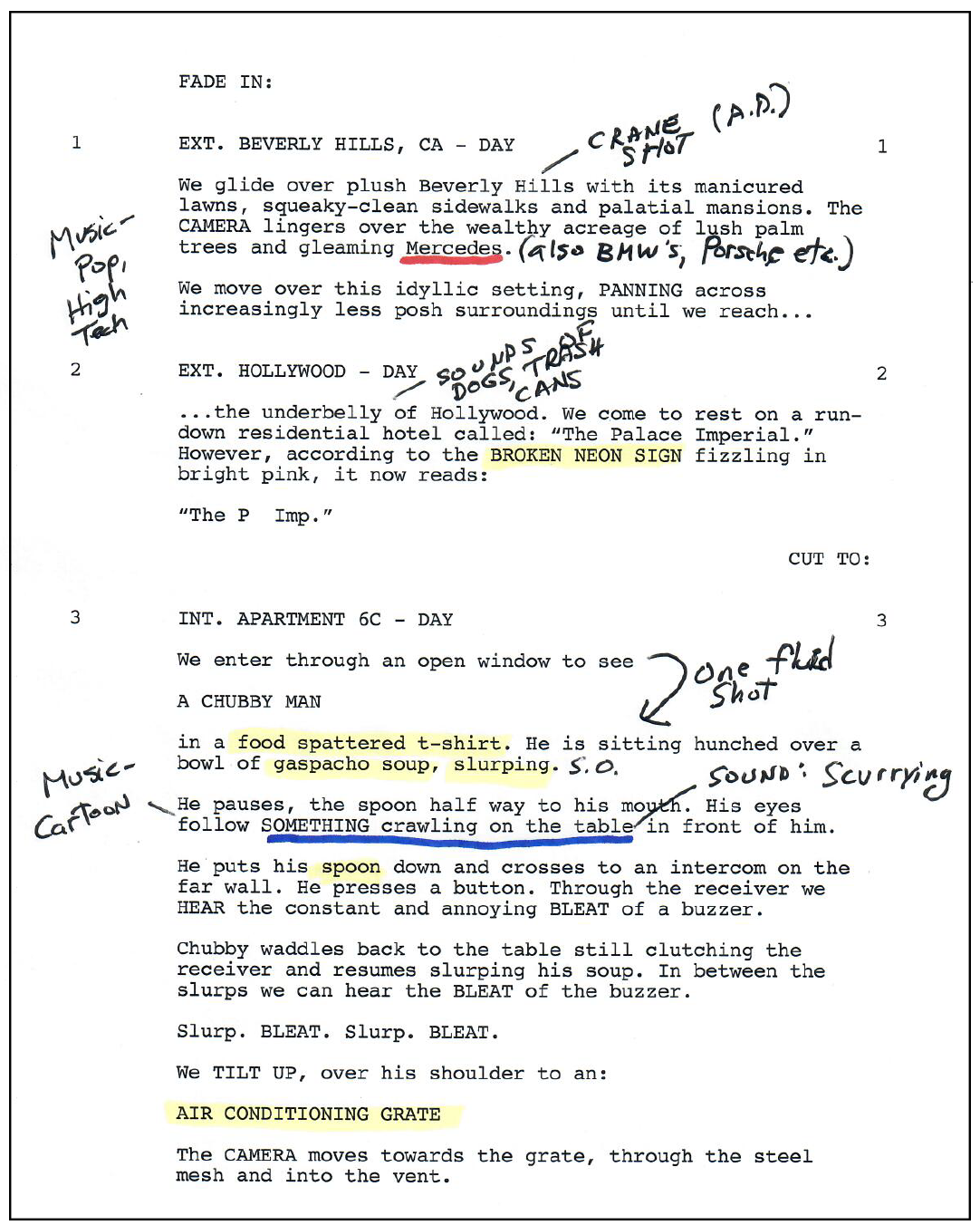
3. Understanding the Categories
The effectiveness of a breakdown depends on accurately categorizing each element. While some are straightforward (e.g., Cast Members), others have important nuances. Your design background makes you uniquely sensitive to the physical world of the film, so mastering the distinction between categories like Props, Set Dressing, and Costumes is key.
The following guide is an excellent, detailed reference for nearly every category you will encounter. You don't need to memorize it, but understanding the key distinctions is crucial.
Script Breakdown Elements — The Complete Guide
The article 'Script Breakdown Elements — The Complete Guide' from StudioBinder provides exceptionally clear definitions and examples for each production category.
Please read the following sections to understand the definitions of the most common and often-confused categories: Cast Members (Section 1, 'How to breakdown the cast'): Actors with speaking roles. Extras (Section 2, 'Extras'): Background actors. Stunts (Section 3, 'Stunts'): Actions requiring special training or safety. Vehicles (Section 4, 'Vehicles'): Picture vehicles that appear on screen. Props (Section 5, 'Props'): Pay close attention to the rule: An object an actor interacts with is a prop. The 'pirate curtains' example is excellent for understanding this nuance. Special Effects (Section 6, 'Special effects'): Effects created on set (rain, fire, smoke). Costumes (Section 7, 'Costumes'): A character's clothing. Makeup (Section 8, 'Makeup'): Specifically for unusual makeup like wounds or prosthetics. Set Dressing (Section 13, 'Set Dressing'): The static environment (furniture, decorations). If it's not interacted with, it's set dressing. Greenery (Section 14, 'Greenery'): A special sub-category of set dressing for plants.
The core takeaway is that every element can only belong to one category. A gun an actor fires is a prop. The holster it sits in is part of the costume. The table it rests on before being picked up is set dressing. This precision prevents confusion and ensures every department knows its responsibilities.
4. Creating the Script Breakdown Sheet
Once a scene is fully marked up, you transfer all the identified elements onto a script breakdown sheet. You use one sheet per scene. This document provides a one-page summary of everything needed to shoot that scene.
A standard breakdown sheet is organized into three sections:
- Top Section: Scene-identifying information (Scene #, INT./EXT., Location, Day/Night, Page Count in eighths).
- Middle Section: The categorized lists of elements (Cast, Props, Wardrobe, etc.).
- Bottom Section: Production notes, questions for the director, or special reminders.
While professional software automates this, doing it manually with a template or a simple spreadsheet is the best way to learn and is perfectly suitable for a short film.
5. Practical Exercise: Your Turn to Break It Down
Let's apply this. Read the following short, one-scene script. Your task is to perform a basic script breakdown.
SCENE 1
INT. ART STUDIO - NIGHT
Rain streaks down the large warehouse window.
Inside, ELARA (30s), dressed in a paint-splattered jumpsuit, stares intently at a large, abstract metal sculpture. The room is filled with finished and unfinished artworks, tools, and sketches pinned to the walls.
She picks up a heavy wrench from a cluttered workbench. She hesitates, her knuckles white.
Her gaze falls on a small, framed photograph on the bench: a picture of her with an older woman.
A tear rolls down her cheek. With a sudden cry, she swings the wrench, smashing it into the sculpture. Metal shrieks and bends.
Your Task (15 minutes):
For the scene above, create a list of all the production elements you can identify. Organize them into the following categories. Be as specific as you can!
- Cast:
- Costumes/Wardrobe:
- Props: (Remember the interaction rule!)
- Set Dressing:
- Special Effects (SFX):
- Stunts:
- Makeup: (Hint: Is there anything beyond a 'natural' look?)
- Production Notes: Write one question or note for a department head. For example, a note for the Prop Master or Stunt Coordinator.
Conclusion
In this lesson, we transitioned from creative ideation to practical planning. We learned that a script breakdown is a director's tool for translating a screenplay into a logistical blueprint. By meticulously identifying, categorizing, and listing every element, you ensure your vision is communicated clearly and is practically achievable.
Key Takeaways:
- Script breakdown is a systematic analysis of a script to identify all elements needed for production.
- The process involves marking up the script with color codes and then transferring the information to a breakdown sheet for each scene.
- Accurate categorization (Props vs. Set Dressing, SFX vs. VFX, etc.) is essential for clear communication between departments.
- For a director, this process builds a deep, practical understanding of the script and its requirements.
What's Next?
By breaking down the script, you've created a comprehensive list of what you need. The next step is to plan how you will use those elements. In our next lesson, we will focus on one of the most powerful mood-setting tools at your disposal: Plan lighting setups that create mood and atmosphere using natural and artificial light.