Recommended resources
The freely available resources this lesson will direct you to.
- Cinematographer Explains 3 Different Camera Lenses | Vanity Fairwww.youtube.com
- Depth of Field Explained: Ultimate Guide to Camera Focus [Shot List Ep. 4]www.youtube.com
- The Focal Lengths and Lenses used by Great Directors - wolfcrowwolfcrow.com
- Focal Length: An Easy Guide to Using and Understanding ...www.studiobinder.com
Hello! Welcome back to our module on designing the cinematic world.
In our last lesson, we explored how to compose shots in natural environments, looking at how directors like Herzog and Bergman use nature as an expressive, symbolic force. We briefly touched upon using a "wide field of view" to make the environment feel like a character in the story.
Today, we will dive deep into the technical and artistic choices that control that field of view and much more. Our goal is to learn how to select lens focal lengths and depth of field to achieve specific emotional and spatial effects. Mastering these two tools is fundamental to cinematography and is one of the most powerful ways a director can shape an audience's perception and emotional response to a scene.
This lesson will equip you with the vocabulary and understanding to translate the artistic intentions we've been discussing—from psychological intimacy to overwhelming scale—into concrete cinematographic decisions.
1. Understanding Focal Length: The Director's Paintbrush
Focal length, measured in millimeters (mm), is the primary attribute of a camera lens. It determines two key things: the field of view (how much of the scene is captured) and the magnification (how large elements appear). Lenses are generally grouped into three categories: wide-angle, normal, and telephoto.
To get a clear, practical introduction to these concepts, let's watch a video from cinematographer Tom Sigel.
Cinematographer Explains 3 Different Camera Lenses | Vanity Fair
In 'Cinematographer Explains 3 Different Camera Lenses,' Tom Sigel breaks down the core characteristics of wide, normal, and telephoto lenses. He provides excellent visual demonstrations of how each type affects the image and the viewer's feeling.
Please watch the following sections: Introduction & Focal Length Explained (00:00 - 02:56): This covers the basic definition of focal length and the difference between field of view and angle of view. Wide vs. Telephoto Lenses (02:56 - 04:23): Pay close attention to the examples from Drive. Notice how a wide lens creates intimacy by placing you in the scene, while a telephoto lens creates a voyeuristic, detached feeling. The Normal Lens (05:09 - 06:03): Understand why this lens creates a 'naturalistic' feel, similar to human vision. Manipulating Space (07:17 - 08:04): This is a crucial demonstration of how wide lenses expand space (making things feel further apart) and telephoto lenses compress space (making them feel closer together).
As the video demonstrates, your choice of focal length is not just technical; it's a primary tool for emotional storytelling. Let's formalize the effects of each lens type.
Spatial and Emotional Effects of Focal Lengths
-
Wide-Angle Lenses (<35mm):
- Spatial Effect: They expand space, making rooms feel larger and distances seem greater. Objects closer to the lens appear disproportionately large, which can lead to distortion.
- Emotional Effect: This expansion can create a sense of grandeur or overwhelming scale (perfect for Herzog's landscapes). It can also create psychological unease or paranoia, as the distorted space feels unnatural. Conversely, as seen in Drive, getting physically close with a wide lens can create a powerful sense of immersion and intimacy.
-
Normal Lenses (approx. 35mm-70mm):
- Spatial Effect: They represent space in a way that feels natural and familiar, closely mimicking the human eye's cone of visual attention. There is minimal distortion.
- Emotional Effect: Their "invisibility" makes them feel objective and truthful. This is why they are often used for dialogue-heavy scenes where the focus is on the performance without stylistic distraction. Directors like Yasujiro Ozu and Robert Bresson famously relied almost exclusively on a 50mm lens to create a sense of calm observation.
-
Telephoto (or Long) Lenses (>70mm):
- Spatial Effect: They compress space, making distant objects appear closer to the foreground than they actually are. This creates a "flattened" look.
- Emotional Effect: This compression can create a sense of claustrophobia or entrapment. By allowing you to film a subject from far away, it can generate a powerful feeling of voyeurism or surveillance. It also excels at isolating a subject from their environment, drawing all our focus to their emotions.
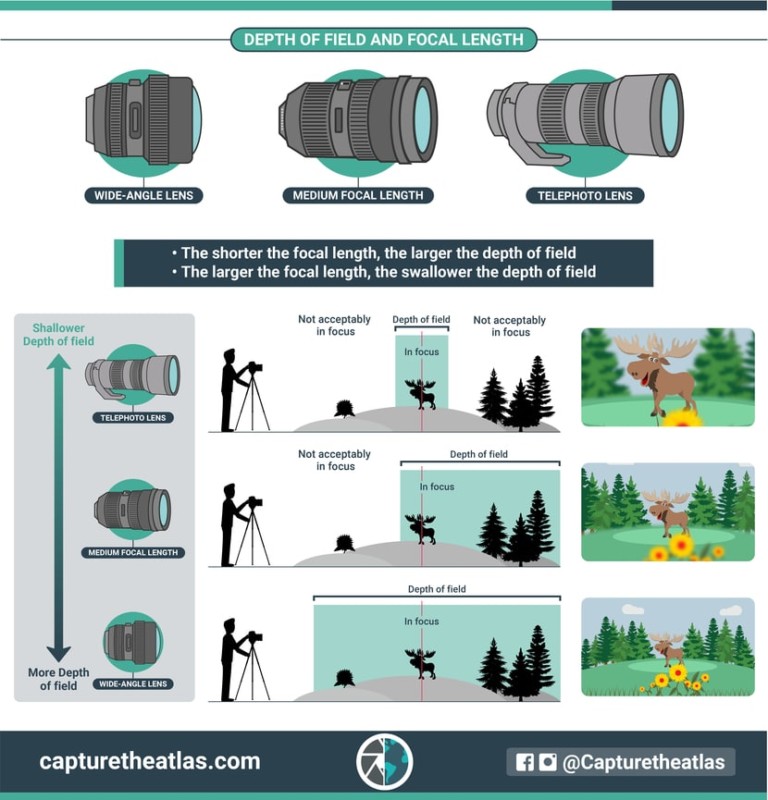
2. Controlling Focus: Depth of Field (DoF)
Depth of field refers to the area of the image that is in acceptably sharp focus. As the infographic above shows, focal length has a strong influence on DoF. Telephoto lenses naturally create a much shallower depth of field than wide-angle lenses (when other settings like aperture are equal).
Manipulating DoF is how you direct the audience's eye and control the relationship between your subject and their environment.
This next video is an excellent guide to the different ways you can use focus.
Depth of Field Explained: Ultimate Guide to Camera Focus [Shot List Ep. 4]
The video 'Depth of Field Explained' from StudioBinder provides a fantastic breakdown of the different types of focus and their narrative functions.
Please watch these key sections: Deep Focus (01:26 - 03:32): Notice how keeping both foreground and background sharp allows the viewer to see the relationship between elements and explore the frame. Shallow Focus (03:32 - 05:46): This is a critical technique for psychological storytelling. Pay attention to how it isolates characters and suggests their internal emotional state, as in the Moonlight example. Rack Focus (07:51 - 09:50): Understand this as an active technique to shift audience attention and create connections between subjects or objects within a single shot. Split Diopter & Tilt-Shift (09:50 - 13:40): These are more specialized, stylistic tools perfect for experimental film. Note how they create 'impossible' or dreamlike perspectives, which aligns with your interest in surrealism.
To summarize:
- Deep Focus: Connects a character to their environment. Empowers the viewer to look around the frame.
- Shallow Focus: Isolates a character from their environment. Directs the viewer's eye and enhances emotional subjectivity. This is a key tool for achieving the psychological intimacy seen in Bergman's films.
- Rack Focus: Creates a dynamic relationship between two points of interest in a shot.
- Split Diopter / Tilt-Shift: Creates unnatural, dreamlike, or psychologically altered states.
3. The Director's Choice
Great directors often have a signature approach to lenses that defines their visual language. Your inspirations—Polanski, Herzog, Bergman—all made very specific and consistent choices.
Let's look at an article that catalogs the preferences of many great directors.
The Focal Lengths and Lenses used by Great Directors
This article, 'The Focal Lengths and Lenses used by Great Directors', provides a fascinating overview of how different filmmakers approach lens selection.
Please read the full article. Start with the introduction explaining the emotional impact of focal lengths. Then, pay close attention to the table of directors. Look for directors you admire. For instance: Roman Polanski (#3): Known for his use of wide lenses (18mm, 40mm anamorphic). Think about how this might contribute to the paranoia and environmental tension in a film like Chinatown. Stanley Kubrick (#19): A major influence on Herzog, he was famous for using very wide lenses (18mm, even 9.8mm) to create his iconic, often disquieting, compositions. Yasujiro Ozu/Robert Bresson/Alfred Hitchcock (#13, #14, #15): Their preference for the 'neutral' 50mm lens is a very deliberate choice to focus on character and composition in a controlled, observational way. This approach has parallels with Bergman's focus on psychological realism.
This shows that choosing a lens is not a shot-by-shot decision alone; it's about defining the entire visual philosophy of your film.
4. Practical Exercise: Designing a Scene
Let's put this knowledge into practice. Imagine you are filming a scene with the following emotional arc:
- A character feels trapped and isolated in their own home, overwhelmed by their thoughts.
- They then notice a small, specific detail across the room that triggers a significant memory.
Your Task (15 minutes):
Plan a sequence of two shots to convey this story. For each shot, describe your technical choices and justify them based on the emotional and spatial effects you want to create.
Shot 1: The Feeling of Entrapment
- Focal Length Choice: (e.g., Wide-angle, Normal, or Telephoto? Specify a mm range if you like, e.g., ~21mm).
- Depth of Field Choice: (e.g., Deep, Shallow).
- Justification: Explain why these choices will create the feeling of being trapped and overwhelmed. How will they manipulate the space of the room and the character's relationship to it?
Shot 2: The Triggering of Memory
- Focal Length Choice:
- Depth of Field Choice: (Consider using a dynamic technique like a rack focus).
- Justification: Explain how your choices for this shot will shift the audience's focus, guide them to the important detail, and convey the character's internal shift in perspective.
Conclusion
Today, we've unpacked two of the most essential tools in a director's kit. We learned that focal length is about more than just "zooming"; it's about defining space, controlling perspective, and generating feelings of intimacy, isolation, or naturalism. We also saw how depth of field acts as a spotlight, allowing you to guide the viewer's eye and decide whether to connect your character to their world or isolate them within their own psychology.
Key Takeaways:
- Wide, Normal, and Telephoto lenses each have distinct spatial properties (expanding, neutral, compressing) that produce different emotional effects.
- Depth of Field (deep vs. shallow) determines what is in focus, controlling audience attention and the relationship between a subject and their environment.
- Combining focal length and DoF is a fundamental part of a director's visual signature, used to create everything from psychological intimacy to epic scale.
What's Next?
In the last few lessons, we've focused on the core artistic components of designing your cinematic world: composition, music, and now, lenses. We're moving from the "what" to the "how." In our next module, "Pre-Production and Practical Planning," we'll begin the process of organizing these creative ideas into a concrete production plan. Our first lesson will be to create script breakdown sheets to identify key production elements for each scene. This is where the director's vision starts to become a logistical reality.