Recommended resources
The freely available resources this lesson will direct you to.
- Kramers-Kronig Relations | Motivation and Derivation | Linear Response Theorywww.youtube.com
- Lecture -- Kramers-Kronig Relationshipwww.youtube.com
- Electrodynamics of correlated electron systems: Lecture ...boulderschool.yale.edu
- 51 Causality and the Kramers-Krönig Relationsgalileoandeinstein.phys.virginia.edu
Hello! Welcome to the third lesson in our module on the optical properties of solids.
In our previous lessons, we developed models for two key contributions to a material's optical response: the free-carrier Drude model for intraband processes and a quantum mechanical treatment of interband transitions. We saw that absorption, whether from free carriers scattering or electrons jumping the bandgap, is quantified by the imaginary part of the dielectric function, . You might naturally wonder if the real part, , which governs the refractive index and dispersion, is an entirely separate property.
Today, we'll discover that they are profoundly linked. Our learning outcome is to apply the Kramers-Kronig relations to connect the real and imaginary parts of the dielectric function. These relations are a direct and powerful consequence of the principle of causality—the simple fact that an effect cannot precede its cause. Understanding this connection is not just a theoretical nicety; it is a critical tool in experimental optical spectroscopy, allowing us to extract the full, complex optical constants of a material from a limited set of measurements.
1. Causality and the Response Function
Let's begin with the fundamental principle. When an electric field is applied to a dielectric material, it induces a polarization . Since the electrons and ions in the material take a finite time to respond, the polarization at a specific time can only depend on the electric field at all prior times .
For a linear and isotropic medium, we can write this relationship as a convolution integral:
The function is the electric susceptibility in the time domain, also known as the response function. Causality is built into this equation by the upper limit of the integral, which ensures we only sum over past contributions of the field. This is equivalent to stating that the response function must be zero for negative time arguments:
where .
In optics, we usually work in the frequency domain. The convolution theorem tells us that the Fourier transform of a convolution is the product of the individual Fourier transforms. So, the time-domain relation becomes a simple multiplication:
Here, is the familiar frequency-dependent susceptibility, which is the Fourier transform of :
Notice the lower limit of the integral is 0, not . This is the mathematical enforcement of causality.
2. Causality and Analyticity
This seemingly simple causality condition has a deep mathematical consequence. Let's consider the frequency as a complex variable, . The susceptibility becomes a function in the complex plane:
Since the integration variable is always positive, the term will be a decaying exponential as long as . This ensures that the integral converges and the function is well-behaved and has no poles or singularities anywhere in the upper half of the complex frequency plane. In the language of complex analysis, is analytic in the upper half-plane.
This direct link—Causality implies Analyticity—is the foundation of the Kramers-Kronig relations.
3. Deriving the Kramers-Kronig Relations
The analyticity of allows us to use one of the most powerful tools in mathematical physics: Cauchy's integral theorem. The derivation involves evaluating a contour integral of over a path that includes the real axis and a large semicircle in the upper half-plane.
The following video provides a clear, rigorous derivation from the ground up, starting with the linear response theory we just discussed and proceeding through the complex analysis. Given your background in theoretical physics, you should find its approach satisfying.
Kramers-Kronig Relations | Motivation and Derivation | Linear Response Theory
This video from MathAndPhysics derives the Kramers-Kronig relations using a contour integral method, which is the standard approach in physics.
Please watch from 7:30 to the end. The video first shows that causality leads to analyticity in the upper half-plane. Then, it uses Cauchy's theorem on a specific contour integral to derive the relations. Finally, it uses the symmetry properties of the real and imaginary parts to rewrite the integrals over positive frequencies, which is the form most useful in practice.
After performing the contour integration and separating the real and imaginary parts, we arrive at the Kramers-Kronig relations. Since the dielectric function is also analytic in the upper half-plane (the +1 is just a constant), the same relations hold for it.
The relations, written for integrals over positive frequencies, are:
Here, denotes the Cauchy Principal Value of the integral, which is a formal way to handle the singularity when .
These equations are the central result of our lesson. They state that the real part of the dielectric function at a frequency is determined by an integral of the imaginary part over all frequencies, and vice versa.
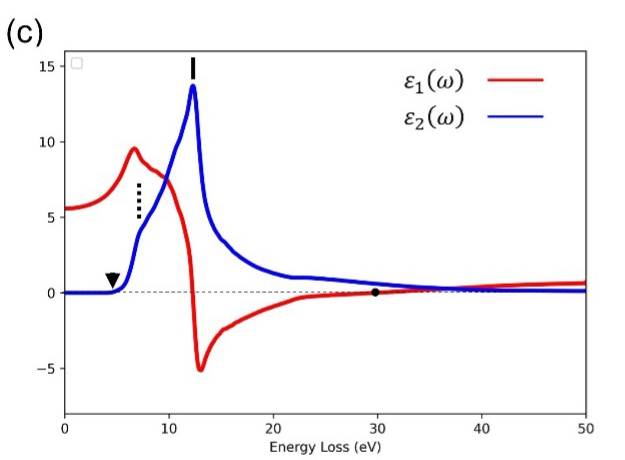
4. Application in Experimental Spectroscopy
The Kramers-Kronig relations are indispensable in the analysis of optical data. Many standard spectroscopic techniques, such as Fourier Transform Infrared (FTIR) spectroscopy, measure the intensity or power of reflected or transmitted light. For instance, a reflectivity measurement yields , which is the squared magnitude of the complex reflection coefficient .
This measurement gives us the amplitude , but the crucial phase information is lost. However, to calculate the material's complex refractive index () or dielectric function (), we need both the amplitude and the phase.
This is where the Kramers-Kronig relations come in. The function is also a causal response function. Therefore, its real and imaginary parts are related by Kramers-Kronig. By measuring (and thus ) over a sufficiently broad frequency range, we can calculate the phase :
Once we have both and , we have the full complex reflectivity and can determine all the other complex optical constants.
The following resource discusses this application in the context of research on correlated electron systems, which aligns with your interests. It also shows concrete examples.
Electrodynamics of correlated electron systems
These lecture notes by D. N. Basov, a leading experimentalist in the optics of quantum materials, provide a concise derivation and, more importantly, discuss the practical application of Kramers-Kronig analysis.
Briefly review the derivation in section II.B (page 6), 'Kramers-Kronig Relations'. It's a compact version of the derivation you saw in the video. Read section III.C (page 14), 'Infrared Fourier transform infrared reflectivity (FTIR)'. Focus on how Eq. 46 is used to obtain the phase from measured reflectivity and the practical challenge of finite measurement range. Look at section IV.A (pages 17-18) and see how this is applied in practice. Figures 17 and 18 show how experimental reflectance curves for gold and silver are transformed to yield their complex dielectric functions.
This procedure highlights a critical point: the integrals are from 0 to . Experimentally, we can only measure over a finite range. Therefore, extrapolations for the behavior at low and high frequencies are required, which can be a source of error in the analysis. This is why techniques like ellipsometry, which directly measure phase, are so valuable, although they are often more complex to implement.
Test your understanding!
You perform an optical reflectivity measurement on a novel semiconductor, but your spectrometer only covers the visible and near-infrared range (0.5 eV to 3 eV). You use the Kramers-Kronig relations on this data to calculate the refractive index in this range. A colleague argues your calculated values are likely inaccurate.
- Why is your colleague probably correct?
- What practical steps would you take to improve the accuracy of your Kramers-Kronig analysis?
Show answer
-
The colleague is correct because the Kramers-Kronig relations require an integral over all frequencies, from 0 to . By only using data from a limited 0.5-3 eV range, you are implicitly assuming the reflectivity is zero (or some constant value used in the extrapolation) everywhere outside this range. Any significant absorption features outside this window (e.g., strong interband transitions in the UV or phonon modes in the far-IR) will contribute to the refractive index inside your measurement window. Ignoring these contributions will lead to errors in the calculated phase and, consequently, the refractive index.
-
To improve the analysis, you would need to:
- Expand the measurement range: Use other spectroscopic techniques to measure the reflectivity at lower and higher energies. For example, use FTIR for the far-infrared and VUV (vacuum ultraviolet) spectroscopy for high energies.
- Use physically motivated extrapolations: For frequencies below your measurement range (towards ), you could use a Drude model fit if the material is metallic or a constant value if it's a wide-gap insulator. For frequencies above your measurement range (), you can often use a free-electron-like power-law decay ().
- Anchor the data: If possible, perform an ellipsometry measurement at a few select frequencies to get an accurate, direct measurement of the complex optical constants. This can be used to constrain and validate the overall Kramers-Kronig transformation.
Conclusion
Today, we've explored the deep connection between causality and the optical response of materials. We have seen how this fundamental principle leads to the analyticity of the dielectric function and, through the power of complex analysis, to the Kramers-Kronig relations.
Key Takeaways:
- The principle of causality dictates that a system's response cannot precede the stimulus.
- In the frequency domain, causality implies that the dielectric function is analytic in the upper half of the complex plane.
- The Kramers-Kronig relations are a direct consequence of this analyticity and provide an integral relationship between the real () and imaginary () parts of the dielectric function.
- These relations are a vital tool in experimental optics, allowing for the determination of complex optical constants (like and ) from measurements of intensity alone (e.g., reflectivity), by enabling the calculation of the phase shift upon reflection.
Preview of the Next Lesson
In our analysis of interband absorption, we treated the excited electron and the hole it left behind as independent particles. However, they are oppositely charged and attract each other via the Coulomb interaction. This can lead to the formation of a bound state—a hydrogen-like quasiparticle called an exciton. In our next lesson, we will model the exciton and see how its presence dramatically modifies the absorption spectrum right at the band edge, creating sharp, resonant peaks that are a hallmark of high-quality optical materials.