Recommended resources
The freely available resources this lesson will direct you to.
Hello! Welcome to your next lesson.
In our previous session, we delved into photoluminescence, a process governed by linear optics where the material's response (emitted light) is directly proportional to the excitation intensity. Today, we transition into the fascinating and powerful domain of nonlinear optics.
Your experimental work has already brought you into contact with Second Harmonic Generation (SHG), and this lesson aims to build the theoretical foundation for it. Our goal is to explain the physical mechanism of SHG and its crucial dependence on crystal symmetry. We will see how SHG arises from the nonlinear response of electrons to an intense light field and, most importantly, why it serves as an exceptionally sensitive probe of broken inversion symmetry in materials.
1. From Linear to Nonlinear Polarization
In conventional optics, the interaction of light with a material is described by assuming the induced dipole moment per unit volume, the polarization , responds linearly to the incident electric field :
Here, is the familiar linear susceptibility, a second-rank tensor that determines the material's refractive index and linear absorption. This approximation holds for weak light fields. However, when the electric field of the light is comparable to the internal electric fields of the crystal (a condition readily achieved with pulsed lasers), this linear relationship breaks down.
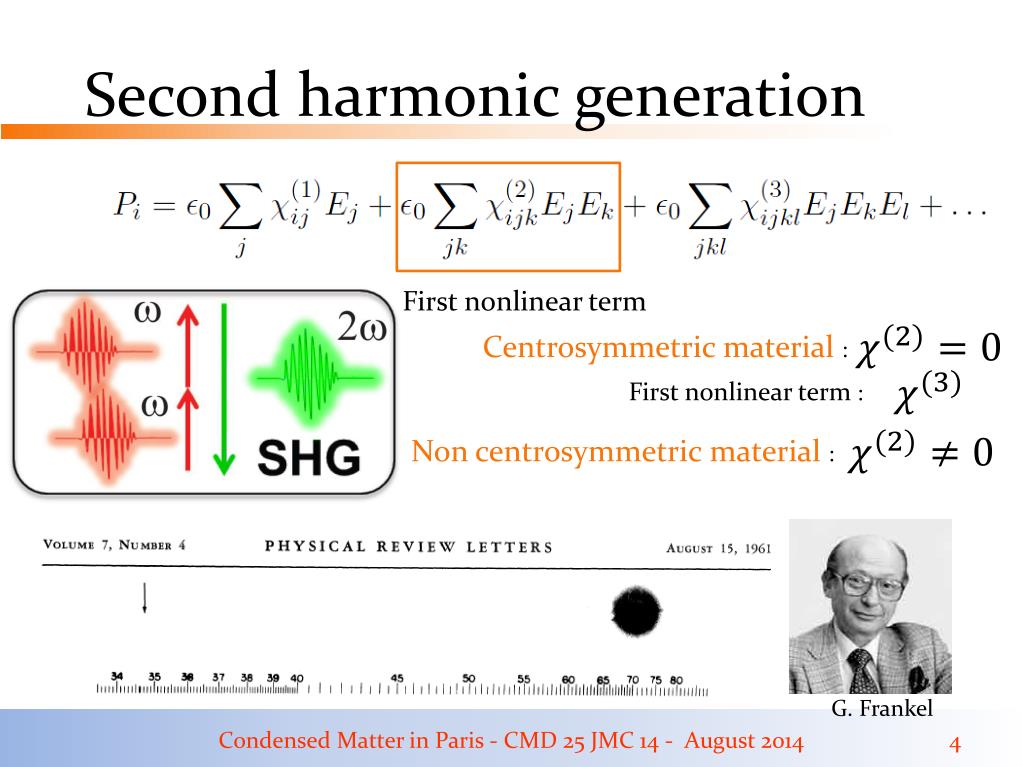
A more general description expresses the polarization as a power series in the electric field strength:
Here, and are the second- and third-order nonlinear susceptibilities, which are tensors of rank 3 and 4, respectively. These higher-order terms give rise to a rich variety of nonlinear optical phenomena.
The following video provides a concise introduction to this core concept.
1/44 Foundation of nonlinear optics I
To start, please watch this segment from the video 'Foundation of nonlinear optics I' by the ISPNLO channel. It clearly introduces the power series expansion of polarization and defines the different orders of susceptibility.
Watch the section from 06:03 to 09:07. Focus on how the polarization is expressed as a series and the physical processes associated with \chi^{(1)}, \chi^{(2)}, and \chi^{(3)}.
2. The Physical Mechanism of Second Harmonic Generation
Second Harmonic Generation is the quintessential process. Let's examine how the second-order term, , leads to the generation of light at double the incident frequency.
Consider a monochromatic incident wave with frequency :
The second-order polarization term involves the square of this field:
This simple trigonometric identity reveals something profound. The material's response has two components:
- A static (DC) polarization term, , which leads to a phenomenon called optical rectification.
- An oscillating polarization term, , that oscillates at twice the incident frequency.
According to classical electromagnetism, an oscillating dipole radiates electromagnetic waves at its oscillation frequency. Therefore, this second-order polarization acts as a source term in Maxwell's equations, generating a new light wave at frequency .
The following short video provides a clear illustration of this.
Optics. Second Harmonic Generation
This clip from the channel 'Physics with Andrés Aragoneses' nicely summarizes the mathematical origin of the second harmonic.
Watch from 00:49 to 02:24. This directly follows our derivation and shows how the oscillating polarization generates the 2\omega wave.
From a quantum mechanical perspective, SHG is a process where two photons of frequency are simultaneously annihilated to create a single photon of frequency , mediated by a virtual electronic state in the material.

3. The Decisive Role of Crystal Symmetry
A key feature of SHG, and the reason it is so useful in materials science, is that it is strictly forbidden in materials that possess inversion symmetry. Such materials are called centrosymmetric.
Let's understand why. A medium is centrosymmetric if its properties are unchanged under the inversion operation . In such a medium, if we reverse the direction of the applied electric field, , the induced polarization must also simply reverse its direction, .
So, for any response in a centrosymmetric material, we must have:
Let's test this condition on the second-order polarization, . If we replace with , we get:
Inversion symmetry demands , but the physics of the second-order term gives . The only way to satisfy both conditions is if for all . This implies that for any centrosymmetric material, the second-order susceptibility tensor must be identically zero: .
An Intuitive Model: The Anharmonic Oscillator
We can visualize this using a classical model of an electron bound to a nucleus.
- Centrosymmetric Crystal: The potential energy binding the electron must be symmetric, . Its Taylor expansion contains only even powers: . The restoring force, , will contain only odd powers of displacement . When driven by a sinusoidal field, the electron's motion will be distorted, but it will only generate odd harmonics ().
- Non-centrosymmetric Crystal: The potential is not required to be symmetric. It can have an asymmetric term: . The restoring force now has a quadratic term, . This asymmetry means the electron responds differently to positive and negative field excursions, and it is precisely this term in the equation of motion that generates the second harmonic.
This crucial point is explained beautifully in the following video.
1/44 Foundation of nonlinear optics I
This segment of the 'Foundation of nonlinear optics I' video provides an excellent intuitive explanation for why centrosymmetry forbids SHG, using the potential well model.
Please watch from 22:19 to 28:03. Pay close attention to the diagrams of the symmetric vs. asymmetric potential wells and the resulting distorted waveforms of the polarization.
This symmetry rule is extremely powerful. It means that if you detect an SHG signal from a material, you know instantly that its crystal structure lacks a center of inversion. This is why SHG is a premier technique for probing surfaces and interfaces, where the bulk inversion symmetry is naturally broken.
Test your understanding!
You are performing an optics experiment on two bulk, single-crystal samples:
- Silicon (Si), which has the diamond cubic crystal structure (point group ).
- Gallium Arsenide (GaAs), which has the zincblende crystal structure (point group ).
The diamond cubic structure is centrosymmetric, while the zincblende structure is non-centrosymmetric. Which sample(s) do you expect to produce a measurable SHG signal from the bulk of the crystal? Why?
Show answer
Only the Gallium Arsenide (GaAs) sample will produce an SHG signal from the bulk.
Reasoning:
- Silicon has a centrosymmetric crystal structure. Therefore, its second-order susceptibility, , is identically zero in the bulk. No SHG can be generated.
- Gallium Arsenide has a non-centrosymmetric crystal structure. Its tensor is non-zero, allowing for the generation of a second harmonic signal from the bulk of the crystal.
4. The Tensor and Crystal Point Groups
The symmetry constraints go deeper. The full description of the second-order polarization relates the vector components of and via the third-rank tensor :
where represent the Cartesian coordinates . Initially, this tensor has components. However, the specific point group symmetry of a non-centrosymmetric crystal dictates which of these 27 components are non-zero and which are related to each other.
For example, for your GaAs sample (point group ), group theory shows that the only non-zero components are those where , and they are all equal: . All other components like or are zero.
This tensorial nature is what you probe in experiments like rotational anisotropy SHG (RA-SHG), where the intensity of the SHG signal changes as the crystal is rotated relative to the polarization of the incident laser. By mapping this intensity pattern, you can determine the crystal's orientation and confirm its symmetry.
The following document provides a more formal treatment of the tensor and its symmetry properties, which should be accessible given your background.
Lecture 8: Polarization in nonlinear optics.
These notes on 'Polarization in nonlinear optics' provide a concise but formal description of the second-order susceptibility tensor, its intrinsic symmetries, and how crystal symmetry (using the example of LiNbO₃) constrains its form.
Please read the first three pages, covering sections '1. Nonlinear susceptibilities: tensor description' up to and including the example of the tensor for the 3m point group. Focus on understanding how permutation symmetries and crystal symmetries reduce the number of independent tensor components.
A Note on Phase Matching
For the SHG process to be efficient, the fundamental wave () and the generated second harmonic wave () must remain in phase as they propagate through the crystal. This is known as the phase-matching condition, , which implies . Due to material dispersion, this is usually not satisfied automatically. Experimentalists use clever tricks, such as exploiting the birefringence of anisotropic crystals or creating periodically poled materials (quasi-phase matching), to fulfill this condition and achieve high conversion efficiency. This is a deep topic in itself but is crucial for practical applications of SHG.
Conclusion
In this lesson, we have uncovered the theoretical basis for Second Harmonic Generation, connecting a macroscopic optical phenomenon to the fundamental symmetry of a crystal lattice.
Key Takeaways:
- SHG is a nonlinear optical process arising from the second-order term () in the material's polarization response to an intense light field.
- The physical mechanism involves the creation of an oscillating polarization at twice the incident frequency (), which then radiates a new light wave at .
- The most critical rule for SHG is based on symmetry: is identically zero for any material with a center of inversion symmetry.
- Consequently, SHG is a background-free probe for non-centrosymmetric crystal structures, surfaces, and interfaces where inversion symmetry is broken.
- The tensor's specific form is determined by the crystal's point group, which allows SHG to be used as a tool to measure crystal orientation and symmetry.
Preview of the Next Lesson
We have now concluded our exploration of the optical properties of solids, moving from linear to nonlinear phenomena. Our next module marks a significant shift in perspective. We will move away from semi-classical models and begin building the formal apparatus of many-body quantum theory.
In the next lesson, you will learn to express single-particle and two-particle operators in the second quantization formalism for fermions. This is the language used to describe systems with many interacting electrons, such as the electron gas in a metal. This formalism, which will leverage your familiarity with ladder operators from QFT, is the essential starting point for tackling topics like screening, collective excitations (plasmons), magnetism, and superconductivity.