Recommended resources
The freely available resources this lesson will direct you to.
- How Crypto Project Changes Are Made!! Onchain VS Offchain Governance EXPLAINEDwww.youtube.com
- What is a DAO in Crypto? (Decentralized Autonomous Organization)www.youtube.com
- Blockchain Governance Explained: On-Chain vs. Off ...phemex.com
- Blockchain Governance: Ultimate Guide to On-Chain & Off- ...www.rapidinnovation.io
Hello! Welcome to the first lesson in our new module, "Governance & Upgradability."
In the previous modules, you've done the heavy lifting of creating and launching a token. You've built the ERC-20 contract, provided liquidity on a decentralized exchange, and even learned how to get it listed on data aggregators like CoinGecko. Your project now exists as a tangible asset in the DeFi ecosystem. But this raises a crucial question: what's next? How does a project evolve, make decisions, and manage its resources over the long term without a CEO or a board of directors?
This is where governance comes in. This lesson will introduce you to the core concepts of decentralized decision-making. Your learning outcome is to describe governance mechanisms for decentralized decision-making. We will explore how blockchain projects manage protocol changes, fund development, and steer their future in a decentralized way.
What is Blockchain Governance?
In a traditional company, decisions are made by a hierarchy of executives and managers. Blockchain projects aim to replace this centralized model with a system where stakeholders—users, developers, and token holders—collectively make decisions. This system is known as blockchain governance.
Blockchain Governance Explained: On-Chain vs. Off ...
To start, let's get a formal definition. The following article from Phemex Academy provides a clear and concise introduction to what blockchain governance is and its key components.
Read the sections 'What is Blockchain Governance?' and 'Key governance elements'. Focus on understanding that governance is about how rules are decided, applied, and changed in a decentralized network.
As the article explains, effective governance is vital for a project's long-term success. It ensures a project can adapt and improve over time while maintaining the trust of its community. The main challenge is finding the right balance between efficiency and decentralization.
There are two fundamental approaches to tackling this challenge: on-chain and off-chain governance.
On-Chain vs. Off-Chain Governance
The core difference between these two models lies in where the decision-making process happens and how the results are enforced.
- On-Chain Governance: Decisions are made directly on the blockchain. Rules are written into smart contracts, and voting happens via on-chain transactions. The outcomes are automatically executed by the code.
- Off-Chain Governance: Decisions are made through discussions outside the blockchain—on forums, social media, or developer calls. Once a consensus is reached, the decision is implemented manually, typically through a software update that node operators must choose to adopt.
To get a clear overview of these two models, their differences, and their trade-offs, the following video from CoinGecko is an excellent starting point.
How Crypto Project Changes Are Made!! Onchain VS Offchain Governance EXPLAINED
This video provides a great high-level comparison of on-chain and off-chain governance, complete with examples.
Watch from the beginning to 01:48 to understand the definitions of on-chain and off-chain governance. Then, watch the crucial section from 02:15 to 03:42, which details the pros and cons of each model. Pay close attention to terms like 'plutocracy' and 'voter apathy'.
Let's summarize the key trade-offs discussed in the video:
| Feature | On-Chain Governance | Off-Chain Governance |
|---|---|---|
| Process | Formal, automated voting on the blockchain. | Informal discussion and social consensus. |
| Enforcement | Code-enforced and automatic. | Requires voluntary software upgrades. |
| Pros | Transparent, fast execution, clear rules. | Flexible, allows for nuanced discussion, values expertise over wealth. |
| Cons | Risk of plutocracy (whales dominate), voter apathy, vulnerable to smart contract exploits. | Slow, can be opaque (back-room deals), hard to gauge consensus, can lead to stalemates. |
| Examples | MakerDAO, Tezos, Polkadot | Bitcoin, Ethereum (at the base layer) |
As you can see, there is no single "best" solution. Many modern projects use a hybrid model, where informal off-chain discussions are used to refine a proposal before it is put to a formal, binding on-chain vote.
DAOs: Governance in Action
The most common structure for implementing on-chain governance is the Decentralized Autonomous Organization (DAO). A DAO is essentially an organization that runs on smart contracts, with its rules and decisions encoded on the blockchain. For your project, transitioning to a DAO would mean giving your token holders the power to govern the protocol.
The concept of a DAO can be a bit abstract, so let's watch a video that breaks it down with clear examples.
What is a DAO in Crypto? (Decentralized Autonomous Organization)
The 'Whiteboard Crypto' channel is excellent at explaining complex topics simply. This video provides a comprehensive introduction to what a DAO is, how it works, and its history.
Watch the entire video (approx. 7 minutes). It will cover: The definition of a DAO, using a vending machine analogy. How DAOs compare to traditional companies. The pros (trustless, censorship-resistant) and cons (security risks). The story of 'The DAO' hack, a pivotal moment in Ethereum's history that underscores the importance of security.
The story of "The DAO" hack is a critical lesson. It shows that while DAOs are powerful, they are also "code is law" systems. A vulnerability in the governing smart contracts can have devastating consequences, which is why security and testing (topics we'll cover later) are paramount.
DAOs come in many forms, each tailored to a specific purpose.
The most common types of DAOs you'll encounter are:
- Protocol DAOs: These govern decentralized protocols, like Uniswap (for its DEX) or MakerDAO (for the DAI stablecoin). Members vote on things like fee changes, protocol upgrades, and treasury management. This is the model your project might one day adopt.
- Investment DAOs: These act like decentralized venture capital funds. Members pool their capital and vote on which projects to invest in.
- Social DAOs: These are online communities with a shared treasury and token. They are focused on social interaction, content creation, and shared cultural goals.
Test your understanding!
A new DeFi lending protocol is launched. Initially, the core development team makes all decisions about which new assets to list and what the interest rate parameters should be. They now want to decentralize control. They propose a system where holders of their native token, LEND, can vote on proposals, and if a vote passes, a smart contract automatically updates the protocol's parameters.
Which governance model are they transitioning from, and which are they transitioning to? What is the name for the type of organization they are creating?
Show answer
They are transitioning from a centralized, developer-driven model (a form of off-chain governance) to an on-chain governance model. The organization they are creating is a Protocol DAO.
Key Governance Mechanisms
Within these broader models, several specific mechanisms are used to facilitate decision-making. Let's briefly touch upon the most important ones, which are detailed in the comprehensive article below.
Blockchain Governance: Ultimate Guide to On-Chain & Off- ...
This article from Rapid Innovation provides a very thorough guide to the different governance models and mechanisms. We'll use it to explore some specific concepts.
First, skim the section '3.2. Mechanisms of On-Chain Governance' to see an overview. Then, read '9.2. Voting Power Distribution', '9.3. Delegation and Liquid Democracy', and '9.4. Quadratic Voting in Blockchain Governance' more closely. These sections explain how votes are counted and assigned.
Here's a quick summary of the key mechanisms:
-
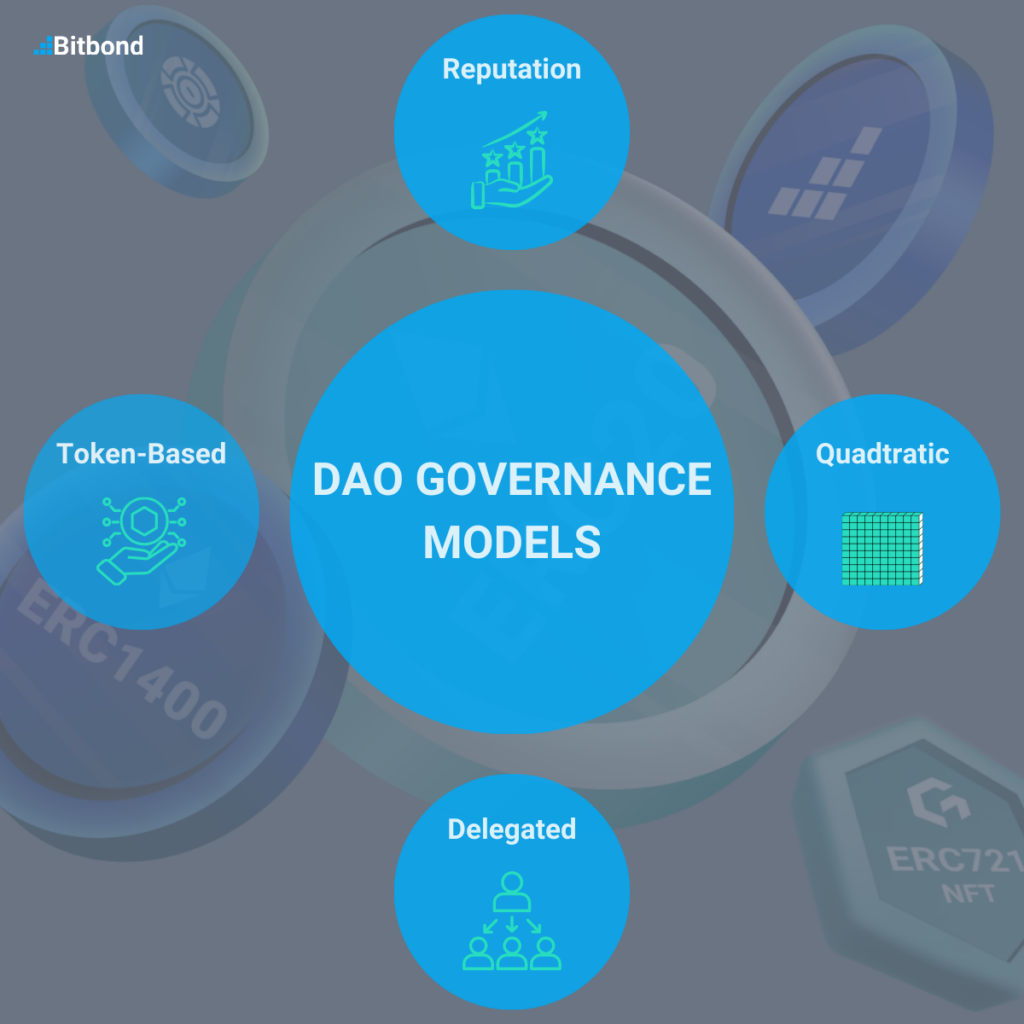
Token-Based Voting: This is the simplest and most common form of on-chain voting. Voting power is proportional to the number of tokens a person holds (1 token = 1 vote). Its main drawback is the risk of plutocracy, where wealthy token holders can easily outvote the rest of the community.
-
Delegation: To combat voter apathy (low turnout), many DAOs allow token holders to delegate their voting power to an active community member or "delegate" they trust to vote on their behalf. This is a core feature of liquid democracy.
-
Quadratic Voting (QV): This is an advanced mechanism designed to solve the plutocracy problem. In QV, the cost of casting multiple votes for the same proposal increases quadratically (1 vote = 1 credit, 2 votes = 4 credits, 3 votes = 9 credits, etc.). This makes it prohibitively expensive for a single large holder to dominate a vote and allows smaller holders to signal the intensity of their preferences on issues they care about most.
Conclusion
You've now taken your first step into the world of decentralized governance. You understand that managing a blockchain project involves a complex set of trade-offs and that there are structured ways to enable community-led decision-making.
Key Takeaways:
- Blockchain governance is the framework for making decisions in a decentralized network, replacing traditional corporate hierarchies.
- The two primary models are off-chain governance (based on social consensus, used by Bitcoin and Ethereum) and on-chain governance (based on code-enforced rules, used by most DAOs).
- A Decentralized Autonomous Organization (DAO) is an organization run by smart contracts, where token holders can vote on proposals to direct the project.
- Governance models have distinct trade-offs regarding speed, transparency, decentralization, and inclusivity.
- Key mechanisms like delegation and quadratic voting are being developed to address the shortcomings of simple token-based voting, such as voter apathy and plutocracy.
Preview of the Next Lesson:
Fully transitioning to a DAO is a complex process that takes time. Most projects start with a more centralized but still secure form of shared control. In our next lesson, we will explore a foundational tool for this: multi-signature wallets. You will learn how they work and why they are the industry standard for securely managing a project's treasury and critical smart contract functions.