Recommended resources
The freely available resources this lesson will direct you to.
Hello! In our last lesson, we explored the world of decentralized governance, discussing how projects transition from centralized control to community-led decision-making through mechanisms like DAOs. We mentioned that before a project is ready for a full-fledged DAO, it needs a secure way to manage its treasury and control key smart contract functions.
This lesson introduces the industry-standard solution for this exact problem: the multi-signature wallet. Your learning outcome is to explain the purpose and architecture of multi-signature wallets for secure asset management. We'll cover what they are, why they are essential for any serious project, and how they are structured, particularly on the Ethereum blockchain.
What is a Multi-Signature Wallet?
You're already familiar with single-signature wallets like MetaMask, where a single private key controls all the funds. If that key is lost or compromised, the assets are gone forever. This represents a critical single point of failure.
A multi-signature (or "multisig") wallet is a type of wallet that requires more than one key to authorize a transaction. Think of it like a bank's safe deposit box that requires two keys to open—one held by you and one by the bank manager. Neither party can open it alone.
To get a more formal understanding, let's start with a foundational article.
What is a Multisig Wallet? The Complete Guide to Multi-Signature Security
The following guide from Cobo provides a clear definition of a multisig wallet and contrasts it with the single-signature wallets you're used to.
Read the sections 'What is a Multisig Wallet?', 'Multi-Signature Technology Explained', and 'How Multisig Differs from Single-Signature Wallets'. Focus on how multisig distributes control to eliminate a single point of failure.
The M-of-N Model
The core of a multisig's architecture is its M-of-N configuration:
- N is the total number of authorized keys (or "signers").
- M is the minimum number of those keys required to approve a transaction.
For example, a 2-of-3 multisig has three total signers, but any transaction requires approval from at least two of them. This simple structure provides both security and redundancy.
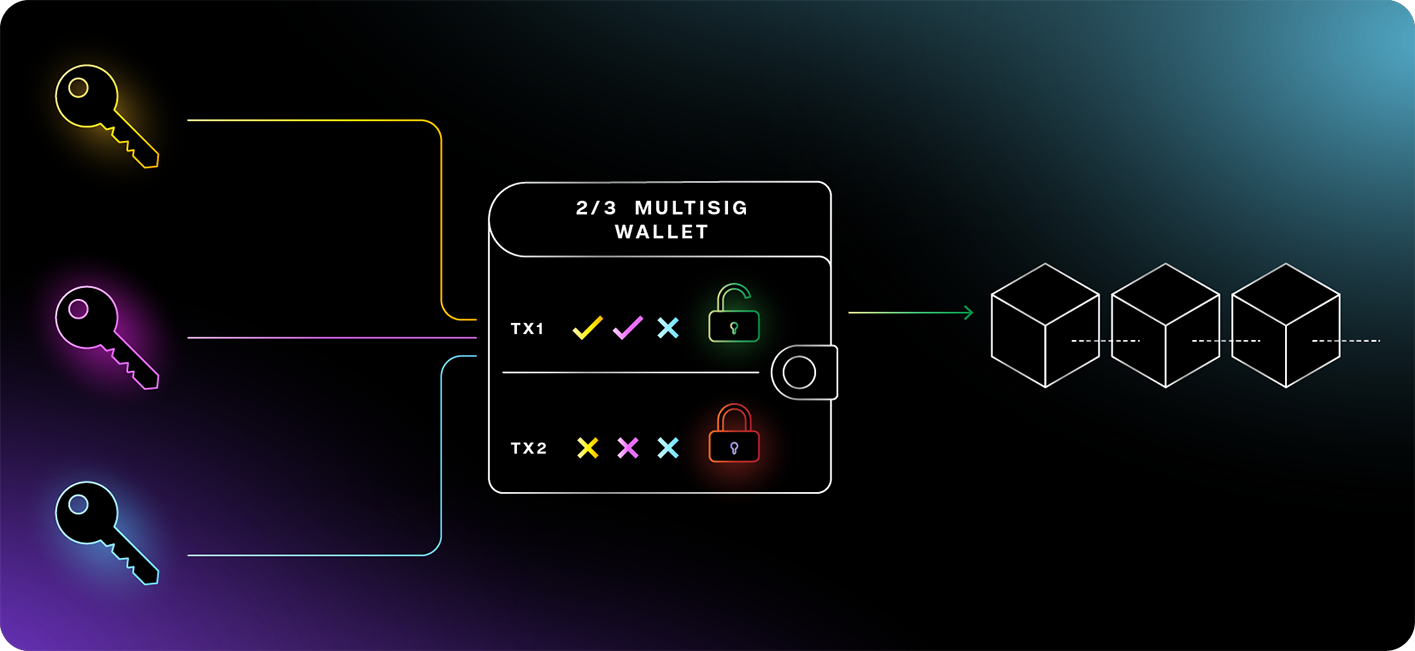
The M-of-N model is highly flexible and can be adapted to different needs.
What is a Multisig Wallet? The Complete Guide to Multi-Signature Security
Let's return to the Cobo guide to see how different M-of-N configurations are used in practice.
Read the section 'The M-of-N Signature Model' to see a table of common configurations and their best use cases, such as 2-of-3 for small teams or 3-of-5 for board-level decisions.
The Purpose: Why is a Multisig Essential?
Now that we know what a multisig is, let's focus on its purpose: secure asset management. For a project like the one you're building, which will hold treasury funds and eventually have administrative control over other smart contracts (like the staking contract), using a simple single-key wallet is far too risky.
A multisig wallet addresses several critical security and operational needs.
What is a Multisig Wallet? The Complete Guide to Multi-Signature Security
The Cobo guide also has an excellent section detailing the key benefits of using a multisig wallet. These points directly explain its purpose.
Read the section 'Key Benefits of Multisig Wallets'. Pay close attention to how it solves the problems of a single point of failure, enhances security against theft, and enables shared control and accountability.
To summarize the key benefits discussed in the article:
- Eliminates Single Points of Failure: This is the most important advantage. If one of the project founders loses their private key in a 2-of-3 setup, the funds are not lost. The remaining two founders can still authorize transactions, including one to add a new third owner and remove the lost key.
- Enhanced Security: An attacker would need to compromise M keys, not just one. This makes phishing, malware, and social engineering attacks significantly more difficult to pull off.
- Shared Control and Accountability: For your project's treasury, this is non-negotiable. It prevents any single person from making unauthorized transactions. Every transaction is reviewed and approved by multiple parties, and all approvals are recorded transparently on the blockchain. This builds trust with your community.
- Secure Recovery Options: The M-of-N model provides built-in redundancy. A 3-of-5 configuration can tolerate the loss of two keys while still maintaining full control over the assets.
Test your understanding!
Your project has three core team members. You need to set up a multisig to manage the project's treasury. You decide on a 2-of-3 configuration.
- Why is this better than giving one person a single-key wallet?
- What happens if one team member's laptop is stolen and their private key is compromised?
- What happens if one team member goes on vacation and is offline for two weeks? Can the project still pay its bills?
Show answer
- It's better because it prevents a single point of failure. No single person can run off with the funds, and if one key is lost, the funds are not lost forever.
- The funds are safe. The attacker only has one of the two keys required to authorize a transaction. The remaining two team members can vote to execute a transaction that removes the compromised address as an owner and adds a new, secure one.
- Yes. Since only two signatures are required, the two online team members can still approve and execute necessary transactions. This demonstrates the balance between security and operational flexibility.
The Architecture on Ethereum
So, how does a multisig wallet actually work on Ethereum? Is it a special type of account?
The answer lies in a concept we covered early in the course: the two types of Ethereum accounts. As a refresher, let's quickly review them.
SAFE Smart Contract Multi-Sig Storage 🔒 (Better than Hardware Wallet!⭐️) Step-by-Step Setup Guide ✅
This video from Crypto Casey provides a great recap of Externally Owned Accounts (EOAs) versus Contract Accounts. Understanding this distinction is key to understanding multisig architecture on Ethereum.
Watch from 02:27 to 05:51. Focus on the key differences: EOAs are controlled by private keys, while Contract Accounts are controlled by code. Your MetaMask is an EOA.
As the video explains, a multisig wallet on Ethereum is not an EOA. It is a smart contract. This contract holds the assets and contains the logic for the M-of-N signature scheme. Unlike blockchains like Bitcoin which have native multisig support in their protocol, Ethereum achieves this functionality through programmable smart contracts.
The Internal Structure of a Multisig Contract
Since you have a backend development background, the best way to understand the architecture is to look at the data structures and logic inside the smart contract. You won't be building one from scratch in this course (we'll use a battle-tested solution), but seeing the internals will make the concept concrete.
The following video shows a developer building a simple multisig. We're only going to focus on the initial setup of the state variables, as they perfectly reveal the contract's architecture.
Multi Sig Wallet | Solidity 0.8
This video from Smart Contract Programmer walks through building a multisig. We will just watch the part where the developer defines the state variables, which form the architectural backbone of the contract.
Watch from 00:34 to 03:29. Pay close attention to each state variable and its purpose: owners: An array to store the addresses of the signers. isOwner: A mapping for a quick, gas-efficient check to see if an address is an owner. required: A uint to store the 'M' value from our M-of-N model. transactions: An array of structs, where each struct holds the details of a proposed transaction. approved: A nested mapping to track which owner has approved which transaction.
Seeing those state variables should make the process flow intuitive. A typical multisig transaction follows these steps:
- Submission: An owner calls a
submitTransactionfunction, providing the recipient's address, the amount, and any other data. The contract creates aTransactionstruct with these details and adds it to thetransactionsarray, assigning it a transaction ID (its index in the array). - Approval: Other owners review the proposed transaction. If they agree, they call an
approveTransactionfunction with the transaction ID. The contract records their approval in theapprovedmapping. - Execution: Once the number of approvals for a transaction ID reaches the
requiredthreshold, anyone can call anexecuteTransactionfunction. The contract verifies the approval count and then executes the transaction (e.g., sends the ETH or calls another contract).
This entire process is transparent and enforced by code, providing the security and accountability we discussed.
Conclusion
You now have a solid understanding of what a multi-signature wallet is, its critical role in secure asset management, and the smart contract architecture that powers it on Ethereum. This is a foundational building block for any serious blockchain project, providing a secure bridge between initial centralized control and future decentralized governance.
Key Takeaways:
- A multi-signature wallet requires a minimum number of approvals (M) from a total set of signers (N) to authorize a transaction.
- Its primary purpose is to eliminate single points of failure, enhance security against theft, and provide shared, accountable control over assets.
- On Ethereum, a multisig wallet is not a native account type but a smart contract that holds funds and contains the logic for the M-of-N approval process.
- The architecture consists of state variables to track owners, the required signature threshold, proposed transactions, and approvals, along with functions to
submit,approve, andexecutetransactions.
Preview of the Next Lesson:
Theory is great, but practice is better. In the next lesson, we will move from explaining the concept to implementing it. You will deploy and configure your own Gnosis Safe (now just called "Safe"), the most widely used and trusted multi-signature wallet on Ethereum. You'll put everything you learned today into practice by setting up owners and a signature threshold on a testnet.