Recommended resources
The freely available resources this lesson will direct you to.
Hello! Welcome back to our study of circuit analysis.
In our last lesson, we mastered the core of mesh analysis: writing Kirchhoff's Voltage Law (KVL) equations for each mesh. We saw how to handle resistors and voltage sources, culminating in a system of linear equations ready for solving. This method works perfectly for a large class of circuits.
However, a new challenge arises when we introduce current sources. A current source on the perimeter of a circuit is simple—it directly sets the value of that mesh current. But what happens when a current source is shared between two meshes? We can't write a KVL equation through it because we don't know the voltage across an ideal current source.
This lesson tackles that exact problem. Your learning outcome is to handle current sources in mesh analysis using the supermesh technique and explain the reasoning behind it. You'll discover that this elegant solution is the direct counterpart to the supernode technique you learned for nodal analysis, reinforcing the powerful dual relationship between these two methods.
The Problem: An Unknown Voltage
Let's start with the "why," as you prefer. Why does a shared current source break our standard mesh analysis procedure?
In the previous lesson, every term in our KVL equation was either a known source voltage or a voltage across a resistor, which we could express using Ohm's Law (e.g., ). A current source disrupts this. The voltage across it is not fixed; it is determined by the rest of the circuit.
When we try to "walk" around a mesh that includes a shared current source, we hit a wall. We can't write a term for the voltage change across it.
This video, 'Supermesh Analysis Explained' from Engineer4Free, begins by perfectly articulating this core problem. It explains exactly why a standard KVL loop can't be completed.
Watch the first minute (0:00 - 01:02). The key takeaway is that we can't use Ohm's law to find the voltage drop across an independent current source, which makes standard mesh analysis impossible for that loop.
The Solution: Combining Meshes
Since we can't go through the current source, we must go around it. The supermesh technique is a systematic way to do this. It involves two key steps:
- Form a Constraint Equation: The current source itself provides a direct relationship (a constraint) between the two mesh currents that share it.
- Form a Supermesh KVL Equation: We combine the two meshes into one large "supermesh" that excludes the problematic current source and write a single KVL equation for this new, larger loop.
Let's explore each step.
1. The Constraint Equation
An ideal current source I_S located between Mesh A (current ) and Mesh B (current ) dictates the net current in that branch. This gives us our first equation. If flows in the same direction as the source and opposes it, the relationship is:
This is a simple application of KCL at the component level and it provides one of our necessary equations.
The same video demonstrates how to create this simple but essential constraint equation.
Continue watching from 01:20 to 02:10. Notice how the net current from the two mesh currents, i1 and i2, must equal the current of the source.
2. The Supermesh KVL Equation
We still need another equation to solve for our two unknowns, and . This is where the "supermesh" comes in.
To understand the reasoning, let's consider the formal derivation. Imagine we assign an unknown voltage, , across the shared current source.
- We could write a KVL equation for Mesh A:
... + v_x = 0 - We could write a KVL equation for Mesh B:
... - v_x = 0
If we then add these two equations together, the unknown voltage cancels out perfectly! The resulting single equation is the same one we would get by tracing a KVL loop around the outer path of both meshes combined.
This outer path is the supermesh.
These lecture slides from UCSB provide an excellent formal derivation of the supermesh. It shows how adding the two individual mesh KVL equations (with an unknown voltage v_3A) leads directly to the supermesh equation.
Review slides 10 through 14. Slide 13 is the key: it shows the two separate KVL equations and how adding them cancels out the unknown voltage v_3A, resulting in the supermesh equation shown on slide 14. This provides the conceptual 'why' for the technique.
In practice, we don't need to write two equations and add them. We can directly form the supermesh KVL equation by visually identifying the loop and applying KVL as usual.
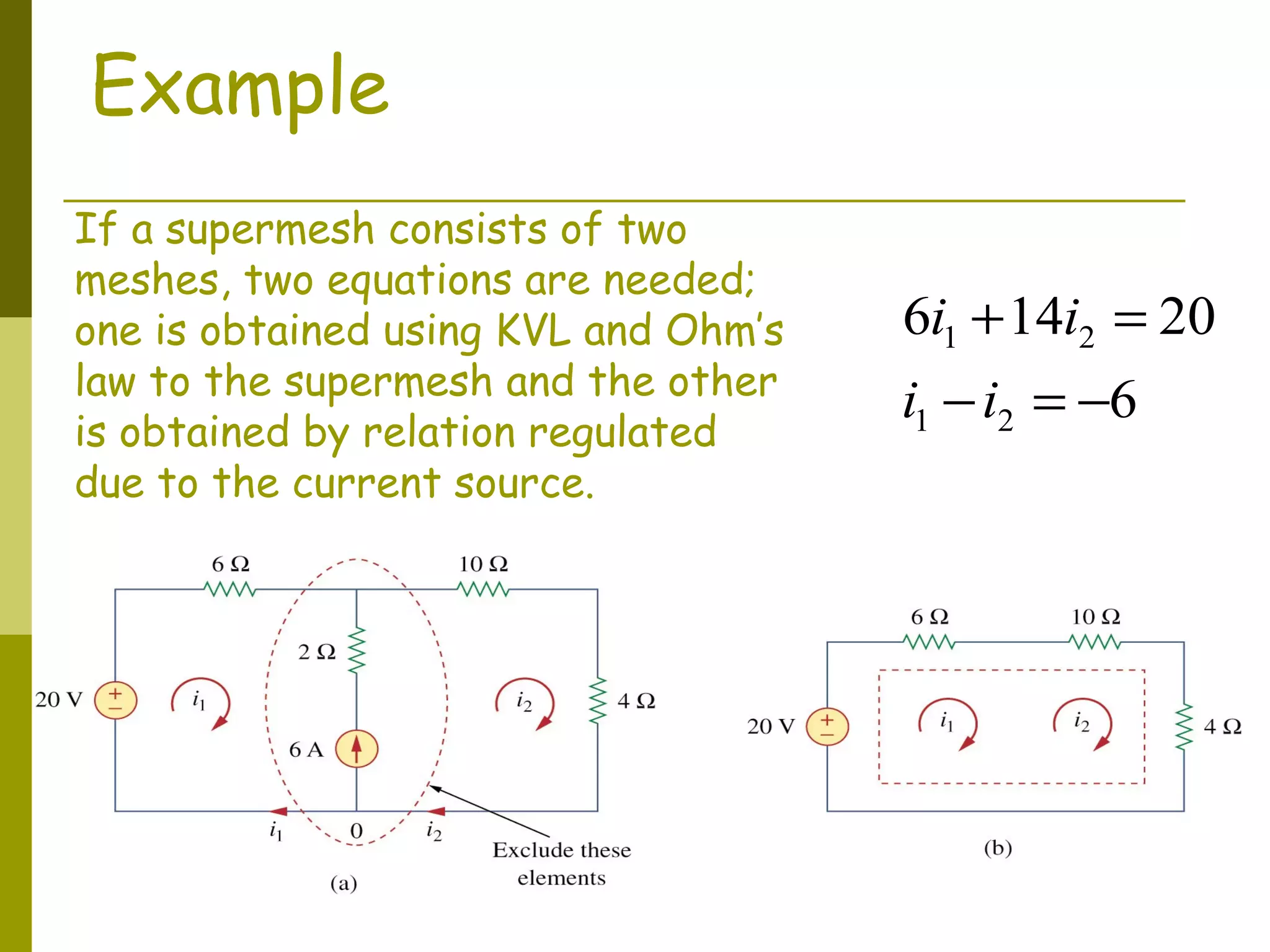
A Complete Supermesh Example
Let's see this entire process in action. We'll analyze a circuit that has both a current source on the perimeter and a shared current source, requiring a supermesh.
The Complete Guide to Mesh Analysis | Engineering Circuit Analysis | (Solved Examples)
This video, 'The Complete Guide to Mesh Analysis', works through an example that requires a supermesh. It will help you consolidate the steps.
Watch from 06:58 to 13:22. The video first handles two perimeter current sources, which simply define their respective mesh currents. Then, starting at 10:15, it tackles a circuit with shared current sources. Pay close attention to how it first derives the constraint equations (e.g., I3 - I1 = 2mA) and then forms a KVL equation for the large outer loop (the supermesh) that bypasses the current sources.
The key steps demonstrated in the video are:
- Identify all meshes and assign mesh currents.
- Write constraint equations for all current sources.
- For a perimeter source: The mesh current is equal to the source current.
- For a shared source: Write an equation relating the two mesh currents to the source current (e.g., ).
- Write KVL equations for all remaining loops.
- For normal meshes (containing no current sources), write a standard KVL equation.
- For every pair of meshes joined by a current source, write one KVL equation for the corresponding supermesh.
- Solve the resulting system of equations.

Summary and Strategic Approach
You now have a complete toolkit for mesh analysis. Let's formalize the strategy for handling current sources.
Mesh Equations with Current Sources
This excerpt from a textbook provides a concise, strategic summary of how to handle current sources in mesh analysis. It confirms the techniques we've discussed.
Read section 'MESH EQUATIONS WITH CURRENT SOURCES'. It outlines three methods: source transformation (if possible), handling a perimeter source (method 2), and using a supermesh for a shared source (method 3). Also, read the 'SUMMARY OF MESH-CURRENT ANALYSIS' at the end for a good set of general guidelines.
Conclusion
In this lesson, we tackled the special case of current sources within mesh analysis. You learned how to handle them systematically and, more importantly, understood the physical reasoning behind the procedure.
Key Takeaways:
- A current source shared between two meshes creates a problem for KVL because its voltage is unknown.
- The solution is the supermesh technique, which replaces two individual mesh equations with two different equations:
- A constraint equation derived from the current source itself, relating the two mesh currents (e.g., ).
- A KVL equation written around the larger supermesh loop, which bypasses the shared current source.
- This method is the direct dual of the supernode technique, where a floating voltage source was handled by a constraint equation and a KCL equation for the supernode.
Preview of the Next Lesson:
We have now fully developed the formulation stage for both nodal and mesh analysis, covering all common components. The next logical step is to become proficient at solving the systems of equations we generate. We will also develop a strategic framework for deciding when to use nodal analysis versus mesh analysis to solve a problem most efficiently.