Recommended resources
The freely available resources this lesson will direct you to.
Introduction
Hello! Welcome to a new module. In our previous discussions, we explored the two extreme ends of the market structure spectrum: perfect competition, with its many firms and identical products, and monopoly, with a single firm dominating the market. We also saw how a monopolist might use price discrimination to capture more profit.
But what about the vast middle ground where most real-world businesses operate? Think about restaurants, hair salons, or clothing stores. These markets are competitive, yet each firm has something unique to offer. This brings us to imperfect competition, the focus of our current module.
Today's lesson addresses the first learning outcome: to describe monopolistic competition and explain the role of product differentiation. We will define this hybrid market structure, which blends elements of both monopoly and competition, and explore how firms use product differentiation to carve out their own niche in a crowded marketplace.
1. Defining Monopolistic Competition: A Hybrid Market
The name "monopolistic competition" might seem like a contradiction, but it perfectly captures the essence of this market structure.
- "Competition": Like in perfect competition, there are many firms competing for the same group of customers, and barriers to entry for new firms are low.
- "Monopolistic": Like a monopoly, each firm's product is slightly different from its competitors. This difference gives the firm a mini-monopoly on its specific version of the product, allowing it some power to set its own price.
To get a clear overview of these characteristics, let's watch a short video.
Micro 4.4 Monopolistic Competition
This video from ReviewEcon provides a concise introduction to the key qualities of monopolistic competition, contrasting them with the market structures we've already studied.
Watch the segment from 00:26 to 01:43. Pay close attention to the four defining features mentioned: many sellers, low barriers to entry, zero long-run economic profit, and differentiated goods.
As the video highlights, the single most important feature that distinguishes monopolistic competition is product differentiation.
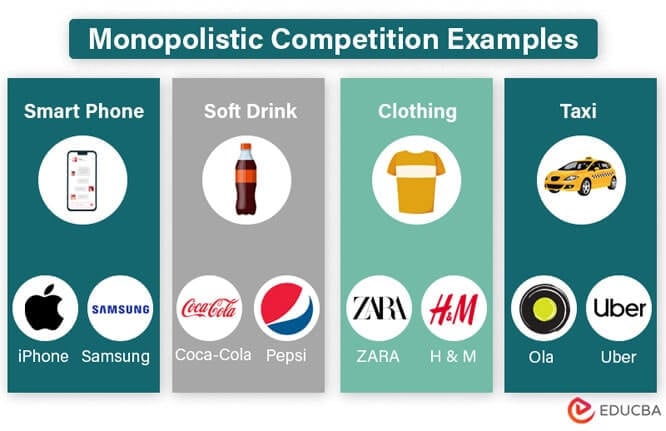
Common examples are all around us. Think of the market for smartphones, soft drinks, or fast-fashion clothing. In each case, many brands compete, but each offers a product that is distinct in terms of features, branding, or quality.
2. The Core Concept: Product Differentiation
Product differentiation is the process firms use to make their products or services distinct from their competitors'. This is not just about the product itself; it's about creating a unique identity in the consumer's mind. A successful differentiation strategy gives a firm a loyal customer base and some control over its price.
So, how do firms achieve this? They can differentiate their products in several key ways.
Monopoly, Monopolistic Competition, and Oligopoly
This reading from the pressbook 'Microeconomics' provides a fantastic breakdown of the different methods firms use to differentiate their products. This is the central idea for today's lesson.
Please read the section titled 'Differentiated Products'. It begins just after the 'Clear It Up' box about the theory of imperfect competition. Focus on the four ways a firm can differentiate its products: physical aspects, location, intangible aspects, and perceptions.
Let's summarize those four avenues of differentiation:
- Physical Aspects: This is the most obvious form. It includes differences in design, features, quality, and materials. For example, one laptop might be lighter and have a longer battery life, while another has a faster processor.
- Location: Sometimes, the key difference is simply where the product is sold. A convenience store in a residential neighborhood offers the same products as a large supermarket, but its convenience is the differentiating factor for which customers are willing to pay a premium.
- Intangible Aspects: These are the services and qualities associated with the product. This includes things like warranties, customer service, free delivery, or a reputation for reliability. In your field as an IT analyst, you might see this in the difference between open-source software (free, but with community support) and enterprise software (paid, but with a dedicated support contract and service-level agreements).
- Perceptions: Often, differentiation exists purely in the mind of the buyer, shaped by branding, advertising, and packaging. Blind taste tests have shown that many people can't distinguish between major brands of cola or ketchup, yet they have strong preferences based on brand loyalty built over time.
The key takeaway is that the variety of styles, flavors, locations, and brand images is what creates both product differentiation and the market structure of monopolistic competition.
3. How Differentiation Affects a Firm's Demand
Why is product differentiation so important? Because it directly shapes the demand curve that a firm faces.
- In perfect competition, products are identical. If a firm raises its price even slightly, it loses all its customers. This results in a perfectly horizontal (perfectly elastic) demand curve.
- In a monopoly, the product is unique with no close substitutes. The monopolist faces the entire market demand curve and can raise its price significantly without losing all its customers. The demand curve is downward-sloping and relatively inelastic.
A monopolistically competitive firm falls in between. Because its product is differentiated, it won't lose all its customers if it raises its price (some loyal customers will stay). However, because there are many close substitutes, it will lose more customers than a pure monopolist would.
This means the monopolistically competitive firm faces a downward-sloping, but relatively elastic, demand curve.
To solidify your understanding of this crucial point, please read the next short section from the same text.
Monopoly, Monopolistic Competition, and Oligopoly
This section explicitly compares the demand curve of a monopolistically competitive firm to those in perfect competition and monopoly.
Read the section titled 'Perceived Demand for a Monopolistic Competitor'. Pay close attention to Figure 9.9, which graphically illustrates the difference between the demand curves in the three market structures.
Since the firm faces a downward-sloping demand curve, a familiar rule applies: to sell more, it must lower its price. And just like with a monopoly, this means that the marginal revenue (the revenue from selling one more unit) will be less than the price. The following video segment provides a great graphical illustration of this relationship, which will be essential for our next lesson.
Micro 4.4 Monopolistic Competition
Let's return to the ReviewEcon video to see how the demand curve for a monopolistically competitive firm is drawn and how its marginal revenue curve relates to it.
Watch from 01:43 to 03:41. Focus on the relationship between the demand curve and the marginal revenue curve. Notice that, just like for a monopoly, the MR curve lies below the demand curve.
Conclusion
In this lesson, we have introduced monopolistic competition as a realistic market structure that sits between the theoretical poles of perfect competition and monopoly. We established its defining characteristics and, most importantly, explored the central role of product differentiation.
Here are the main takeaways:
- Monopolistic competition is a market with many firms, low barriers to entry, and differentiated products.
- Product differentiation is the strategy of making a product distinct from competitors' through physical aspects, location, intangible qualities, or brand perception.
- This differentiation gives each firm a mini-monopoly, resulting in a downward-sloping demand curve that is more elastic than a monopolist's but less elastic than a perfect competitor's.
- As with a monopoly, the firm's marginal revenue is less than its price.
We have now laid the foundation by understanding the structure of this market and the demand a firm faces. In our next lesson, we will build on this by analyzing how a monopolistically competitive firm determines its profit-maximizing price and output in the short run, applying the familiar MR = MC rule in this new context.