Recommended resources
The freely available resources this lesson will direct you to.
Introduction
Hello! In our last lesson, we explored the social cost of a single-price monopoly, measuring it as deadweight loss. We saw that a monopolist maximizes profit by restricting output and raising prices, which leaves two interesting areas on our graph: consumer surplus (value captured by consumers) and deadweight loss (value captured by no one).
This outcome presents an intriguing puzzle for a profit-hungry monopolist: Is there a way to capture some of that leftover value? The answer is yes, if the firm can charge different prices to different buyers. This brings us to today's topic.
This lesson directly addresses the final learning outcome of this module: to explain the concept of price discrimination and identify its necessary conditions. We will define what price discrimination is, establish the three crucial conditions a firm must meet to practice it, and then explore the different "degrees" of price discrimination with real-world examples and graphical analysis.
1. What is Price Discrimination?
At its core, price discrimination is the business practice of selling the same good or service at different prices to different customers, where the price difference is not based on differences in production costs.
Think about movie tickets (adult vs. child pricing), airline fares (business traveler vs. tourist), or student discounts at a campus bookstore. In each case, the product is identical, but the price is not. The goal for the firm is simple: increase profits by charging each customer, or group of customers, a price closer to their maximum willingness to pay.
To start, let's get a formal definition and see some common examples.
This brief reading from Lumen Learning provides a concise definition of price discrimination and distinguishes it from price differences that arise from varying production costs.
Please read the first two sections, titled 'Price Discrimination' and 'Examples of Price Discrimination'. Focus on the core definition and how it differs from cost-based price variations.
2. The Necessary Conditions for Price Discrimination
As you might guess, a firm can't just decide to start charging different prices. It's a strategy that is only feasible under specific circumstances. For a firm to successfully price discriminate, it must meet three key conditions.
To explore these, let's watch the beginning of a video that lays them out clearly.
Y2 19) Price Discrimination - First, Second and Third Degree
This video from EconplusDal will be our main guide for this lesson. We'll start with the first part, which introduces the three essential conditions for price discrimination.
Watch the video from the beginning until 01:38. The presenter will define price discrimination and then explain the three conditions necessary for it to work. Take note of these three conditions.
To summarize and reinforce what you just watched, the three conditions are:
- Market Power: The firm must be a "price maker," meaning it faces a downward-sloping demand curve. A firm in a perfectly competitive market is a "price taker" and has no power to set prices. This is why price discrimination is a strategy for monopolies, oligopolies, or monopolistically competitive firms.
- Ability to Segment the Market: The firm must be able to identify and separate different groups of buyers based on their willingness to pay. This is often done using observable characteristics like age (senior discounts), student status, or geography. In essence, the firm is trying to group customers by their price elasticity of demand.
- Prevention of Resale (Arbitrage): The firm must be able to prevent customers who buy the product at a low price from reselling it to customers who would otherwise have to pay a high price. This is easy for services (like a haircut or a flight) but harder for physical goods.
For a more detailed written explanation of these conditions, the "Price Discrimination" article from Economics Help is a useful reference. Section 1 of that resource, titled "Conditions necessary for price discrimination," provides a clear, list-based summary.
3. The Three Degrees of Price Discrimination
Economists categorize price discrimination into three types, or "degrees," based on how finely the firm can segment its market.
First-Degree (or Perfect) Price Discrimination
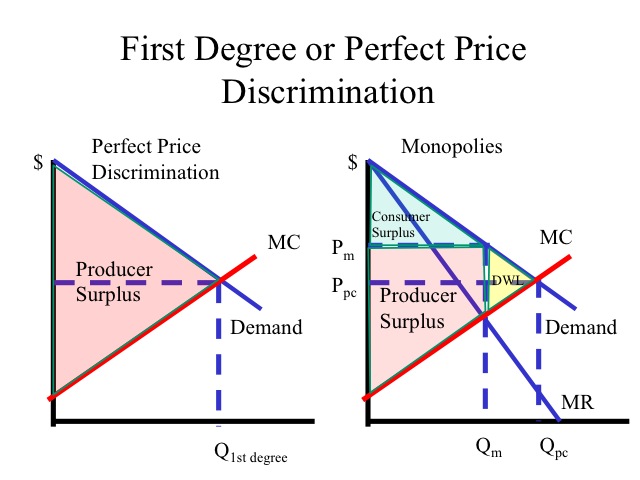
This is the most extreme and theoretical form. Here, the firm charges each customer the absolute maximum price they are willing to pay for each unit.
If a firm could achieve this, two striking things would happen:
- All consumer surplus would be converted into producer surplus (profit).
- There would be no deadweight loss. The firm would sell to every customer whose willingness to pay is greater than or equal to the marginal cost, resulting in the same quantity as a perfectly competitive market.
The following video provides an excellent graphical comparison that will connect to your analytical background and the graphs from our previous lesson.
Price Discrimination- Micro Topic 4.3
In this video, Jacob Clifford masterfully contrasts a standard single-price monopoly with a perfectly price-discriminating one. Pay close attention to what happens to marginal revenue, consumer surplus, and the quantity produced.
Watch the full video. Notice how for the perfectly price-discriminating monopolist, the demand curve is the marginal revenue curve. Understand why consumer surplus disappears and why the firm produces the allocatively efficient quantity.
The image below reinforces this key idea. On the left, the producer captures the entire area under the demand curve above marginal cost. On the right, you see the familiar monopoly graph with consumer surplus and deadweight loss, which we studied previously.
Second and Third-Degree Price Discrimination
While perfect price discrimination is rare, firms frequently use second and third-degree price discrimination.
-
Second-Degree Price Discrimination: This involves charging different prices based on the quantity consumed. Examples include "buy two, get one free" offers, or tiered pricing for electricity where the price per kilowatt-hour decreases after a certain level of usage. The firm is letting consumers "self-select" into different price brackets based on their consumption patterns.
-
Third-Degree Price Discrimination: This is the most common form. It involves dividing consumers into distinct groups and charging a different price to each group. This relies on the "market segmentation" condition we discussed earlier. The key is to charge a higher price to the group with a more inelastic demand (e.g., business travelers) and a lower price to the group with a more elastic demand (e.g., leisure travelers).
Let's return to the EconplusDal video to see how these two types work.
Y2 19) Price Discrimination - First, Second and Third Degree
We'll now watch the rest of the EconplusDal video, which explains second and third-degree price discrimination with clear diagrams.
Watch from 02:41 to 08:43. First, observe the 'excess capacity' example for second-degree. Then, focus on the third-degree example, noting how the firm sets different prices in the 'inelastic' and 'elastic' sub-markets to maximize its total profit.
The diagram for third-degree price discrimination is particularly important. It shows the firm acting as a monopolist in two separate markets, setting quantity where MR=MC in each, but charging different prices based on each group's demand curve.

Conclusion
In this lesson, we moved beyond the single-price model to understand how firms with market power can enhance their profits through price discrimination. This strategy, while beneficial for the firm, has complex effects on consumers and overall market efficiency.
Here are the key takeaways:
- Price discrimination involves charging different prices for the same product for reasons unrelated to cost, with the goal of capturing more consumer surplus.
- It requires three conditions: market power, the ability to segment the market, and a way to prevent resale.
- First-degree (perfect) price discrimination eliminates all consumer surplus and deadweight loss, making it allocatively efficient but highly inequitable.
- Third-degree price discrimination is the most common form, where firms charge higher prices to groups with inelastic demand and lower prices to groups with elastic demand.
This lesson concludes our module on perfect competition and monopoly. We've seen the two extremes of market structure. In the next module, we will explore the ground in between, starting with monopolistic competition, a market where many firms compete by selling similar but differentiated products.