Recommended resources
The freely available resources this lesson will direct you to.
- Monopolistic Competition- Short Run and Long Run- Micro 4.4www.youtube.com
- Monopolistic competition and economic profit | Microeconomics | Khan Academywww.youtube.com
- 11.1 Monopolistic Competition: Competition Among Many2012books.lardbucket.org
- 10.1 Monopolistic Competition – Principles of Microeconomicspressbooks.oer.hawaii.edu
Introduction
Hello! In our previous lesson, we established that a monopolistically competitive firm determines its short-run output by finding where marginal revenue equals marginal cost (MR = MC). This can lead to either an economic profit or a loss, depending on whether the price is above or below the average total cost.
Today, we'll explore the dynamic nature of these markets. The existence of short-run profits or losses acts as a powerful signal that triggers a predictable adjustment process. Our learning outcome is to illustrate the long-run adjustment to zero economic profit in monopolistic competition. We will examine how the freedom of entry and exit, a key characteristic of this market structure, ensures that any short-run profits or losses are temporary.
From Short-Run Profit to Long-Run Equilibrium
Let's start from the scenario we saw last lesson: a firm enjoying economic profits. Because monopolistic competition has low barriers to entry, this profitability won't go unnoticed. It acts as an incentive for new firms to enter the market, hoping to capture some of that success.
Think of a town's first gourmet coffee shop that's always busy. Its success will likely inspire others to open competing coffee shops nearby, perhaps with slightly different themes or specialty drinks.
What is the effect of this new competition on the original firm?
- More Substitutes: Consumers now have more choices. The original coffee shop is no longer the only option for a premium coffee.
- Decreased Demand: With more substitutes available, the demand for the original firm's product will fall. Some of its customers will be lured away by the new entrants.
- Increased Elasticity: The firm's demand curve also becomes more elastic (flatter) because consumers are more sensitive to price changes now that they have viable alternatives.
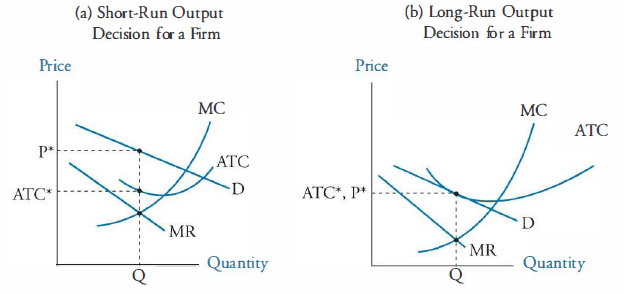
Graphically, this is represented by a leftward shift of the original firm's demand curve and its corresponding marginal revenue curve.
The following video provides an excellent narrative of this entire process, using a tangible example to make the concept clear.
Monopolistic competition and economic profit | Microeconomics | Khan Academy
This Khan Academy video, 'Monopolistic competition and economic profit', walks through the complete adjustment from a firm earning short-run profit to the long-run zero-profit outcome. It clearly explains the 'why' and 'how' of this market dynamic.
Please watch from the beginning to 07:41. Pay close attention to how the entry of competitors (like Samsung competing with Apple's iPad) causes the initial firm's demand curve to shift left, ultimately eroding its economic profit.
The Long-Run Equilibrium: The Tangency Point
As the video explained, new firms will continue to enter the market as long as there are economic profits to be made. This process of entry and the resulting leftward shift of the demand curve for existing firms will stop only when economic profit is driven down to zero.
This occurs at a very specific point: the long-run equilibrium is reached when the firm’s demand curve becomes tangent to its Average Total Cost (ATC) curve.
At this point of tangency:
- The firm still maximizes its profit by producing the quantity where its (new) Marginal Revenue equals Marginal Cost (
MR = MC). - At this quantity, the price the firm can charge (read off the demand curve) is exactly equal to its Average Total Cost (read off the ATC curve).
- Since
Price = Average Total Cost, the profit per unit is zero, and therefore, the total economic profit is zero.
The following reading and diagrams provide a formal illustration of this adjustment.
11.1 Monopolistic Competition: Competition Among Many
This section from the textbook 'Economics: Principles v2.0' provides a clear, step-by-step explanation of the long-run adjustment, complete with diagrams that show the demand curve shifting.
Please read the subsection titled 'The Long Run'. Focus on Figure 11.2, which shows the demand curve D1 shifting left to D2, resulting in the new long-run equilibrium at point A, where the demand curve is tangent to the ATC curve.
This pair of graphs provides a clear "before and after" picture of the adjustment process.
The Adjustment from Short-Run Losses
The process also works in reverse. If firms in a monopolistically competitive market are incurring economic losses, some will choose to exit the market.
- Exit of firms means fewer substitutes for the consumers who remain.
- This increases the demand for the products of the surviving firms, shifting their demand curves to the right.
- This process of exit continues until the economic losses are eliminated, and the remaining firms are once again earning zero economic profit. The market returns to the same long-run equilibrium shown in graph (b) above.
What "Zero Economic Profit" Really Means
It is crucial to remember the distinction between economic profit and accounting profit. Earning zero economic profit does not mean the firm isn't making any money.
- Accounting Profit = Total Revenue - Explicit Costs (e.g., wages, rent, materials)
- Economic Profit = Total Revenue - (Explicit Costs + Implicit Costs)
Implicit costs represent the opportunity cost of the resources used in the business—what those resources could have earned in their next-best alternative use. Therefore, earning zero economic profit means the firm's accounting profit is just enough to cover the opportunity cost of its resources. The firm is doing just as well as it would in any other comparable venture, earning a "normal profit." This is why there's no incentive for firms to either enter or exit the industry.
The final part of the Khan Academy video you watched earlier touches on this important distinction.
Monopolistic competition and economic profit | Microeconomics | Khan Academy
Let's revisit a short clip from the same Khan Academy video to reinforce the difference between economic and accounting profit.
If you need a refresher, please re-watch from 07:41 to 08:15, where the narrator clarifies that zero economic profit can coexist with positive accounting profit.
Conclusion
In this lesson, we've traced the journey of a monopolistically competitive market from a state of short-run profitability to its long-run equilibrium. This dynamic adjustment is a central feature of this market structure.
Here are the key takeaways:
- Short-run economic profits attract new firms into the market due to low barriers to entry.
- The entry of new firms reduces the demand for existing firms' products, shifting their demand curves to the left.
- This adjustment continues until economic profits are driven to zero.
- The long-run equilibrium occurs where the firm's demand curve is tangent to its average total cost curve, meaning Price equals Average Total Cost.
- A similar adjustment occurs in reverse when firms make short-run losses, leading to exit until remaining firms break even.
In our next lesson, we will shift our focus to another form of imperfect competition: Oligopoly. We will explore the key characteristics of oligopolies, where a few large firms dominate the market, and introduce the concept of strategic interdependence—where each firm's decisions critically depend on the actions of its rivals.