Recommended resources
The freely available resources this lesson will direct you to.
Introduction
In our last lesson, we examined monopolistic competition, a market structure where many firms sell differentiated products. A key takeaway was that due to the large number of competitors, each firm makes decisions about price and output without strategically considering the reactions of any single rival.
Today, we transition to oligopoly, the final and arguably most complex market structure we will study. Here, a small number of large firms dominate the market. This "fewness" introduces a dynamic that was absent before: strategic interdependence. Our goal for this lesson is to explain the key characteristics of an oligopoly, with a deep focus on understanding what strategic interdependence means and why it's the defining feature of this market. You'll see how firms in an oligopoly operate in a way that is much like a game of chess, where every move is made with the opponent's potential response in mind.
What is an Oligopoly?
An oligopoly sits between monopoly (one firm) and monopolistic competition (many firms). It is a market structure defined by a few key characteristics:
- A Few Large Firms: A handful of firms control the vast majority of market share. Think of the market for mobile operating systems (Apple's iOS and Google's Android), game consoles (Sony, Microsoft, Nintendo), or the US airline industry.
- High Barriers to Entry: Significant obstacles—such as large capital requirements, economies of scale, patents, or brand loyalty—make it difficult for new firms to enter and compete.
- Interdependence: This is the most important characteristic. Each firm's profit depends not just on its own actions, but on the actions of its rivals.
- Differentiated or Homogeneous Products: Oligopolies can feature either. The auto industry offers differentiated products, while the steel or aluminum industries historically produce more homogeneous ones.
This first video provides a quick and clear overview of what an oligopoly is, with several relatable, modern examples.
Game Theory and Oligopoly: Crash Course Economics #26
Watch this brief segment from CrashCourse Economics to get a feel for what an oligopoly is and where we see them in the real world.
Watch from 01:33 to 01:59. This will provide a concise definition and several good examples of oligopolistic markets.
Strategic Interdependence: The Core of Oligopoly
Unlike any other market structure, firms in an oligopoly are locked in a game of strategy. A decision by one firm to change its price, increase its advertising budget, or launch a new product will have a direct and noticeable impact on its competitors, forcing them to react. Consequently, every firm must anticipate these reactions when making its own decisions.
The following reading formally defines this crucial concept.
Chapter 5. Monopolistic Competition and Oligopoly
This section from an economics textbook provides a formal definition of oligopoly and introduces the concept of strategic interaction.
Please read the subsection titled '5.3.1 Strategic Interactions'. Focus on how a firm's profit depends on the decisions of other firms and the idea that each firm must consider the reactions of its rivals.
As the text highlights, this continuous interplay of decisions and reactions is the foundation of oligopoly. For an oligopolist, strategic interaction is a "fact of life." This is what makes the analysis of oligopoly so fascinating and complex. It's not enough for a manager to ask, "What is the best price for us to charge?" They must ask, "What is the best price for us to charge, given how we expect our competitors to react to that price?"
Game Theory: The Language of Strategy
To formally analyze these strategic interactions, economists use a set of tools known as game theory. Game theory is the study of how people (or firms) make decisions in situations where their outcomes depend on the choices of others.
The idea of a "game" is a powerful analogy for an oligopoly. There are:
- Players: The firms in the industry.
- Strategies: The potential actions each firm can take (e.g., set a high price, set a low price, advertise, don't advertise).
- Payoffs: The profits or losses that result from the combination of strategies chosen by the firms.
The goal is to find the equilibrium of the game—a situation where each firm has chosen its best possible strategy, given the strategies chosen by its rivals. This is known as a Nash Equilibrium, named after the mathematician John Nash.
This next video from MIT OpenCourseWare introduces the necessity of using game theory to understand oligopolies.
In this video, Professor Jonathan Gruber explains why the simple models of competition and monopoly are insufficient for oligopolies and why we must turn to the new tool of game theory.
Watch from 04:29 to 08:02. Pay close attention to how he defines a Nash Equilibrium: 'no player wants to change their strategy given all the other players' strategies'.
Illustrating Interdependence in Action
How does strategic interdependence manifest in the real world? Firms in an oligopoly are often reluctant to compete on price, as this can easily escalate into a mutually destructive price war. Instead, they often engage in non-price competition.
1. Non-Price Competition
Firms will try to distinguish themselves through advertising, branding, product quality, and customer service. The constant battle between Coca-Cola and Pepsi, with their massive advertising campaigns and new product variations (Vanilla Coke, Pepsi Zero Sugar), is a classic example of non-price competition driven by strategic interdependence.
The CrashCourse video you watched a moment ago also has an excellent segment on this.
Game Theory and Oligopoly: Crash Course Economics #26
Let's revisit the CrashCourse video to see how strategic interdependence leads to non-price competition.
Please watch from 01:59 to 04:02. Notice how the goal is to distinguish the product to gain an edge without initiating a price war.
2. Price Rigidity: The Kinked Demand Curve Model
Even when considering price, the strategic interaction leads to a very particular behavior: price rigidity, where firms are hesitant to change prices at all. The kinked demand curve model is a classic way to visualize why this happens.
The model isn't a complete theory of oligopoly, but it's an excellent illustration of the strategic thought process. It assumes that a firm's managers believe their rivals will react asymmetrically to a price change:
- If we raise our price: Our rivals will not follow suit. They will keep their prices low to capture our customers. Therefore, a price increase will lead to a large loss of market share. This implies the demand curve is highly elastic for a price increase.
- If we lower our price: Our rivals will immediately match our price cut to avoid losing their own market share. Therefore, a price decrease will not lead to a large gain in customers. This implies the demand curve is inelastic for a price decrease.
This thinking creates a "kink" in the firm's demand curve at the current price, as shown below.
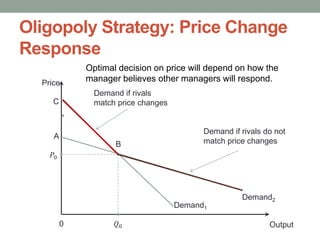
This model provides a clear visual representation of strategic interdependence. The shape of the firm's own demand curve—and thus its optimal decision—is determined entirely by its expectations about its rivals' behavior.
Conclusion
In this lesson, we've defined the key characteristics of an oligopoly and focused on its most important feature: strategic interdependence. Unlike firms in other market structures, oligopolists are playing a strategic game where each player's success is tied to the actions of others.
Here are the key takeaways:
- An oligopoly is a market dominated by a few large firms with high barriers to entry.
- The defining feature is strategic interdependence: each firm must consider the potential reactions of its rivals when making decisions.
- Game theory is the analytical framework used to model these strategic interactions, and the goal is often to find a Nash Equilibrium.
- This interdependence often leads firms to engage in non-price competition (like advertising and product differentiation) and can result in price rigidity, as illustrated by the kinked demand curve model.
In our next lesson, we will dive deeper into game theory. We will use one of its most famous examples, the Prisoner's Dilemma, to build and analyze a simple payoff matrix and see how it helps us predict the outcomes of strategic interactions between firms.