Recommended resources
The freely available resources this lesson will direct you to.
Introduction
Welcome to our second lesson on measuring the macroeconomy. In our previous lesson, we mapped out the economy using the circular flow model. We saw how money circulates between households, firms, and the government through spending and income. The key insight was that one person's spending becomes another person's income, leading to a fundamental identity: Total Production = Total Spending = Total Income.
Today, we will build directly on that foundation to tackle one of the most important concepts in macroeconomics: Gross Domestic Product (GDP). GDP is the primary measure of a country's economic output, frequently cited in the news as an indicator of economic health.
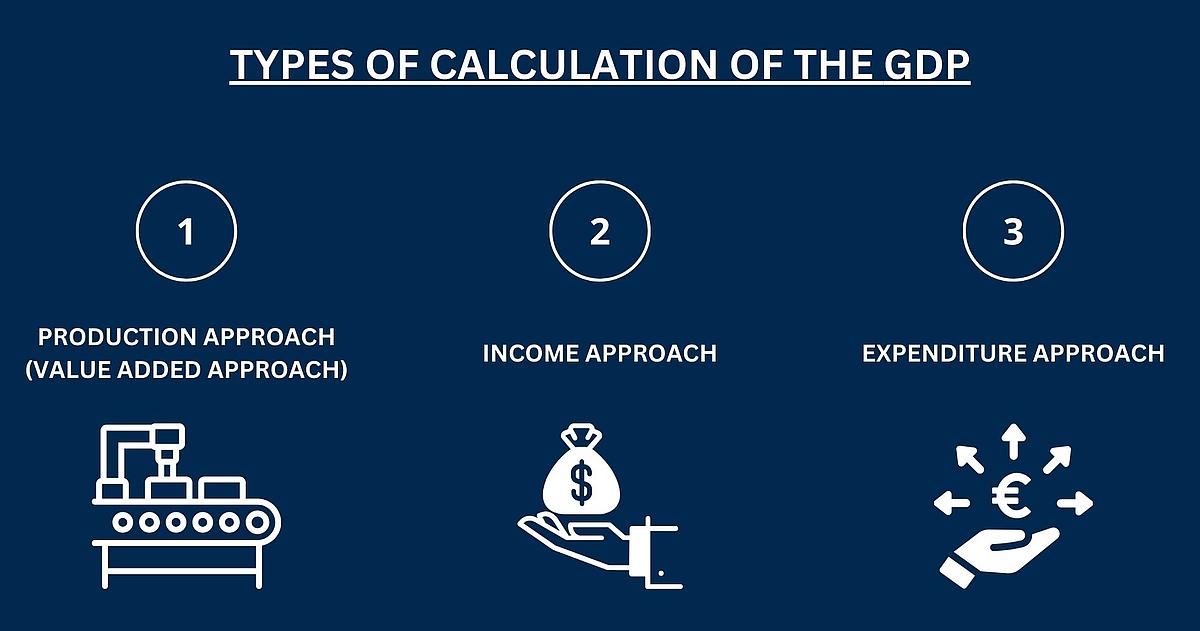
Our learning outcome is to define Gross Domestic Product (GDP) and calculate it using the expenditure approach (C+I+G+NX). This approach measures GDP by summing up the spending components we identified in the circular flow model. While there are other ways to calculate GDP, the expenditure method is the most common and provides a clear link to the economic activity of different sectors.
1. Defining Gross Domestic Product (GDP)
Before we can calculate GDP, we need a precise definition. At a high level, GDP represents the total value of everything a country produces in a year. But to measure it accurately, economists use a very specific definition.
Let's start with a video that breaks down the official definition into its core components.
GDP and the Circular Flow- Macro Topic 2.1
This clip from Jacob Clifford's popular macroeconomics series provides an excellent and memorable introduction to the concept of GDP.
Watch from 00:56 to 02:05. Pay close attention to the four key parts of the GDP definition he highlights: dollar value, final goods, produced within a country, and in one year.
As the video explained, the formal definition is: GDP is the market value of all final goods and services produced within a country in a given year.
To ensure this definition is perfectly clear, let's go through it with a more detailed textual explanation, which aligns with your interest in having textbook-style resources.
National Income Accounting - ECON 151: Macroeconomics
The following text from an introductory macroeconomics course provides a formal, in-depth explanation of the GDP definition, reinforcing what you just saw in the video.
Please read the first part of the page, from the beginning down to the heading 'Section 02: The Expenditures Approach.' As you read, focus on understanding why each part of the definition is so important.
Let's summarize the four critical components from that reading:
- Market Value: GDP is measured in a currency unit (e.g., dollars). This allows us to sum the value of vastly different things, like cars and haircuts, into a single number. We can't add 10 cars and 50 haircuts, but we can add their dollar values.
- Final Goods and Services: GDP only includes the value of the final product. It excludes intermediate goods—goods used in the production process—to avoid double-counting. For example, we count the price of a new car, but not the value of the steel and tires that were used to build it (their value is already included in the car's final price).
- Produced Within a Country: GDP measures all production that occurs within a nation's geographical borders, regardless of who owns the company. A car produced in a Toyota factory in Kentucky is part of U.S. GDP. A car produced in a Ford factory in Mexico is part of Mexico's GDP.
- In a Given Year: GDP is a measure of current production. It only includes goods and services produced during a specific time period, usually a quarter or a year. The sale of a used car produced in 2020 does not count towards 2024's GDP because its value was already counted in 2020.
2. The Expenditure Approach: GDP = C + I + G + NX
Now that we have a solid definition, how do we calculate GDP? The expenditure approach does so by answering the question: "Who is buying all the stuff we produce?" As we saw in the circular flow model, there are four main groups of spenders: households, firms, the government, and the rest of the world.
The expenditure approach sums up the spending from these four groups. Given your background, you can think of this as a simple but powerful accounting identity. The formula is:
GDP = C + I + G + NX
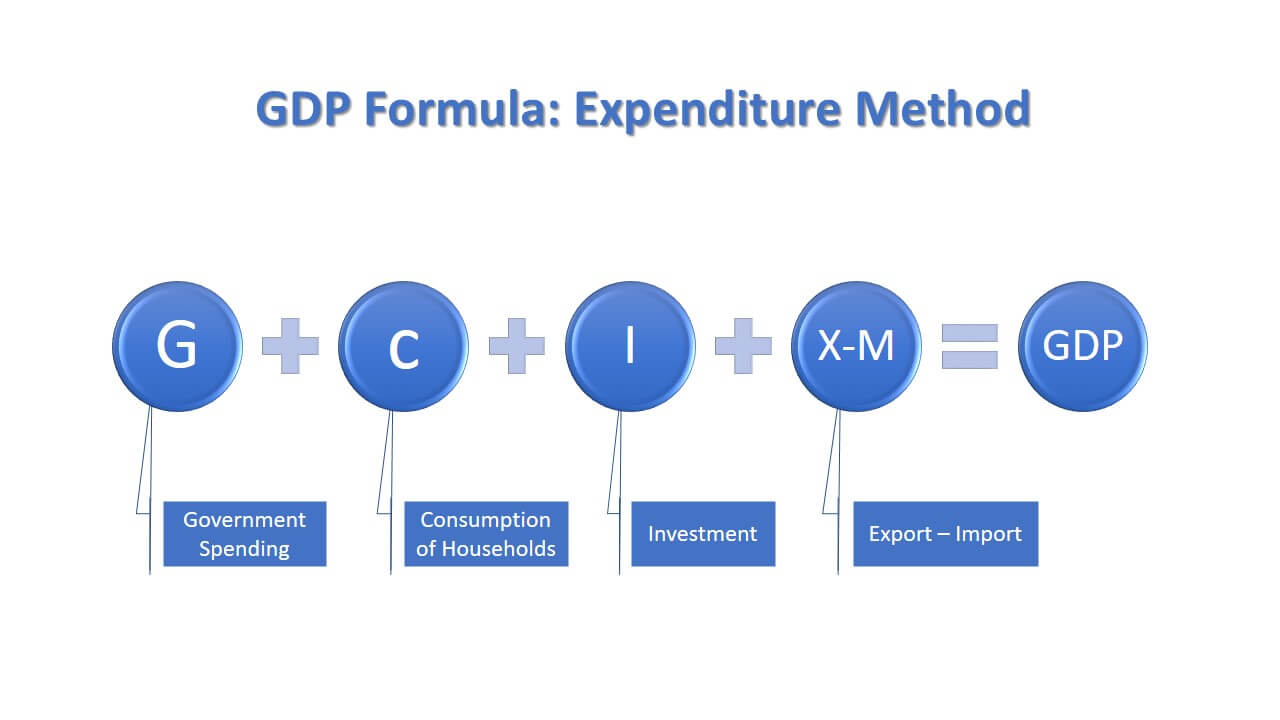
Let's define each variable and, crucially, clarify what is and is not included in each category.
-
C is for Consumption: This is the largest component of GDP. It represents all spending by households on goods (e.g., food, cars, computers) and services (e.g., haircuts, medical care, tuition).
-
I is for Investment: This category is more specific than its everyday meaning. In economics, "investment" refers to spending on capital goods that will be used to produce other goods and services in the future. It includes:
- Business fixed investment: Firms spending on new factories, machinery, and equipment.
- Residential fixed investment: Households spending on new housing.
- Changes in inventories: The value of goods that were produced but not sold in a given year.
- Crucially, this does not include financial investments like buying stocks or bonds. These are considered transfers of assets, not production of new goods.
-
G is for Government Purchases: This includes all spending by federal, state, and local governments on goods (e.g., military hardware, new roads) and services (e.g., the salaries of public school teachers and police officers).
- Crucially, this does not include transfer payments. These are payments for which the government receives no good or service in return, such as Social Security benefits or unemployment insurance. These payments are counted in "C" when the recipients spend them.
-
NX is for Net Exports: This accounts for trade with other countries. It is calculated as Exports minus Imports (X - M).
- Exports (X) are goods and services produced domestically and sold to foreigners. We add these because they represent domestic production.
- Imports (M) are goods and services produced abroad and purchased by domestic consumers, firms, or government. We subtract these because while they are part of C, I, or G, they were not produced domestically.
The following video provides excellent, clear examples to help solidify your understanding of these components, especially the common points of confusion around 'I' and 'G'.
Expenditure approach to calculating GDP examples | AP Macroeconomics | Khan Academy
This Khan Academy video works through several practical scenarios to illustrate how different transactions are categorized within the GDP expenditure formula. It's particularly useful for understanding the nuances of Investment, Government Spending, and Net Exports.
Watch the entire video (00:00 - 08:05). Pay special attention to the explanations for why buying stocks is not 'Investment' and why Social Security payments are not 'Government Purchases'. These are key distinctions.
3. Putting It All Together: A Calculation Example
Now, let's apply the formula to a set of data. This exercise will move us from the conceptual to the quantitative, which should feel familiar given your analytical background.
Please return to the "National Income Accounting" resource we looked at earlier. This time, we'll focus on the section with a worked example.
National Income Accounting - ECON 151: Macroeconomics
This resource provides a clear example of calculating GDP using a table of national income data, followed by a practice problem for you to solve.
Read 'Section 02: The Expenditures Approach.' First, study the 'Example' where GDP is calculated from hypothetical data. Notice how they identify C, I, G, and NX from the list. Then, use the same method to solve the 'Think About It: Calculating GDP with the Expenditures Approach' problem using the 2009 data provided.
Let's check your work for the practice problem. The goal is to find C, I, G, and NX in the table and sum them up.
- Household Consumption (C) = $10,001.30
- Investment Expenditures (I) = $1,589.20
- Government Expenditures (G) = $2,914.90
- Net Exports (NX) = -$386.40
GDP = C + I + G + NX = $10,001.30 + $1,589.20 + $2,914.90 + (-$386.40) = $14,119 (in billions).
Notice that many items in the table, like "Wages" and "Corporate Profits," were not used. These are components of the income approach to calculating GDP, which we will discuss in the next lesson.
Conclusion
In this lesson, we have moved from the conceptual map of the circular flow to a concrete tool for measuring the economy. We established a precise definition of GDP and mastered the most common method for calculating it.
Key Takeaways:
- Gross Domestic Product (GDP) is the market value of all final goods and services produced within a country's borders in a given year.
- The expenditure approach calculates GDP by summing the four categories of spending: GDP = C + I + G + NX.
- Consumption (C) is household spending, but not on new houses.
- Investment (I) is primarily business spending on capital and household spending on new housing. It does not include financial assets.
- Government Purchases (G) are for goods and services. It does not include transfer payments.
- Net Exports (NX) is the value of exports minus the value of imports.
Understanding the components of GDP is not just an academic exercise. It allows economists and policymakers to analyze the drivers of economic growth and diagnose the sources of economic weakness.
Preview of the Next Lesson:
The expenditure approach is just one way to calculate GDP. As the circular flow model implies, total spending must equal total income. In our next lesson, we will explore the income approach, which calculates GDP by summing up all the income earned in the economy (wages, rent, interest, and profit). This will provide an alternative perspective on the same fundamental measure of economic activity.