Recommended resources
The freely available resources this lesson will direct you to.
Welcome back. In our last lesson, we constructed a comprehensive checklist for the monthly and annual accounting close. This checklist acts as our master plan, ensuring no step is missed in the pursuit of accurate financial reporting.
Today, we move from planning to execution. We will perform a deep dive into one of the most critical and frequently performed tasks from that checklist: the reconciliation of sub-ledgers. This lesson directly addresses the learning outcome: to perform the reconciliation of accounts receivable and accounts payable sub-ledgers with the general ledger.
Mastering this procedure is fundamental. It ensures that the summary figures in your financial statements are backed by accurate, detailed records, which is a cornerstone of reliable accounting.
1. The Core Concept: General Ledger vs. Sub-Ledger
Imagine a company has three bank accounts. The company's total cash balance is the sum of the balances in each of those three accounts. In accounting, the General Ledger (GL) is like that total cash balance—it holds the summary for every account. A Sub-ledger is like the detailed statement for each individual bank account.
- General Ledger (
Grand-Livre): This is the main accounting record of a company. It contains all the financial accounts, but at a summary level. For example, it will have one single account called "Accounts Receivable" showing the total amount owed by all customers combined. This summary account in the GL is called a Control Account (Compte CollectiforCompte de Contrôle). - Sub-ledger (
Livre Auxiliaire): This is a detailed record of the transactions that make up the balance of a control account. There is a separate sub-ledger for each control account that requires detailed tracking. For instance, the Accounts Receivable sub-ledger contains a separate account for each individual customer, showing every invoice and payment related to them.
Why the separation? For a small business with only five customers, you could manage everything in the general ledger. But for a Moroccan SME with hundreds or thousands of customers, the GL would become impossibly cluttered. Sub-ledgers keep the GL clean and manageable while preserving the necessary detail for day-to-day operations (e.g., knowing exactly how much customer 'X' owes).
The video below explains this relationship clearly.
To start, let's watch a brief explanation from finacteduconnect on the roles of the General Ledger and Sub-ledger. This will clarify their distinct purposes and the relationship between them.
Watch the video from the beginning until 05:45. Focus on understanding why larger businesses need sub-ledgers and how they group individual accounts (like specific customers) into a single control account in the general ledger.
This diagram provides a clear visual summary of the concept. The individual sub-ledgers (for each customer or supplier) feed into their respective control accounts in the General Ledger.
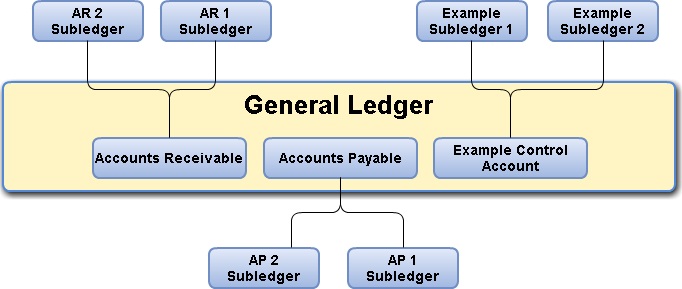
2. The Reconciliation Process: Accounts Receivable (Clients)
Reconciliation is the process of proving that the total of the sub-ledger details equals the balance of the control account in the general ledger. Let's walk through the process for Accounts Receivable (Créances Clients), using Moroccan account numbers for context. The control account is typically 411 - Clients et comptes rattachés.
The process involves four key steps:
- Generate the Sub-ledger Listing: At the end of the period (e.g., end of the month), run a report from your accounting software that lists every customer and their outstanding balance. In professional practice, this is often an A/R Aging Report (
Balance âgée clients), which also shows how long each invoice has been outstanding. - Sum the Sub-ledger Balances: Calculate the total of all the individual customer balances from the report.
- Get the General Ledger Balance: Look up the closing balance of the control account (e.g., Account 411) in the General Ledger.
- Compare and Investigate: The total from Step 2 must equal the balance from Step 3.
- If they match: The ledgers are reconciled. You have assurance that your summary A/R balance is correct.
- If they don't match: There is an error. You must investigate and find the cause of the discrepancy.
The video you just watched demonstrates this entire process with a practical example.
Now, let's see the reconciliation process in action. The same video will now walk through a complete example of posting sales and receipts to individual customer sub-ledgers and then verifying that the total matches the General Ledger control account.
Watch from 05:45 to 17:30. Pay close attention to how each transaction is first recorded in the individual customer's account (the sub-ledger) and how the final balances of all customers are summed up to match the General Ledger's 'Accounts Receivable' account balance.
Common Causes for Discrepancies
If your sub-ledger and general ledger don't match, the cause is almost always a posting error. The most common mistake is posting a journal entry that affects a customer directly to the control account (411) without specifying the individual customer sub-account. This updates the total but not the detail, immediately creating an imbalance.
3. A Practical Tool: Account Matching (Lettrage)
To keep sub-ledgers clean and make reconciliation easier, accountants use a process called lettrage (matching or clearing). This involves matching related debit and credit entries within a single customer or supplier account. For a customer, you would match a payment (credit) against the specific invoice(s) it settles (debits).
Look at the example below for a customer named 'PIERRE'.

Let's break it down:
- The initial balance of 2,500 (
Solde initial) is marked with (A). It is settled by the first payment of 2,500, also marked with (A). These two items are now "lettrées" (matched) and considered closed. - Invoice 208 (3,600) and Invoice 226 (1,400) are both marked with (B). They are settled by two payments totaling 5,000 (3,000 + 2,000), also marked with (B).
- Invoice 302 (1,800) is marked with (C) and settled by a payment of 1,800, also marked with (C).
- The only item left unmatched is Invoice 315 for 4,200. This is the final outstanding balance (
Solde débiteur).
Lettrage is a vital housekeeping task. It allows you to see precisely which invoices are unpaid at any given moment, which is essential for effective credit control and simplifies the month-end reconciliation.
4. Application to Accounts Payable (Fournisseurs)
The exact same principles and processes apply to Accounts Payable (Dettes Fournisseurs).
- Control Account: The GL control account is typically 441 - Fournisseurs et comptes rattachés. It shows the total amount your company owes to all its suppliers.
- Sub-ledger: The A/P sub-ledger contains a separate account for each supplier, detailing every invoice received from them and every payment made to them.
- Reconciliation: The process is identical. You sum the balances of all individual supplier accounts in the sub-ledger, and this total must equal the balance in the GL control account (441).
Lettrage: This process is also used to match your company's payments (debits) against specific supplier invoices (credits).
The main difference is the nature of the balances. For A/R, the balance is a debit (an asset). For A/P, the balance is a credit (a liability).
Test your understanding!
You are closing the books for a Moroccan SME. The General Ledger shows a balance of 250,000 MAD in account 441 - Fournisseurs et comptes rattachés.
You run the Accounts Payable sub-ledger report, which shows the following outstanding balances:
- Supplier Alpha: 120,000 MAD
- Supplier Beta: 85,000 MAD
- Supplier Gamma: 40,000 MAD
- Are the ledgers reconciled?
- What is the amount of the discrepancy?
- What is the most likely cause of this discrepancy?
Show answer
- No, the ledgers are not reconciled.
- The total of the sub-ledger is 120,000 + 85,000 + 40,000 = 245,000 MAD. The General Ledger balance is 250,000 MAD. The discrepancy is 5,000 MAD.
- The most likely cause is that a journal entry for 5,000 MAD was posted directly to the control account (441) without being assigned to a specific supplier in the sub-ledger. This could be, for example, a bank fee related to a foreign supplier payment that was incorrectly coded, or a manual adjustment that wasn't properly recorded at the sub-ledger level.
Conclusion
You have now learned how to perform one of the most essential internal control procedures in accounting. This process is not just a mechanical check; it is a fundamental verification that connects the detailed, day-to-day transactions with the high-level summaries used for financial reporting and decision-making.
Key Takeaways:
- The General Ledger contains summary control accounts, while Sub-ledgers hold the transaction-level details for specific areas like customers (
Clients) and suppliers (Fournisseurs). - Reconciliation is the process of proving that the sum of the balances in a sub-ledger equals the balance of its corresponding control account in the general ledger.
- The reconciliation process is a simple four-step cycle: generate the sub-ledger list, sum the balances, get the GL balance, and compare.
Lettrage(matching) is a practical technique used within sub-ledgers to clear settled items and easily identify what remains outstanding.- The same principles of reconciliation apply to both Accounts Receivable and Accounts Payable.
Preview of the Next Lesson:
With our primary balance sheet accounts reconciled, we will continue down our closing checklist. The next lesson will focus on another critical part of Phase 2 (Reconciliations and Adjustments): "Review and finalize all period-end adjusting entries for accruals, prepayments, and provisions." We will explore how to apply the matching principle to correctly recognize revenues and expenses in the proper period.