Recommended resources
The freely available resources this lesson will direct you to.
Hello! Welcome to our lesson on one of the most striking applications of the WKB approximation: quantum tunneling.
In our last session, we developed the core WKB machinery. We learned how to write down approximate wavefunctions for slowly varying potentials and, crucially, how to use connection formulae involving the Airy function to bridge the gap across classical turning points where the approximation naively fails.
Today, we will put this machinery to work. Our objective is to calculate tunneling probabilities through potential barriers using the WKB approximation. We'll first derive the general formula for the transmission coefficient and then explore two profound physical applications: the alpha decay of nuclei and the field emission of electrons from a metal—a topic directly relevant to your interest in condensed matter physics.
1. Tunneling Through a Potential Barrier
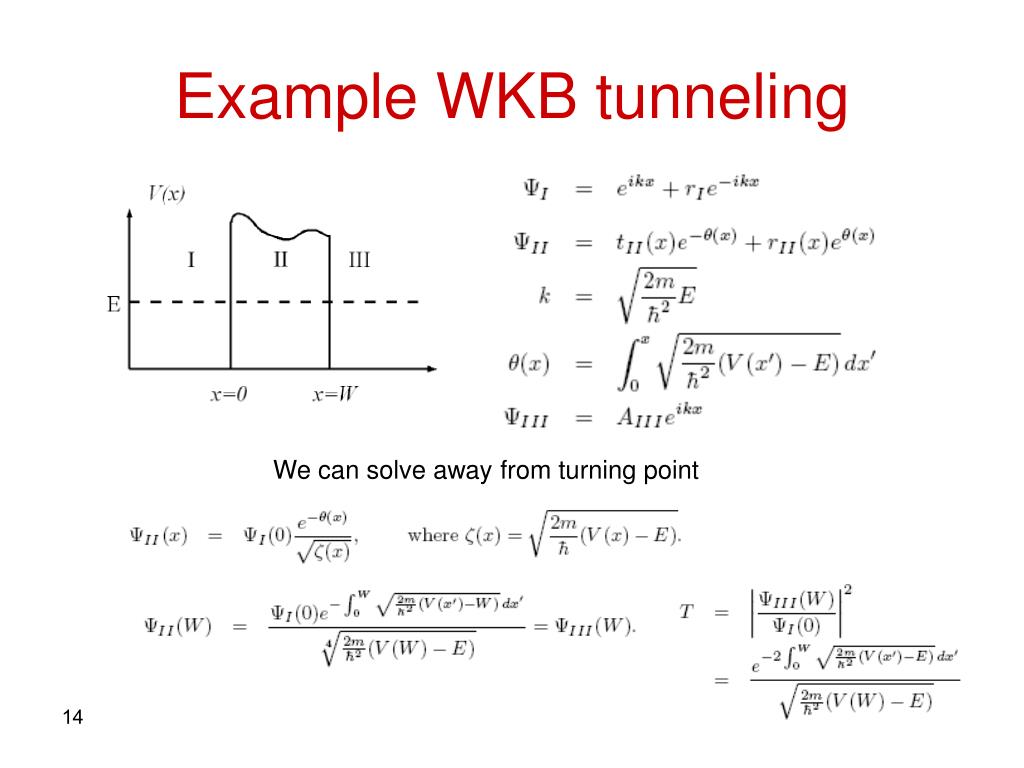
Imagine a particle with energy incident from the left on a potential barrier that is taller than . Classically, the particle can never pass. Quantum mechanically, there's a non-zero probability of finding the particle on the other side. Our goal is to calculate this probability.
The potential barrier defines three regions:
- Region I (): Classically allowed. We have an incident and a reflected wave.
- Region II (): Classically forbidden. Here . and are the classical turning points.
- Region III (): Classically allowed. We have only a transmitted wave.
The WKB wavefunctions in these regions are:
- Region I:
- Region II:
- Region III:
Here, and .
A full derivation would involve applying the connection formulae at both and to relate to . However, in the limit of low tunneling probability (i.e., a "thick" or "high" barrier), we can use a very effective shortcut. The amplitude of the wavefunction decays exponentially across the forbidden region.
The core idea is that the amplitude of the wavefunction at the exit point is suppressed relative to its amplitude at the entry point by an exponential factor determined by the integral of across the barrier.
The transmission probability, or transmission coefficient , is the ratio of the transmitted probability current to the incident probability current. For potentials that are constant far from the barrier, this simplifies to . The result of the WKB analysis is that this ratio is dominated by an exponential decay factor.
The following section from David Tong's notes offers a clear and physically motivated derivation of the tunneling probability. It focuses on how the wavefunction's amplitude is suppressed across the barrier, leading directly to the transmission coefficient.
Please read the subsection 'Tunnelling out of a Trap' (pages 46-48). While it's framed as tunneling out of a trap, the core physics is identical to tunneling through a barrier. Focus on how equations (2.29) and (2.30) are established. The key result is that the transmission probability T is given by an exponential factor involving the integral of the imaginary momentum across the forbidden region.
As the reading shows, the transmission coefficient is given by:
where is the integral of the magnitude of the imaginary momentum across the classically forbidden region:
This gives us the celebrated WKB tunneling formula:
This exponential dependence makes the tunneling probability extremely sensitive to the energy and the shape of the barrier .
2. Application 1: Alpha Decay of Nuclei
One of the first great triumphs of quantum mechanics was explaining alpha decay. Certain heavy nuclei, like Uranium-238, decay by emitting an alpha particle (a Helium nucleus). The puzzle was that the kinetic energy of the emitted alpha particles (around 4 MeV) was much lower than the height of the Coulomb barrier holding them in the nucleus (around 30-40 MeV). Classically, this is impossible. George Gamow proposed in 1928 that the alpha particle was quantum tunneling through the Coulomb barrier.
Let's watch a video that sets up this problem beautifully.
Gamow's Theory of Alpha Decay AND Geiger Nuttal Law
This video from 'For the Love of Physics' explains the classical paradox of alpha decay and introduces quantum tunneling as the only possible explanation. It provides the essential physical context for our calculation.
Please watch from 2:50 to 9:34. This segment will introduce the nuclear potential, highlight the energy discrepancy that puzzled physicists, and explain qualitatively how quantum tunneling resolves the paradox.
Now let's apply our WKB formula. We can model the potential seen by the alpha particle as:
- An attractive, deep, and narrow square well representing the strong nuclear force inside the nucleus (radius ).
- A repulsive Coulomb potential outside the nucleus: , where is the charge of the daughter nucleus.
An alpha particle with energy is trapped. The turning points are at (the nuclear radius) and where , so .
The transmission probability for a single "attempt" is given by our WKB formula:
This integral can be solved analytically. The lifetime of the nucleus is related to this probability. If the alpha particle has velocity inside the nucleus of radius , it hits the barrier with a frequency . The decay rate is then the frequency of attempts multiplied by the probability of success: .
The crucial physics is in the exponent. The calculation shows that . This means that nuclei emitting higher-energy alpha particles have drastically shorter lifetimes, a relationship known as the Geiger-Nuttall law, which was experimentally observed long before it was theoretically explained.
3. Application 2: Field Emission from a Metal
This application is central to many areas of condensed matter and surface science. Electrons in a metal are bound within a potential well. The energy required to remove the most energetic electron (at the Fermi level ) is called the work function, .
If we apply a strong external electric field pointing away from the metal surface, the potential outside the metal () is modified. The potential becomes . This creates a triangular potential barrier. An electron at the Fermi energy now has a chance to tunnel through this barrier and escape the metal. This process is called field emission or cold emission.
These lecture notes provide a clear derivation of the tunneling probability for field emission, an excellent condensed matter physics application of the WKB method.
Please read the section 'Field Emission (aka Cold Emission)' on pages 6-7. Follow the calculation where the WKB tunneling formula is applied to the triangular potential barrier created by the external electric field.
As shown in the notes, the electron at the Fermi energy sees a barrier .
The turning points are and . We can now apply the WKB formula:
The integral evaluates to:
Plugging this in gives the tunneling probability:
The emitted electron current is proportional to this probability, leading to the Fowler-Nordheim equation, which shows that the logarithm of the current is inversely proportional to the applied electric field: . This result is fundamental to technologies like scanning tunneling microscopy (STM) and modern flat-panel displays.
Test your understanding!
Consider a particle of energy incident on a symmetric, parabolic potential barrier given by for , and elsewhere.
Set up the integral needed to find the WKB tunneling probability. You don't need to solve the integral, just determine the limits of integration and the integrand.
Show answer
First, we need to find the classical turning points and where .
Since , we solve . This gives , so the turning points are and .
Next, we need the integrand, .
With , this is .
Therefore, the integral is:
(This integral can be solved and equals ).
Conclusion
In this lesson, we have seen the practical power of the WKB approximation by applying it to the phenomenon of quantum tunneling.
Key Takeaways:
- The probability of a particle tunneling through a classically forbidden region is given by the WKB formula: .
- The tunneling probability is exponentially sensitive to the barrier's width, height, and shape, as well as the particle's mass and energy.
- This single formula provides a quantitative explanation for diverse physical phenomena, including the alpha decay of nuclei (Gamow theory) and the field emission of electrons from metals (Fowler-Nordheim theory).
Preview of the Next Lesson:
We have now used the WKB method for tunneling, which involves unbound states. In our next lesson, we will turn to the other major application of WKB: finding the approximate energy levels of bound states in a potential well. We will use the connection formulae in a new way to derive the famous Bohr-Sommerfeld quantization condition.