Recommended resources
The freely available resources this lesson will direct you to.
Hello! Welcome to your third lesson.
In our previous lesson, we analyzed how composers for the Sega Genesis cleverly combined the YM2612 FM chip and the SN76489 PSG to create a hybrid soundscape, expanding polyphony and timbral range. We looked at this from a high-level, architectural perspective.
Today, we will zoom in on the YM2612 itself. Our goal is to address the learning outcome: Deconstruct the operator configurations of 2-3 common FM patch archetypes from early Genesis titles (e.g., brass, bass, strings).
We'll move from the "what" (the hardware components) to the "how" (the synthesis techniques). You'll learn how the fundamental building blocks of FM synthesis—operators and algorithms—are manipulated to create the specific instrument sounds, or "patches," that define the Genesis's sonic palette. Given your background in modeling physical systems, you might find the process of building a sound from sine waves and mathematical relationships quite intuitive.
This lesson will provide the foundational knowledge of sound design necessary to appreciate the specific artistic and technical choices made by the composers we'll study in later modules.
1. The Building Blocks: A Quick Refresher
Before we start building sounds, let's briefly revisit the core components of YM2612 synthesis.
- Operator: The most basic unit. Think of it as a sine wave generator with its own dedicated envelope generator (EG).
- Carrier vs. Modulator: An operator can be a carrier, meaning its output is audible, or a modulator, meaning its output alters the frequency (and thus, the timbre) of another operator.
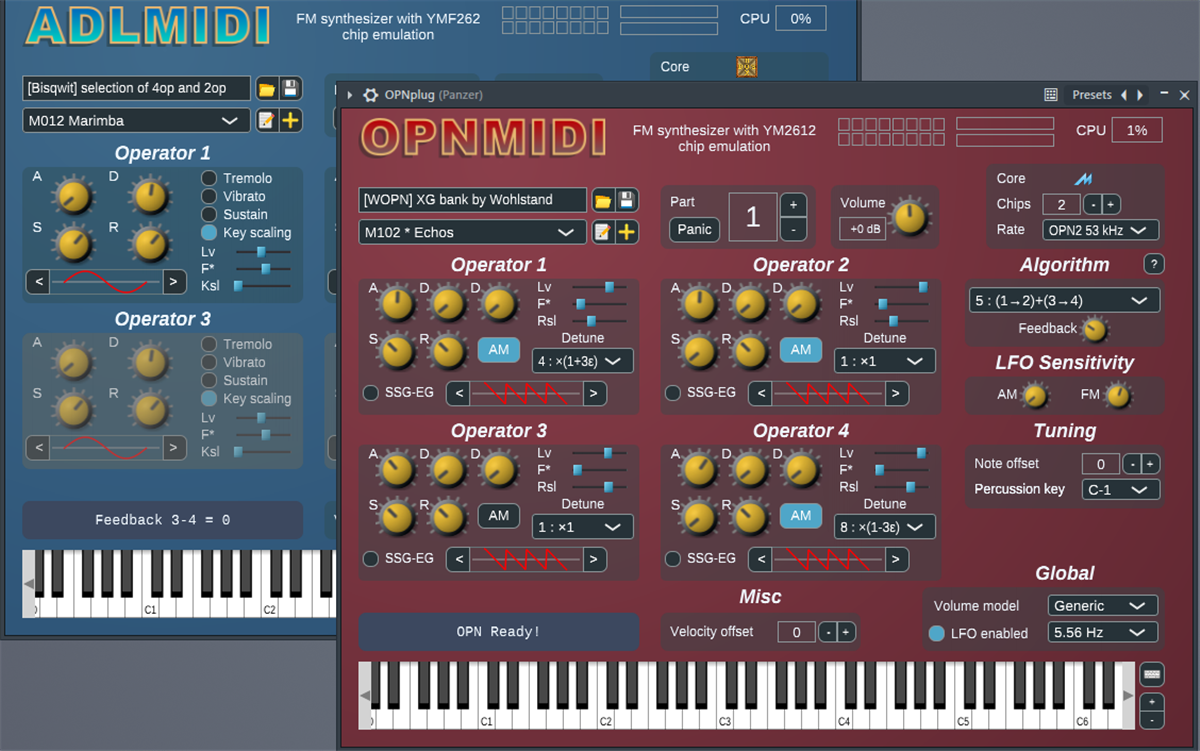
- Algorithm: A fixed configuration that determines how the four operators in a channel are connected—which are carriers, which are modulators, and what modulates what.
To see the official layout of these components, it's useful to consult the original technical documentation.
Sega Genesis Technical Manual - YM2612 section
This document, based on the official YM2612 manual, provides the definitive diagrams of the eight available algorithms. It's the blueprint from which all Genesis FM sounds are built.
Please review the section 'A little bit about operators' and focus on the diagrams for Algorithms 0 through 7. The shaded boxes represent 'slots' or carriers—the operators that produce the final audible sound.
Each of those eight algorithms offers a different starting point for sound design. A "tall" stack like Algorithm 0 is ideal for creating complex, harmonically rich sounds, while a "wide" parallel structure like Algorithm 7 is essentially four independent sine wave generators, perfect for additive synthesis or layered sounds.
2. Archetype 1: The FM Bass
A punchy, clear bass sound is a cornerstone of many early Genesis tracks. Let's deconstruct how one is made. The process involves thinking about the sound's acoustic properties and then translating them into FM parameters.
To see this process in action, we'll watch a tutorial on creating an FM bass patch. While the video uses a Yamaha DX11 synthesizer, its 4-operator architecture is directly analogous to a single channel on the YM2612.
This video from Synthesizer Keith provides an exceptionally clear, methodical walkthrough of designing an FM bass patch from first principles. It's a masterclass in the engineering approach to sound design.
Please watch from 01:08 to 08:09. Pay close attention to how the desired sound is first broken down into conceptual layers ('pop', 'resonant', 'decay') and how this conceptual model is then mapped onto a specific operator algorithm (Algorithm 5).
As you saw, the process is highly structured:
- Conceptualization: The sound is broken into components: an initial percussive
pop, a strong but fastresonance, a sustainedring, and a finaldecay. - Algorithm Selection: These components are mapped to operator stacks. The
popandresonanceneed complex harmonics, suggesting a modulator-carrier pair, possibly with feedback. Theringanddecaycan be simpler. By combining and simplifying these needs to fit within four operators, we arrive at Algorithm 5.

Let's deconstruct the patch using the YM2612's parameters:
- Algorithm 5: Two parallel stacks (OP1 modulated by OP2; OP3 modulated by OP4). This is excellent for a bass sound because one stack can provide the percussive attack while the other provides the sustained body, and they can be mixed.
- The "Body" Stack (OP2 -> OP1):
- OP1 (Carrier): This operator's envelope defines the bass note's overall shape. It needs a very fast Attack Rate (AR), a quick first Decay Rate (D1R) to a moderate sustain level, and a relatively fast Release Rate (RR). Its Frequency Multiplier (MUL) is typically set to 1 or 0 (for 0.5x, an octave down) to produce the fundamental pitch.
- OP2 (Modulator): This operator adds harmonic content. Its Total Level (TL) determines how "rich" or "buzzy" the bass sounds. Its frequency ratio relative to the carrier is key; a simple integer MUL (like 2 or 3) keeps the sound harmonically clean.
- The "Pluck" Stack (OP4 -> OP3):
- OP3 (Carrier): This operator contributes to the overall sound, often adding a higher-frequency component to help the bass cut through a mix.
- OP4 (Modulator with Feedback): This is the secret to the "pluck" or "pop." By setting the channel's Feedback (FB) level, OP4 modulates itself, creating a noisy, sawtooth-like waveform. Its envelope is set to be extremely fast—a quick burst of noise at the very beginning of the note. Its TL controls the intensity of this effect.
By carefully balancing the envelopes and Total Levels of these four operators, composers could craft a wide variety of bass tones, from soft and round to aggressive and gritty.
3. Archetype 2: The FM Brass
Brass sounds were a staple of arcade and console fanfares. Replicating their bright, complex harmonic structure is a classic application of FM synthesis.
- Algorithm Selection: A "tall" stack is ideal here. Let's use Algorithm 0 (OP1 -> OP2 -> OP3 -> OP4). In this configuration, each operator progressively adds harmonic complexity, culminating in a rich timbre from the single carrier, OP4.
- Deconstruction:
- OP4 (Carrier): The envelope will mimic a brass instrument: a fast AR, a slow decay (D1R/D2R) to a high sustain level, and a moderate RR.
- OP1, OP2, OP3 (Modulators): This is where the magic happens. The timbre of the brass is defined by the frequency ratios and output levels of this stack.
- Frequency (MUL): To create the characteristic "brassy" tone, composers often used non-integer frequency relationships. However, on the YM2612 with its integer multipliers, they would set up a stack of simple integer ratios (e.g., OP1=4, OP2=2, OP3=1) to generate a rich set of harmonics. The
DefleMask Instrument Tutorialvideo (ID: 5c3e7) demonstrates this principle of stacking multipliers for brightness in its analysis of Algorithm 1 (part 3, from 24:20). - Envelopes & Levels (TL): A common technique is to have the modulators' envelopes decay faster than the carrier's. This creates a sound that is very bright and harmonically complex at the beginning (the "blast") but mellows out into a more simple, sustained tone. The TL of the top-most modulators (OP1, OP2) has a dramatic effect on the overall brightness.
- Frequency (MUL): To create the characteristic "brassy" tone, composers often used non-integer frequency relationships. However, on the YM2612 with its integer multipliers, they would set up a stack of simple integer ratios (e.g., OP1=4, OP2=2, OP3=1) to generate a rich set of harmonics. The
- Feedback (FB on OP1): Adding a small amount of feedback can introduce a saw-like grit at the base of the modulation chain, further enhancing the aggressive attack of the brass sound.
4. Archetype 3: The FM String/Pad
Creating a wide, shimmering string ensemble or atmospheric pad requires a different approach. Instead of a complex stack, the goal is to create a sense of multiple instruments playing together.
- Algorithm Selection: A parallel algorithm is best. Algorithm 3 (OP1 -> OP2, plus OP3 and OP4 as separate carriers) is a good choice. It gives us three independent sound sources to work with (the OP1->OP2 stack, OP3, and OP4).
- Deconstruction:
- The Chorus Effect: The key to a string patch is simulating multiple instruments. This is achieved by having the three carrier outputs (OP2, OP3, OP4) play the same fundamental pitch but slightly out of tune with each other.
- Frequency (MUL & DT1): All three carriers would have the same MUL value (e.g., 2). Then, the Detune (DT1) parameter is used to shift their pitches slightly. For example, OP2 might be detuned by -1, OP3 by 0, and OP4 by +2. This subtle pitch variation creates a rich, shimmering "chorus" effect.
- Envelopes: String and pad sounds need to "swell" and linger.
- AR: A slower Attack Rate creates a gentle fade-in.
- RR: A long Release Rate allows the sound to fade out slowly after the key is released.
- Sustain: A high sustain level (or very slow D2R) ensures the note is held.
- LFO Modulation: To add life and movement, the Low-Frequency Oscillator (LFO) is essential. By enabling Amplitude Modulation Sensitivity (AMS) for the channel, a slow LFO can create a gentle, periodic change in volume (tremolo), mimicking the natural volume fluctuations of a string section.
- The Chorus Effect: The key to a string patch is simulating multiple instruments. This is achieved by having the three carrier outputs (OP2, OP3, OP4) play the same fundamental pitch but slightly out of tune with each other.
Conclusion
Today, we've moved beyond the hardware and into the art of sound design on the YM2612. By manipulating a handful of parameters across four operators, composers could construct a vast array of timbres from scratch.
Key Takeaways:
- FM patch design is a systematic process of selecting an algorithm and configuring each operator's parameters (Frequency, Envelope, Level, Feedback).
- Bass patches often use parallel algorithms (like 5) with fast envelopes and feedback on a modulator to create a percussive attack.
- Brass patches typically use stacked algorithms (like 0) with specific modulator frequency ratios to generate a bright, harmonically dense sound that mellows over time.
- String/Pad patches leverage parallel algorithms (like 3), using detuned carriers to create a wide chorus effect, complemented by slow envelopes and LFO modulation for movement.
Preview of the Next Lesson
Now that you understand how these fundamental sound archetypes are constructed, we can begin to analyze their use in practice. In our next lesson, we will do a case study on Tokuhiko Uwabo's sound design in early Sonic titles, examining how he used these very techniques not just for music, but for iconic sound effects like collecting rings and jumping, thereby establishing a sonic identity for the entire franchise.