Recommended resources
The freely available resources this lesson will direct you to.
- How Sound Works on the Sega Genesis and Mega Drive | Genesis Music Tutorial part 0www.youtube.com
- This is Why Sega Mega Drive/Genesis Music was Incrediblewww.youtube.com
- Mega Drive / Genesis Architecture | A Practical Analysiswww.copetti.org
- Sega Genesis Technical Manual - YM2612 sectionwww.smspower.org
Hello! Welcome back to your second lesson on the music of the Sega Genesis.
In our previous lesson, we explored the significant challenges Japanese composers faced when moving from powerful arcade hardware to the more constrained Genesis. We saw that they had to contend with fewer FM channels, a difficult, programming-heavy workflow, and often-opaque hardware documentation.
Today, we'll focus on one of the key creative solutions to these hardware constraints. This lesson addresses the learning outcome: Analyze how composers combined the YM2612 FM channels and the SN76489 PSG to create early Genesis soundscapes.
We will examine the Genesis's hybrid sound architecture, looking at the distinct capabilities of its two sound chips and, most importantly, the strategies composers used to blend them into a cohesive and iconic whole.
1. A Tale of Two Chips
The Genesis sound system is not a single entity but a partnership between two very different pieces of silicon. Understanding their individual strengths and weaknesses is the first step to analyzing how they were used together.
To get a comprehensive overview of both chips, please watch the following segments from the video "How Sound Works on the Sega Genesis and Mega Drive".
How Sound Works on the Sega Genesis and Mega Drive | Genesis Music Tutorial part 0
This video by Inglebard Gaming provides an excellent breakdown of the Genesis's sound hardware. These sections detail the capabilities of the YM2612 FM chip and the SN76489 PSG chip.
Please watch the segment on the YM2612 from 03:28 to 07:18, and the segment on the SN76489 from 12:53 to 16:39. As you watch, focus on the fundamental differences in how each chip produces sound and the character of that sound.
As the video explains, we have two distinct sound sources:
-
The Yamaha YM2612: This is the heart of the Genesis sound. It's a powerful FM (Frequency Modulation) synthesizer with six channels, stereo output, and the ability to create complex, evolving timbres. As someone with a background in physics and modeling, you might find the concept of FM synthesis interesting—it involves using one waveform (a modulator) to alter the frequency of another (a carrier), resulting in a harmonically rich and complex final waveform. This is what gives the YM2612 its versatility.
-
The Texas Instruments SN76489: This is a much simpler PSG (Programmable Sound Generator). It was included primarily for backward compatibility with the Sega Master System. It provides three square wave channels and one noise channel. Its output is mono, and its timbral range is very limited compared to the YM2612. It produces the raw, "chiptune" sounds characteristic of 8-bit era consoles.
To add a layer of technical detail, the following article provides a concise architectural summary of both chips.
Mega Drive / Genesis Architecture | A Practical Analysis
The article 'Mega Drive / Genesis Architecture' by Copetti.org offers a more technical, written summary of the hardware we've just seen in the video.
Please read the sections titled 'Yamaha YM2612' and 'Texas Instruments SN76489'. Note the description of FM synthesis using 'operators' and the PSG's simple pulse and noise wave generation.
2. The Art of Combination
Having two separate sound chips is one thing; making them work together effectively is another. Composers quickly learned to treat the Genesis not as a 6-channel FM synth, but as a 10-channel hybrid instrument.
Architectural Integration
First, let's look at how this is possible at a hardware and software level. The signals from both chips are not independent; they are explicitly combined before being sent to the audio output.
Mega Drive / Genesis Architecture | A Practical Analysis
This brief section from the same Copetti.org article explains the final step in the audio signal path.
Read the short sections titled 'Mixed' and 'The conductor'. This explains how the signals are physically mixed and how the Z80 CPU orchestrates both chips.
As the article notes, an Audio Mixer component combines the analog signals from both the YM2612 and the SN76489. This entire process is typically managed by a program running on the secondary Z80 CPU, which acts as a "conductor" or sequencer, sending the correct musical data to each chip at the right time.
Creative Strategies
This hybrid architecture gave composers two primary advantages, which they used to overcome the limitations we discussed in the last lesson:
-
Increased Polyphony: The most straightforward benefit is a larger note count. Instead of just 6 FM channels, composers had a total of 10 channels (6 FM + 4 PSG) to work with. This was a significant asset for creating fuller arrangements with distinct melodic, harmonic, and rhythmic parts. The video you watched earlier concludes with this exact point.
-
Timbral Layering and Specialization: This is the more artistic advantage. The distinct sonic characters of the two chips allowed for powerful layering techniques and role specialization. A common approach in early Genesis soundtracks was to assign specific musical roles to each chip based on its strengths:
- YM2612 (FM Channels): Used for sounds requiring timbral complexity and expression. This included main melodies, intricate pads, realistic-ish instrument emulations (like brass or electric piano), and complex synthesized percussion.
- SN76489 (PSG Channels):
- Square Waves: Their simple, raw, and "buzzy" quality was perfect for punchy basslines, simple counter-melodies, or fast arpeggios that could cut through the mix. Using the PSG for the bassline was a particularly common and effective trick, as it freed up a precious, powerful FM channel for more complex duties.
- Noise Channel: This was the workhorse for percussive sounds that are difficult or "expensive" (in terms of channel usage) to create with FM synthesis, such as snares, hi-hats, and cymbals.
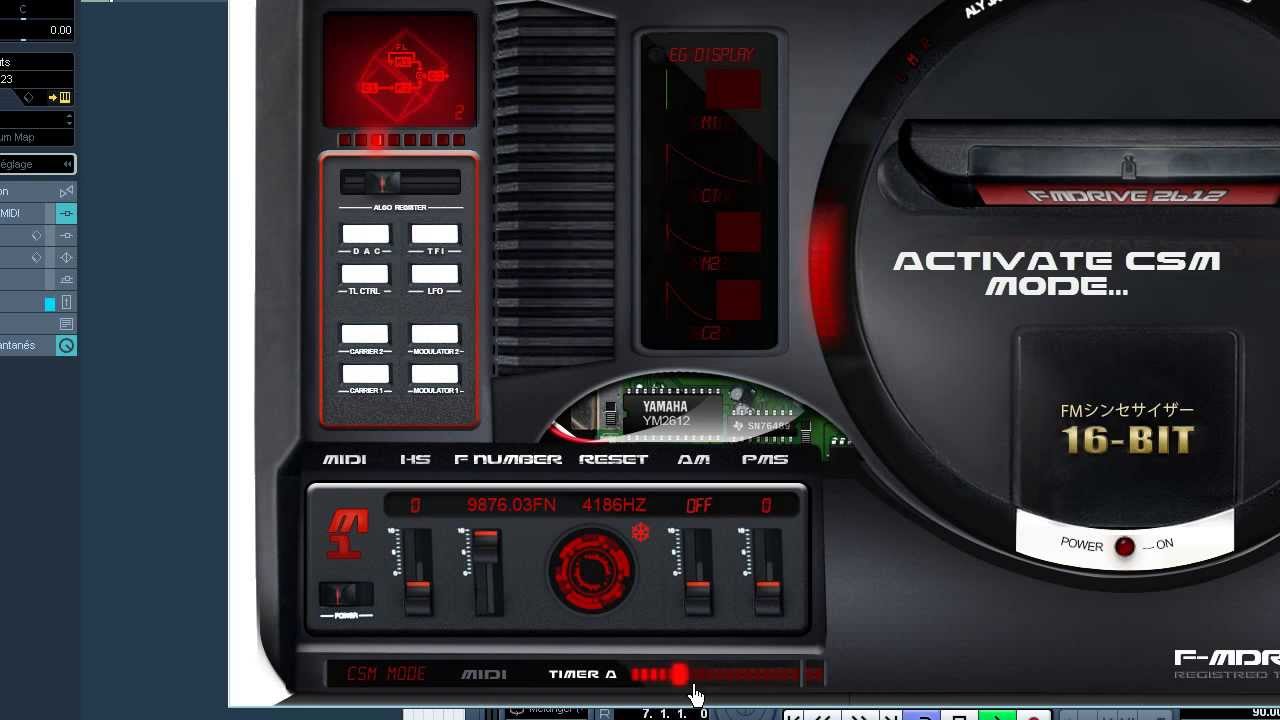
The image below shows the interface of a modern software synthesizer that emulates the Genesis hardware. Notice how it provides controls for both the 6 FM channels and the 4 PSG channels in a single unified view, reflecting how a composer would have approached the system.
3. Early Soundscapes in Practice: Sonic the Hedgehog (1991)
Let's analyze how these principles were applied in one of the most iconic early Genesis soundtracks: Masato Nakamura's score for Sonic the Hedgehog. Listen to the music for the "Green Hill Zone" stage and try to identify the different sonic layers.
Even without isolating the tracks, you can hear the division of labor:
- Main Melody (YM2612): The bright, catchy lead melody is a complex FM patch. It has a distinct attack and a rich harmonic character that would be impossible to create on the PSG.
- Bassline (SN76489): The driving, rhythmic bassline that underpins the track is a classic PSG square wave. It's simple, punchy, and does its job perfectly without consuming a valuable FM channel.
- Harmonies (YM2612): The sustained chords that provide the harmonic foundation are played on several FM channels.
- Percussion (A Hybrid Approach):
- The kick drum has a tonal quality, suggesting it's an FM-synthesized sound.
- The sharp, noisy "snap" of the snare drum is a textbook use of the PSG's noise channel.
- The main drum kit sounds are often augmented by a crunchy, low-fidelity drum sample played back via the YM2612's 6th channel in DAC mode.
This strategic combination is the key to the track's sound. The YM2612 provides the melodic and harmonic richness, while the SN76489 provides the solid, rhythmic foundation and percussive texture, creating a soundscape far greater than the sum of its parts.
Conclusion
Today we've seen how early Genesis composers turned a hardware constraint into a creative advantage. By treating the YM2612 and SN76489 not as separate entities but as a single, 10-channel hybrid synthesizer, they were able to craft rich and memorable soundscapes.
Key Takeaways:
- The Genesis sound system combines the six-channel Yamaha YM2612 (FM) synthesizer with the four-channel Texas Instruments SN76489 (PSG).
- An onboard audio mixer physically combines the signals from both chips, orchestrated by the Z80 CPU.
- Composers leveraged this hybrid system to increase polyphony and to achieve timbral contrast and layering.
- A common strategy was to assign roles based on each chip's strengths: complex, expressive sounds to the YM2612, and simple, punchy sounds (basslines, noise percussion) to the SN76489.
Preview of the Next Lesson
Now that we understand the high-level architecture of how the two chips work together, our next lesson will zoom in on the YM2612. We will deconstruct the fundamental building blocks of FM synthesis—operators and algorithms—to analyze how composers built common patch archetypes like brass, bass, and strings from scratch.