Recommended resources
The freely available resources this lesson will direct you to.
- Karl Popper, Science, & Pseudoscience: Crash Course Philosophy #8www.youtube.com
- Sir Karl Popper's "Science as Falsification"www.youtube.com
- Notes on Karl Popper's "Towards a Rational Theory of Tradition"www.criticalrationalism.net
- Karl Popper's Critical Rationalism And The Notion Of An “ ...thepostil.com
Hello! Welcome back to our fourth module, "Synthesis: A Philosophy of Critical-Traditionalism."
In our last lesson, we established the foundational tenets of this philosophy, reconciling the apparent tension between respecting tradition and demanding rational criticism. We concluded that tradition is the indispensable starting point for all knowledge and social action, but that its value lies in its being open to continuous improvement through a process of critical, piecemeal reform.
Today, we move from the what to the how. If "rational criticism" is the engine of progress, what are its specific components? What does it mean, in practice, to critically engage with the conjectures embodied in our traditions?
Lesson 4.2: The Toolkit of Critical Reason
Today's Goal: By the end of this lesson, you will be able to define the role of critical reason within the Critical-Traditionalist framework, using 'falsification' and 'good explanations' as tools for improving the conjectures embodied in tradition.
This lesson should take approximately 55-60 minutes to complete.
Recap from Lesson 4.1:
- Tenet 1: Tradition is the necessary starting point, providing the raw material for criticism.
- Tenet 2: Traditions are repositories of evolved, problem-solving conjectures that provide social order.
- Tenet 3: Rational criticism (falsification, piecemeal reform) is the evolutionary mechanism for improving these inherited conjectures.
Today, we'll open up the toolkit of that third tenet and examine its two primary instruments.
1. The First Tool: Falsification as a Diagnostic Instrument
The most fundamental tool of Popperian critical reason is, of course, falsification. You'll recall from Module 1 that Popper proposed falsifiability as the line of demarcation between science and non-science. But its role here is more active; it's not just for classification, but for interrogation.
To hear the power of this idea from Popper himself, please watch this short excerpt from a lecture where he lays out his seminal argument.

Focus on the section from 09:55 to 12:19, where he summarises his conclusions from contrasting Einstein with Marx and Freud.
Popper's key insight is that a theory's strength lies in what it forbids. A "good" theory is prohibitive and takes risks. Every genuine test is an attempt to see if reality will do what the theory forbids.
How does this apply to the conjectures embodied in tradition? Think of a long-standing institution, a common law principle, or a traditional policy as a deeply embedded theory.
- A traditional legal principle might conjecture: "If we follow this rule of evidence, we will minimize wrongful convictions without letting the guilty go free."
- A traditional economic policy might conjecture: "If we maintain a stable money supply, we will foster predictable long-term investment."
Critical reason, using falsification, doesn't try to find instances that confirm these conjectures. Instead, it actively searches for the "falsifying instances"—the cases where the rule of evidence led to a miscarriage of justice, or where stable money failed to produce the expected investment.
As Popper makes clear in his political philosophy, this link is not just an analogy; it's a direct application of his epistemology to society.
Please take a few minutes to read Section 8, "Social and Political Thought," in the Stanford Encyclopedia of Philosophy entry on Popper. It should take about 3-4 minutes.
Karl Popper - Stanford Encyclopedia of Philosophy
The key sentence crystallizes our point:
"So too in an open society... undesirable policies will be eliminated in a manner analogous to the elimination of falsified scientific theories..."
Falsification, in this context, is the diagnostic tool that identifies errors. It's the process of finding where the inherited solution (the tradition) fails to solve the problem it's meant to address.
However, a warning is in order. When a traditional belief is falsified by evidence, the temptation is to rescue it. Popper called this the "conventionalist twist." In the same SEP article (Section 2, "Backdrop to Popper’s Thought"), he argues that Marxism began as a scientific theory with testable predictions. When those predictions failed, its followers "rescued the theory from refutation by the addition of ad hoc hypotheses which made it compatible with the facts." This action, Popper says, "destroyed its much advertised claim to scientific status."
The lesson for a Critical Traditionalist is clear: When a tradition's conjecture is falsified, the rational response is not to immunize it with ad hoc excuses, but to acknowledge the error and begin the search for a better conjecture.
2. The Second Tool: "Good Explanations" as a Constructive Principle
This brings us to a crucial question. Falsification is a powerful destructive tool—it helps us clear away what is false. But what should we build in its place? If we have two competing new ideas that have both, so far, survived falsification, how do we choose between them?
This is where the second tool, David Deutsch's criterion of "good explanations," becomes essential. As we covered in Module 3, a good explanation is one that is hard to vary and has reach.
- Hard to Vary: The details of the explanation are so constrained by the structure of the problem that you can't easily change one part without destroying the entire explanation. It feels tight, logical, and non-arbitrary.
- Reach: The explanation solves not only the initial problem but also explains other phenomena that were not part of the original question.
Think of this in the context of your background in econometrics. You might have several models that fit the data well and pass standard specification tests (they haven't been "falsified" by the data). How do you choose the best one?
- You might appeal to parsimony, which is a variant of "hard to vary"—the explanation uses fewer moving parts.
- You might prefer the model whose causal story is most consistent with established economic theory—its parameters aren't just "fished" but are constrained by a deeper logic. This is another form of being "hard to vary."
- You might find one model particularly compelling if it unexpectedly sheds light on a different dataset or a related economic puzzle. This is "reach."
Falsification gets you into the game by eliminating bad models. The search for good explanations is how you win. Progress doesn't come just from avoiding falsehood, but from seeking deeper, more powerful truths.
As David Deutsch argues, the very capacity for this kind of progress is what distinguishes a dynamic, problem-solving tradition from a static one. Please watch this segment from his interview.
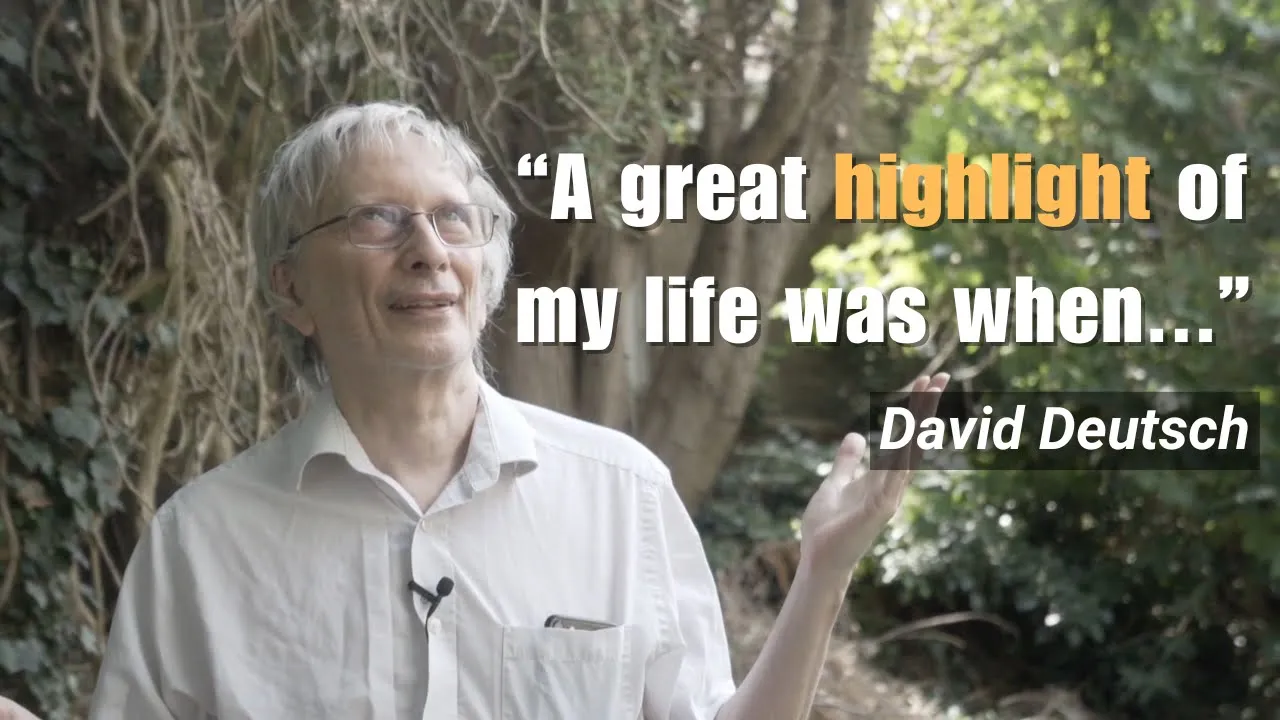
Focus on the segment from 00:21:29 to 00:26:20. Deutsch argues that what makes Western science "objectively better" than indigenous ways of knowing is not its origin, but its built-in capacity for progress—its tradition of error-correction allows it to improve. A culture that forbids claiming one idea is better than another makes improvement impossible. This is precisely what the "good explanation" criterion enables: a rational basis for claiming that a new conjecture is a genuine improvement.
3. The Toolkit in Synergy: The P1 → TT → EE → P2 Cycle
Falsification and good explanations are not opposing methods; they are partners in the creative and critical dance of knowledge growth, perfectly mapping onto Popper's evolutionary schema: .
Let's see how the toolkit drives this cycle when applied to a tradition:
-
(Problem) and (Tentative Theory): We inherit a problem from our society (), and we inherit a set of traditional institutions, norms, and beliefs that serve as the current best guess at a solution (). For example, is "how to fund public goods," and is a "progressive income tax system."
-
(Error Elimination) - The Critical Phase: This is where the toolkit is deployed.
- Falsification: We use critical reason to find where the fails. We look for evidence that the progressive tax system creates unforeseen negative consequences (e.g., capital flight, deadweight loss, complexity) that undermine its ability to solve . These are falsifying instances.
- Good Explanations (Creative/Constructive Part): The falsification creates a new problem: "how to fund public goods without the errors of the old system." We now have to conjecture new tentative theories (, , etc.). Maybe a flat tax? A land value tax? We use the "good explanation" criterion to guide our creativity. We don't just want a new theory; we want one that is harder to vary (more logically coherent, fewer arbitrary exemptions) and has more reach (perhaps it also solves a problem related to asset bubbles, as a land value tax proponent might argue).
-
(New Problem): By selecting the best new explanation (), we move to a new state. Our understanding has progressed. is now the incumbent tradition, and it will generate its own set of more subtle problems (), beginning the cycle anew at a higher level of sophistication.
This synergy is the engine of piecemeal reform. You use falsification to identify the specific part of the traditional "machine" that is broken. Then, guided by the search for a "good explanation," you engineer a better replacement part. As Popper noted in an analogy you've seen before, an engineer "develops [an engine] from earlier models; he changes it; he alters it over and over again." (Notes on Karl Popper's "Towards a Rational Theory of Tradition", point 39).
Conclusion
Today, we've unpacked the practical meaning of "critical reason" within the Critical-Traditionalist framework. It is not simply a disposition for argument, but a disciplined, two-part process for the improvement of ideas.
- Falsification is the razor. It is the rigorous, empirical, and logical process of error detection. It probes the conjectures embedded in our traditions to find where they are weak, false, or counter-productive.
- The search for Good Explanations is the forge. It is the creative, constructive principle that guides us in building superior replacements for the errors we've found. It pushes us beyond merely "not-yet-falsified" ideas toward conjectures with greater depth, coherence, and explanatory power.
Together, these tools allow a Critical-Traditionalist to approach the past with respect but not reverence. Tradition provides the invaluable starting point, but it is through the relentless application of this critical toolkit that we can ensure our inheritance is a foundation for progress, not a cage.
In our next lesson, we will put this toolkit to work. We will apply the criteria of falsifiability and good explanations to a major political philosophy—classical liberalism—to evaluate its explanatory power and see how this framework can be used to analyze complex ideologies.