Recommended resources
The freely available resources this lesson will direct you to.
Hello! Welcome back to our module on "Planning a Learning Project."
In our previous lesson, you created a learning roadmap by deconstructing your project goal into smaller components and arranging them in a logical sequence. You now have a destination (your goal) and a map (your learning plan). The next logical question is: what vehicle will you use to make the journey?
Today, we'll answer that. Our learning outcome is to select appropriate learning resources (e.g., courses, books, documentation) for your project. This process is much like a crucial step in your design work: choosing the right tools, component libraries, or research methods for a new project. It’s not about finding a single "best" resource, but about assembling a toolkit that is perfectly suited for the job at hand, guided by the blueprint you've already created.
Start with a Map: Metalearning and Benchmarking
Before you start hunting for resources, you need to know what a good learning path even looks like. This is where the principle of metalearning—learning about how to learn a subject—comes in. A key part of metalearning is figuring out how others have successfully learned your topic before you.
This is a research phase. Let's explore two key methods from Scott Young's Ultralearning framework to guide this research.
Ultralearning by Scott Young - Summary & Notes
This summary of Scott Young's book 'Ultralearning' introduces the concepts of 'Benchmarking' and the 'Emphasize/Exclude Method'. These are foundational for building your initial list of potential resources.
Please read the section titled 'Metalearning'. Focus on the descriptions of 'Benchmarking' and the 'Emphasize/Exclude Method'. These two techniques will form the basis of our search strategy.
To summarize the key ideas:
-
Benchmarking: Find the common ways people learn your skill. This is your starting point.
- If there's a university course on it, what's on the syllabus? What's on the recommended reading list?
- If there's a popular online certification (like the Google UX Design Certificate), what are its modules?
- Who are the well-regarded experts in the field? What books or courses have they created?
-
Emphasize/Exclude: Once you have a benchmark curriculum, compare it to the learning roadmap you created in our last lesson.
- Emphasize resources that directly cover the most critical components of your personal learning plan.
- Exclude or deprioritize parts of a standard curriculum that aren't relevant to your specific goal. For instance, if a data analysis course has a deep module on statistical theory but your goal is purely applied analysis, you might skim that section and focus more on the chapters about data manipulation and visualization libraries.
This research and customization phase prevents you from blindly following a path that may not be the most efficient one for your goals.
A Framework for Evaluating Resources
After benchmarking, you'll likely have a list of potential candidates: a few online courses, a couple of books, maybe some official documentation. How do you choose?
Just as you would evaluate a design tool based on specific criteria, you should evaluate learning resources systematically. Here is a framework to guide your selection, inspired by formal instructional design principles but adapted for self-learners.
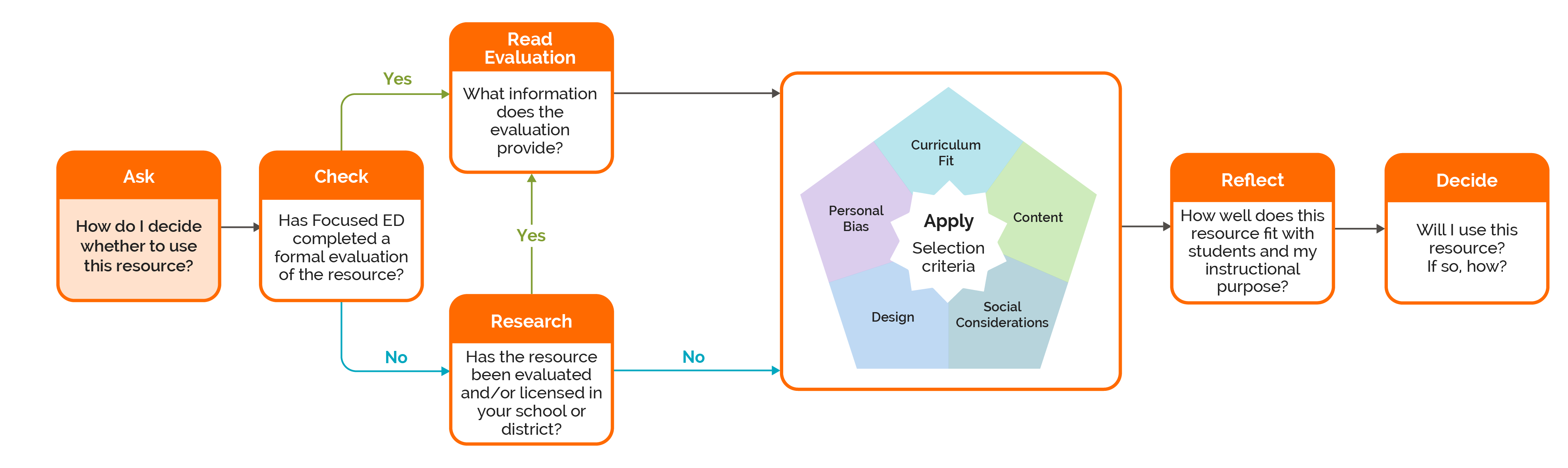
Criterion 1: Alignment with Your Roadmap
This is the most important check. Does the resource actually teach you what you need to know, as defined by your deconstructed learning plan?
- Review the table of contents, syllabus, or course outline. Match it against the list of components you created in the last lesson.
- A resource doesn't need to cover 100% of your list, but it should have strong coverage of the highest-priority items.
Criterion 2: Match to Your Current Skill Level
Resources are not one-size-fits-all. A resource that is perfect for a beginner might be too slow for someone with some experience, and vice-versa. The Dreyfus Model of Skill Acquisition gives us a useful language for this.

- If you're a Novice: Look for highly structured, step-by-step resources like a guided online course (e.g., a Coursera course) or a "for Dummies" style book. You need explicit instructions.
- If you're an Advanced Beginner or Competent: You might benefit more from project-based tutorials or a comprehensive textbook that you can jump around in. You can start connecting concepts to context.
- If you're Proficient or Expert: You likely only need reference materials, like official documentation, advanced articles, or case studies to solve specific problems.
Criterion 3: Prioritize Active Practice ("Directness")
As we've discussed, learning is not a passive activity. The best resources don't just present information; they compel you to use it. This is the principle of directness: learning is most effective when it is tied closely to the context in which you will use the skill.
Ultralearning by Scott Young - Summary & Notes
Let's revisit the 'Ultralearning' summary to understand why resources that promote active learning are far superior to passive ones.
Please read the section on 'Directness'. The key takeaway is that watching lectures or reading is not where most learning happens—it happens when you are actively solving problems.
When evaluating a resource, ask yourself:
- Does it include practice problems, exercises, or quizzes?
- Does it guide you through building real projects?
- Does it challenge you to apply what you've learned, or does it just ask you to watch and read?
A video course with code-along exercises is far more valuable than one with lectures alone. A book with end-of-chapter problems is better than one without.
Criterion 4: Opportunities for Feedback
How will you know if you're doing it right? Effective learning requires a feedback loop. Your chosen resources should, ideally, have built-in mechanisms for feedback.
How To Self Study Effectively. 📚 step by step guide to teach yourself anything!!
The speaker in this video on effective self-study briefly touches on the importance of finding resources that help you test your knowledge.
Watch from 03:07 to 03:22. Notice the recommendation to find resources with practice questions or access to an expert.
Look for resources that provide:
- Answer keys for exercises.
- Completed project files to compare against your own work.
- An active community forum where you can ask questions.
- Expert access, such as instructor Q&A sessions.
Practical Strategies for Resource Curation
Armed with your evaluation framework, here are two final strategies for building your learning toolkit.
Strategy 1: Triangulate Your Sources
Don't rely on a single textbook or one online course. Every resource has biases, gaps, and a specific point of view. By using multiple sources, you get a more robust and well-rounded understanding.
7 Tips For Learning Anything On Your Own
In this short clip, Dr. Benjamin Keep explains the simple but powerful rationale for using multiple resources.
Watch from 03:22 to 04:08. The core message is to use at least three resources to gain different perspectives on the same topic.
A good combination might be:
- Primary Resource: A structured online course or textbook that forms the backbone of your learning plan.
- Secondary Resource: A project-based book or tutorial series to ensure you are applying your knowledge.
- Reference Resource: The official documentation or a "cookbook" style resource for quick lookups.
Strategy 2: Deconstruct the Resource Itself
Once you've chosen a resource, you can apply a mental model to analyze its content. A good resource will teach the three "atoms" of knowledge.
Lesson 2: The three questions for effective meta-learning
Scott Young's blog post on meta-learning provides a brilliant way to break down the type of knowledge you need to acquire. This helps you check if a resource is comprehensive.
Please read 'Question #2: What facts, concepts and procedures must be acquired?'. This will give you a lens through which to evaluate the content of any book or course.
When you look at a chapter or module, ask:
- What are the facts I need to memorize (e.g., syntax in a programming language, vocabulary)?
- What are the concepts I need to understand (e.g., what is a 'component' in a design system, what is 'statistical significance')?
- What are the procedures I need to practice (e.g., how to run A/B test analysis, how to create a prototype in Figma)?
If a resource only gives you facts without explaining the underlying concepts, or explains concepts without giving you procedures to practice, it's incomplete.
Test your understanding!
Let's put this into practice. Take the learning project and roadmap you developed in the last lesson.
- Brainstorm & Benchmark (5 mins): Spend a few minutes searching online. Find one potential primary resource (e.g., a specific online course or book) that seems to cover your topic.
- Evaluate (5 mins): Using the four criteria we discussed (Alignment, Skill Level, Active Practice, Feedback), write 1-2 sentences evaluating that resource for your specific project. Is it a good fit? Why or why not?
Example:
- Project Goal: Learn Python/Pandas for basic data analysis.
- Potential Resource: "Python for Data Analysis, 3rd Edition" by Wes McKinney.
- Evaluation:
- Alignment: Excellent. The table of contents maps almost perfectly to my deconstructed plan.
- Skill Level: Seems appropriate for an Advanced Beginner, which is my level. It assumes some programming knowledge but not expertise.
- Active Practice: Good. The book is filled with code examples, and the author encourages following along in a Jupyter Notebook.
- Feedback: Fair. There are no explicit exercises with answer keys, so I would need to find supplementary problem sets to get feedback on my own code. I may need a secondary resource for this.
Conclusion
You now have a structured, professional-grade process for selecting learning materials. This moves you away from randomly picking the top-rated course on a platform and toward a deliberate strategy that is aligned with your specific goals, much like how you would approach any serious design project.
Key Takeaways:
- Start with Benchmarking: Research how others successfully learn the skill to create a baseline curriculum.
- Use an Evaluation Framework: Judge potential resources on their alignment with your roadmap, fit for your skill level, opportunities for active practice, and built-in feedback loops.
- Triangulate Your Sources: Combine a primary structured resource with supplementary materials for practice and reference to build a more robust understanding.
- Look for the "Atoms" of Knowledge: A great resource will teach the necessary facts, concepts, and procedures for a skill.
What's Next?
With a goal, a map, and now a set of well-chosen vehicles (your resources), the final piece of the planning puzzle is to plot your journey over time. In our next lesson, we will focus on how to map your learning outcomes onto a realistic timeline. This will be key to building consistency and tackling one of your main challenges: procrastination.