Recommended resources
The freely available resources this lesson will direct you to.
Hello! Welcome back to our module on "Planning a Learning Project."
In our last two lessons, you’ve done the foundational work of a project planner. First, you deconstructed your learning goal into a logical roadmap of outcomes. Then, you curated a set of high-quality resources to guide you. You have the what and the how. Today, we address the when.
Our learning outcome is to map your learning outcomes onto a realistic timeline. This is where the plan meets reality. For anyone, but especially for someone aiming to debug their learning process and fight procrastination, creating a realistic schedule is non-negotiable. An overly ambitious timeline is a primary trigger for task aversion and eventual burnout. A well-crafted, achievable schedule, on the other hand, builds momentum and makes it easier to start each day.
We'll approach this like a design problem: understanding the constraints (cognitive biases and time), creating a blueprint (estimation), and then refining it based on real-world testing (scheduling and adapting).
Part 1: The Psychology of Planning – Why We Almost Always Get It Wrong
Before we build a timeline, we must acknowledge a fundamental human bias: we are naturally poor at estimating how long things will take. This isn't a personal failing; it's a well-documented cognitive bug called the Planning Fallacy.
To understand this, let's look at a quick article that defines the Planning Fallacy and a related concept, Hofstadter's Law.
Hofstadter's Law and the Planning Fallacy: 1 Planning Lesson
This brief article from ParetoAnalysis.tools defines two key concepts that explain why we consistently underestimate the time needed for complex tasks.
Please read the sections 'What is Hofstadter’s Law?' and 'Why does Hofstadter’s Law occur more often with complex projects?'. Focus on understanding the core definitions and why complex projects are particularly vulnerable.
In short:
- Planning Fallacy: We tend to underestimate the time needed to complete a future task, even when we know from experience that similar tasks have taken longer.
- Hofstadter's Law: "It always takes longer than you expect, even when you take into account Hofstadter's Law."
This happens because our plans are often best-case scenarios. We don't account for unexpected interruptions, challenging topics that require extra time, or simply getting sick. Complex projects, like learning a new coding language or data analysis framework, have many steps, and each step is an opportunity for delay.
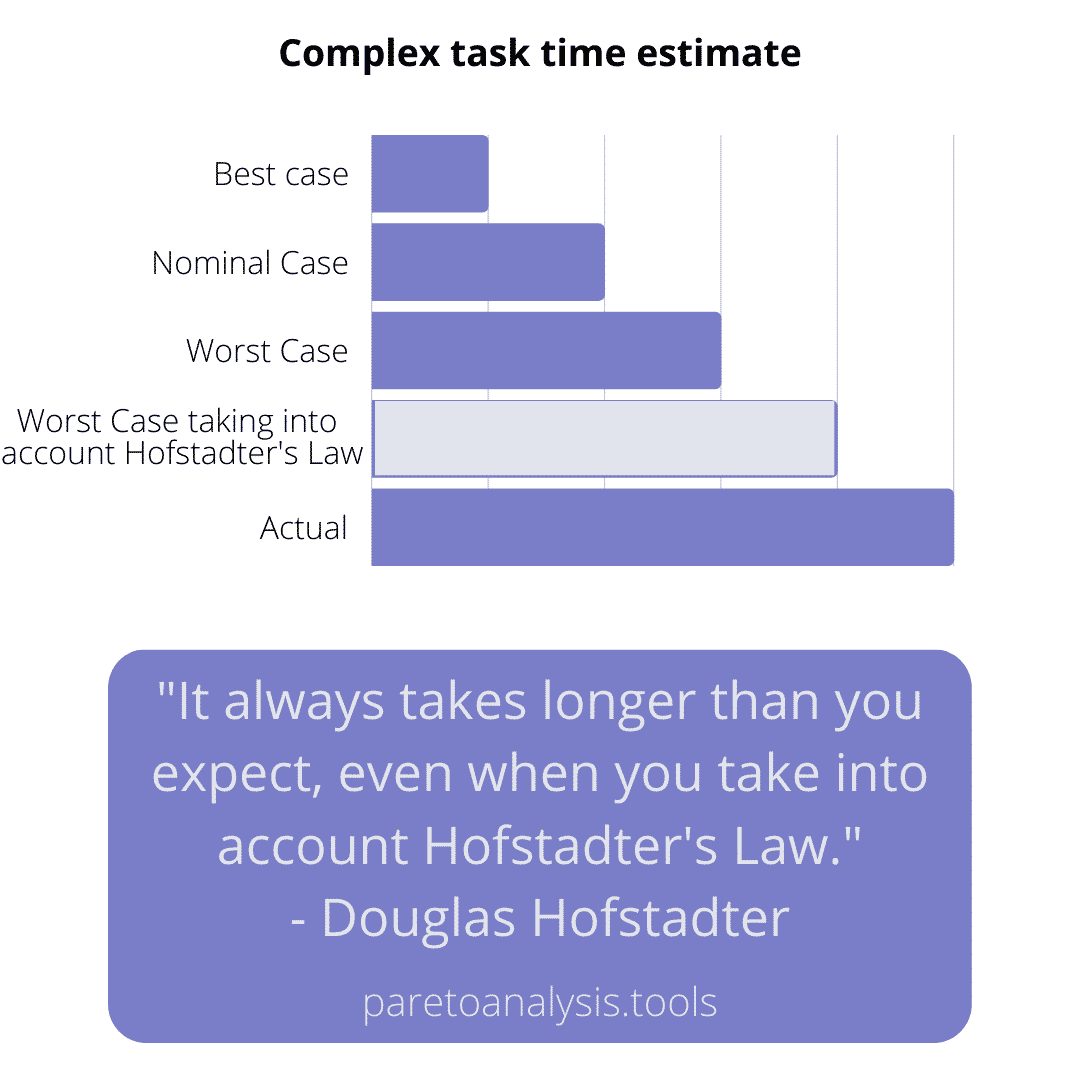
Acknowledging this bias upfront allows us to treat our initial estimates with healthy skepticism and build in buffers from the start.
Part 2: A Practical Framework for Estimation and Scheduling
Knowing that we're likely to be wrong, how can we create a timeline that's at least in the right ballpark? We need a systematic process. The following video by learning expert Scott Young provides an excellent, actionable framework.
Seven Steps for Making a Solid Studying Plan
In his video 'Seven Steps for Making a Solid Studying Plan,' Scott Young outlines a clear process for estimating time and building a schedule. We'll focus on the core steps related to time calculation and sanity checking.
Please watch from 02:32 to 07:07. This covers four key steps: calculating minimum time, estimating additional study, scheduling, and doing a 'sanity check'. Pay close attention to how he separates passive consumption from active practice.
Let's break down that process and apply it to the learning project you've been designing.
Step 1: Estimate the Minimum Time Investment
This is the time it takes to simply go through the materials you've selected.
- Videos/Lectures: Add up the total runtime. If you plan to watch at 1.5x speed, divide the total time by 1.5.
- Readings: Time yourself reading a few pages of a chosen book at a comfortable, deliberate pace. Extrapolate that to estimate the time for the whole book or required chapters.
- Courses: The platform (e.g., Coursera, Udemy) often provides an estimated time commitment. Use this as a starting point.
Step 2: Estimate Additional "Active" Study Time
This is where much of the real learning happens and is often the most underestimated component. This includes:
- Doing practice problems or end-of-chapter exercises.
- Working on projects.
- Creating and reviewing flashcards (retrieval practice).
- Writing self-explanations of complex concepts.
A good rule of thumb is to start by budgeting a 1:1 ratio. For every hour of lecture or reading, budget an hour of active practice. You can adjust this based on your own experience and the difficulty of the subject.
Step 3: Schedule the Time
Once you have a total estimated time, you need to fit it into your week. As Young mentions, you have two main options:
- Rigorous Appointments: Block out specific study times in your calendar as if they were meetings. This works well if you have a busy, inflexible schedule.
- Flexible Routines: Designate recurring times for study (e.g., "every weekday from 8-9 AM," "Tuesday and Thursday evenings"). This allows for more flexibility in what you study during that block. Given your 1-hour-a-day goal, this approach is likely a good fit.
Step 4: The Sanity Check
Now, compare your total estimated time with the time you've actually scheduled.
- Estimated time > Available time? Your plan is unrealistic. You need to either find more time, expand your project timeline, or reduce the project scope.
- Estimated time ≈ Available time? You're on track, but there’s no room for error. An unexpected difficult topic or a missed day could derail you.
- Estimated time < Available time? This might seem good, but too much slack can lead to procrastination. Consider setting "soft deadlines" to keep up the momentum.
Part 3: The Art of Realistic Scheduling – Embracing Constraints
What do you do when the sanity check reveals a problem? This is where many people get discouraged and abandon their plan. Instead, we can see it as a design constraint to be solved. The solution isn't to "try harder" but to plan smarter.
A common failure mode is overscheduling—creating a "fantasy world" schedule where you are a perfect, uninterrupted version of yourself.
How to Actually Stick to Your Schedule (2 Simple Rules)
In this video, learning coach Justin Sung provides two powerful rules for making schedules you can actually stick to. These are crucial for turning a fragile plan into a resilient one.
Please watch from 04:48 to 07:49. This covers the ideas of scheduling less than you think you can do and, most importantly, proactively 'picking your losses.'
This brings us to two vital principles for a realistic timeline:
-
Overestimate and Schedule Less: Intentionally budget more time for tasks than you think you'll need. A common suggestion is to multiply your initial estimate by 1.5 or even 2. This builds in a buffer for the Planning Fallacy. It feels better to finish a task early and have extra time than to constantly be falling behind.
-
Pick Your Losses: This is a profound strategic shift. If your sanity check shows you can't do everything, you must proactively decide what not to do, rather than letting circumstances decide for you. In your field, this is akin to descopeing less critical features to meet a product launch deadline. It’s a mark of professional maturity, not failure.
- Could you exclude an optional module from a course?
- Could you focus on competence instead of mastery for a particular sub-skill?
This second point is supported by the 100-Hour Rule.
This article from Modern Mrs Darcy introduces the '100-Hour Rule' as a refreshing alternative to the famous '10,000-Hour Rule'. It's a great mental model for setting realistic scope.
Read the sections that introduce and explain the 100-hour rule. The key idea is that achieving competence (knowing more than 95% of people) takes far less time than achieving mastery.
The 100-Hour Rule suggests that for most skills, about 100 hours of active learning (~1 hour a day for 3 months) is enough to become highly competent. Framing your project with this in mind makes it easier to "pick your losses" and focus on a realistic, achievable goal rather than an intimidating, abstract "mastery."
Test your understanding!
Let's apply this to your own learning project. Take the roadmap and the primary resource you identified in the last two lessons.
- Estimate (5 mins): Choose one major module or the first 2-3 chapters of your primary resource. Create a rough time estimate for it. Remember to include both "minimum investment" (reading/watching) and "active practice" (exercises/projects).
- Schedule & Sanity Check (5 mins): Look at a typical week in your calendar. Where could you schedule the time needed to complete this module? Be honest.
- Adapt (if needed): If your estimate exceeds your available time for, say, a two-week period, what is one "loss" you could proactively "pick"? (e.g., "I will skim the 'history of' chapter," or "I will do only the odd-numbered practice problems to save time but still get feedback.")
Conclusion
You now have a complete toolkit for planning a learning project. Creating a timeline isn't just about filling a calendar; it's a strategic exercise in managing your time, energy, and expectations. A realistic plan is one of your most powerful weapons against procrastination because it transforms an overwhelming mountain into a series of manageable hills.
Key Takeaways:
- Acknowledge the Planning Fallacy: Your initial time estimates will likely be too optimistic. Plan for this.
- Estimate Systematically: Calculate time for both passive consumption (reading, watching) and active practice (doing, solving).
- Perform a Sanity Check: Compare your estimated time with your available time to identify potential failures before they happen.
- Embrace Constraints: When time is tight, don't just hope for the best. Overestimate task durations and proactively "pick your losses" by reducing scope, not quality.
- Aim for Competence: Use the 100-Hour Rule as a guide to set achievable goals within a reasonable timeframe.
What's Next?
You have a goal, a roadmap, resources, and now a timeline. The plan is complete. But how do you ensure you stay on track and that your learning is actually effective? In our next and final lesson of this module, we will learn how to design a feedback loop for your project, turning your plan into a living document that adapts as you learn.