Recommended resources
The freely available resources this lesson will direct you to.
Hello! Welcome to the next lesson in our module on core valuation and comparison metrics.
In our last session, we looked at the Gross Rent Multiplier (GRM), or PER as it's known in Spain. We saw it's a great "back-of-the-napkin" tool for quickly comparing properties based on their gross income. However, its major drawback is that it ignores expenses and doesn't tell you about the ultimate profitability of your investment when you sell.
Today, we shift our focus from ongoing income to the final outcome of a property sale. We'll explore the Return on Investment (ROI), a fundamental metric that measures the total gain or loss on an investment relative to its cost. Our goal is to calculate the ROI for a property sale transaction, and we'll do this by looking at both a simple pre-tax version and a more precise, real-world after-tax calculation specific to the Spanish market.
1. The Core Concept: Return on Investment (ROI)
ROI is one of the most common performance metrics in any type of investment. It answers the simple question: "For every euro I put in, how many euros did I get back as profit?"
The general formula is:
To apply this to a real estate sale, we need to be very clear about what goes into "Total Investment" and "Net Profit."
Let's start with a foundational article that explains these components in the Spanish real estate context.
ROI inmobiliario: cómo calcularlo y cuál es un buen retorno
This article from Fotocasa provides a clear and professional overview of how to calculate ROI for real estate. It's a great starting point for understanding the key components of the formula.
Please read the sections titled 'Cómo se calcula el ROI inmobiliario: fórmula y explicación paso a paso' and 'Tabla de ejemplos de ROI inmobiliario en compraventa vs. alquiler'. Focus on: Inversión total: The detailed list of costs included beyond just the purchase price. Beneficio neto: How it's defined for a sale (Precio de venta – Inversión total). The example calculation in the table for a purchase/sale ('Compraventa').
Breaking Down the Pre-Tax ROI Calculation
As the article highlights, the calculation for a simple, pre-tax ROI on a property sale involves two main steps:
1. Calculate the Total Investment (Inversión Total):
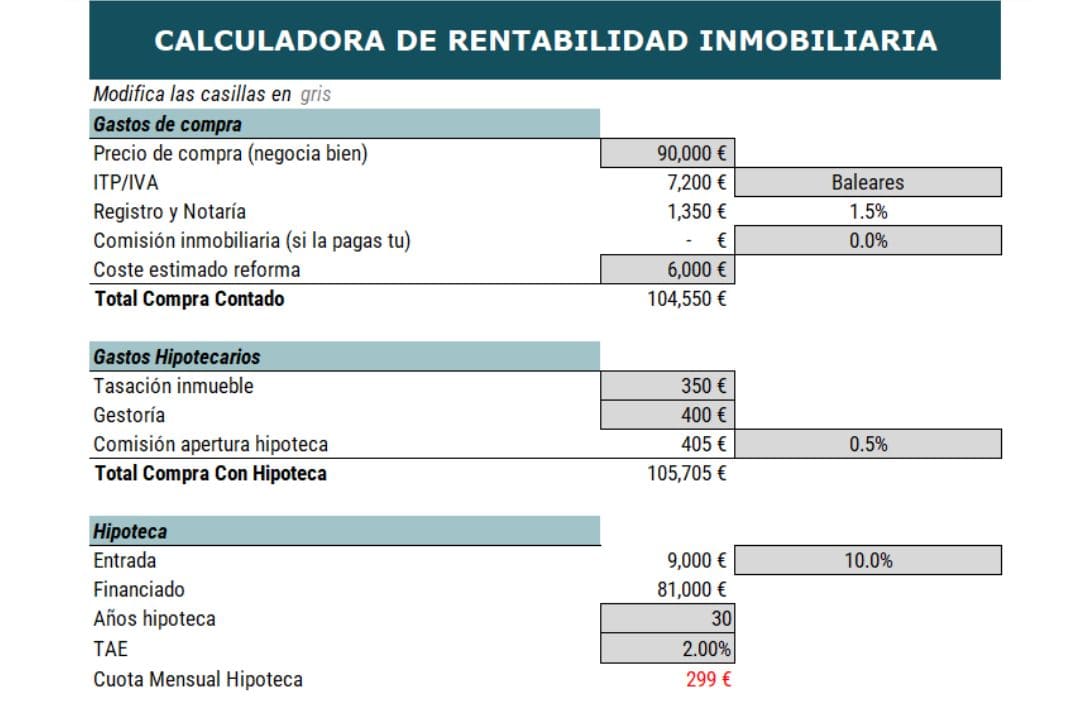
This is the full capital outlay required to acquire and prepare the property. It's much more than just the purchase price. A comprehensive list includes:
- Property Purchase Price
- Acquisition Taxes (ITP or IVA)
- Notary, Registry, and Gestoría Fees
- Real Estate Agency Fees
- Costs of any Reforms or Major Improvements
- Furniture and Equipment Costs
The following image provides a great visual breakdown of these typical upfront costs in Spain.
2. Calculate the Net Profit (Pre-Tax):
For a sale, this is simply the sale price minus your total investment.
Example:
Using the numbers from the Fotocasa article's table:
- Total Investment: €210,000
- Sale Price: €250,000
- Net Profit: €250,000 - €210,000 = €40,000
- ROI: (€40,000 / €210,000) * 100 = 19.05%
This 19.05% represents the total return on the capital you invested, before considering taxes.
2. The Real-World Calculation: After-Tax ROI
A 19% ROI looks good on paper, but it's not the amount you'll actually put in your pocket. The Spanish tax agency, Hacienda, will require its share of the profit. To get a true picture of your return, you must calculate the after-tax ROI.
This requires us to calculate the taxable capital gain (ganancia patrimonial) according to Spanish IRPF (Personal Income Tax) rules. The process is more detailed and regulated than our simple pre-tax calculation.
Let's dive into an excellent resource that explains exactly how Hacienda calculates this gain.
Estos son los gastos deducibles de la venta de una vivienda
This article from Idealista is essential for understanding how to calculate taxable capital gains in Spain. It introduces the specific concepts of 'valor de adquisición' and 'valor de transmisión' used by the tax authorities.
Read the sections 'Gastos deducibles del valor de adquisición', 'Gastos deducibles del valor de transmisión', and 'Calcular la ganancia patrimonial de la venta de un inmueble'. Pay close attention to: The specific expenses that can be added to the purchase price to calculate the 'valor de adquisición'. The expenses that can be subtracted from the sale price to calculate the 'valor de transmisión'. The final formula for 'Ganancia patrimonial'.
Calculating the Taxable Gain (Ganancia Patrimonial)
Based on the article, the process involves three key steps:
Step 1: Calculate the Adjusted Acquisition Value (Valor de Adquisición)
This is the official cost basis of your property for tax purposes.
- Acquisition Expenses: Include ITP/IVA, notary, registry, and agency fees.
- Major Improvements: Costs for works that increase the property's capacity or extend its useful life (e.g., adding a room), not simple repairs.
Step 2: Calculate the Adjusted Transmission Value (Valor de Transmisión)
This is the net proceeds from your sale.
- Selling Expenses: Include agency fees paid on the sale and the plusvalía municipal tax.
Step 3: Calculate the Taxable Gain (Ganancia Patrimonial)
This is the profit figure that Hacienda will tax.
Calculating the Capital Gains Tax
This taxable gain is then subject to IRPF tax at progressive rates on the "savings income base" (base imponible del ahorro).

The rates are applied in tiers. For a gain of, say, €55,000:
- The first €6,000 is taxed at 19%.
- The next €44,000 (from €6,001 to €50,000) is taxed at 21%.
- The final €5,000 (from €50,001 to €55,000) is taxed at 23%.
Let's put it all together with a comprehensive example:
Imagine you buy an apartment:
- Purchase Price: €200,000
- Acquisition Costs (ITP, Notary, etc.): €20,000
- Major Renovation: €25,000
You sell it a few years later:
- Sale Price: €300,000
- Selling Costs (Agency Fee, Plusvalía): €15,000
Calculation:
- Total Investment: €200,000 + €20,000 + €25,000 = €245,000
- Valor de Adquisición: Same as Total Investment = €245,000
- Valor de Transmisión: €300,000 - €15,000 = €285,000
- Ganancia Patrimonial (Taxable Gain): €285,000 - €245,000 = €40,000
- IRPF Tax Calculation:
- On the first €6,000: €6,000 * 19% = €1,140
- On the remaining €34,000: €34,000 * 21% = €7,140
- Total IRPF Tax: €1,140 + €7,140 = €8,280
- After-Tax Net Profit: Taxable Gain - IRPF Tax = €40,000 - €8,280 = €31,720
- After-Tax ROI: (€31,720 / €245,000) * 100 = 12.95%
As you can see, the after-tax ROI of 12.95% is significantly lower than the pre-tax gain would suggest and represents your true return.
Test your understanding!
You are analyzing a fix-and-flip deal in Spain with the following data:
- Purchase Price: €150,000
- Acquisition Costs (ITP, Notary): €13,000
- Renovation Costs (major improvements): €30,000
- Planned Sale Price: €240,000
- Estimated Selling Costs (Agency fee, Plusvalía): €12,000
Calculate the After-Tax ROI for this project. Use the IRPF tax brackets shown in the lesson.
Show answer
-
Total Investment / Valor de Adquisición:
€150,000 (Price) + €13,000 (Acq. Costs) + €30,000 (Renovation) = €193,000 -
Valor de Transmisión:
€240,000 (Sale Price) - €12,000 (Selling Costs) = €228,000 -
Ganancia Patrimonial (Taxable Gain):
€228,000 - €193,000 = €35,000 -
IRPF Tax Calculation:
- On the first €6,000: €6,000 * 19% = €1,140
- On the remaining €29,000 (€35,000 - €6,000): €29,000 * 21% = €6,090
- Total IRPF Tax: €1,140 + €6,090 = €7,230
-
After-Tax Net Profit:
€35,000 (Taxable Gain) - €7,230 (Tax) = €27,770 -
After-Tax ROI:
(€27,770 / €193,000) * 100 = 14.39%
3. Python Implementation
This entire workflow is perfectly suited for a Python model. It allows you to quickly adjust assumptions and see the impact on your final return. The function to calculate the progressive tax is particularly useful.
def calculate_after_tax_roi_spain(
    purchase_price: float,
    acquisition_costs: float,
    improvement_costs: float,
    sale_price: float,
    selling_costs: float
) -> dict:
    """
    Calculates the after-tax ROI for a property sale in Spain.
    """

    # Step 1: Calculate Total Investment & Valor de Adquisición
    total_investment = purchase_price + acquisition_costs + improvement_costs
    valor_adquisicion = total_investment

    # Step 2: Calculate Valor de Transmisión
    valor_transmision = sale_price - selling_costs

    # Step 3: Calculate Ganancia Patrimonial
    ganancia_patrimonial = valor_transmision - valor_adquisicion

    if ganancia_patrimonial <= 0:
        return {
            "ganancia_patrimonial": ganancia_patrimonial,
            "irpf_tax": 0,
            "after_tax_profit": ganancia_patrimonial,
            "after_tax_roi_percent": (ganancia_patrimonial / total_investment) * 100 if total_investment > 0 else 0
        }

    # Step 4: Calculate IRPF Capital Gains Tax (progressive brackets)
    tax = 0
    gain_remaining = ganancia_patrimonial

    # Bracket 1: up to 6,000 EUR @ 19%
    if gain_remaining > 0:
        taxable_in_bracket = min(gain_remaining, 6000)
        tax += taxable_in_bracket * 0.19
        gain_remaining -= taxable_in_bracket

    # Bracket 2: 6,001 to 50,000 EUR @ 21%
    if gain_remaining > 0:
        taxable_in_bracket = min(gain_remaining, 50000 - 6000)
        tax += taxable_in_bracket * 0.21
        gain_remaining -= taxable_in_bracket

    # Bracket 3: 50,001 to 200,000 EUR @ 23%
    if gain_remaining > 0:
        taxable_in_bracket = min(gain_remaining, 200000 - 50000)
        tax += taxable_in_bracket * 0.23
        gain_remaining -= taxable_in_bracket

    # Bracket 4: 200,001 to 300,000 EUR @ 27% (updated for recent changes)
    if gain_remaining > 0:
        taxable_in_bracket = min(gain_remaining, 300000 - 200000)
        tax += taxable_in_bracket * 0.27
        gain_remaining -= taxable_in_bracket

    # Bracket 5: > 300,000 EUR @ 28% (updated for recent changes)
    if gain_remaining > 0:
        tax += gain_remaining * 0.28

    # Step 5 & 6: Calculate After-Tax Profit and ROI
    after_tax_profit = ganancia_patrimonial - tax
    after_tax_roi = (after_tax_profit / total_investment) * 100 if total_investment > 0 else 0

    return {
        "total_investment": total_investment,
        "ganancia_patrimonial": ganancia_patrimonial,
        "irpf_tax": tax,
        "after_tax_profit": after_tax_profit,
        "after_tax_roi_percent": after_tax_roi
    }

# --- Using the function with the example from the exercise ---
deal_data = {
    "purchase_price": 150000,
    "acquisition_costs": 13000,
    "improvement_costs": 30000,
    "sale_price": 240000,
    "selling_costs": 12000
}

results = calculate_after_tax_roi_spain(**deal_data)

print(f"--- After-Tax ROI Analysis ---")
for key, value in results.items():
    print(f"{key.replace('_', ' ').title()}: {value:,.2f}")
Conclusion
Today you've learned how to calculate one of the most important metrics for evaluating the success of an investment that involves a sale. You can now confidently assess the total profitability of a "fix-and-flip" or a "buy-and-sell" strategy.
Key Takeaways:
- ROI measures the profitability of an investment relative to its total cost.
- The pre-tax ROI is a simple starting point, but the after-tax ROI reflects the true return.
- Calculating after-tax ROI in Spain requires a precise, step-by-step process defined by tax law: determine the
Valor de Adquisición,Valor de Transmisión, calculate theGanancia Patrimonial, and then apply the progressive IRPF tax rates. - Failing to account for all acquisition, improvement, and selling costs will lead to an inaccurate and likely overstated ROI.
Preview of the Next Lesson:
Our ROI calculation today is perfect for an investment that is bought and sold without being rented out. But what about a buy-and-hold rental property that you eventually sell? Its total return comes from two sources: the rental cash flow you receive during the holding period and the profit from the final sale.
In our next lesson, we will learn how to compute the total return for a single period, which combines cash flow, appreciation, and equity buildup, giving you a complete performance picture for a buy-and-hold investment.