Recommended resources
The freely available resources this lesson will direct you to.
Hello. In the previous lesson, you learned to distinguish aberrations by asking whether an image error depends on pupil position, field position, or wavelength. This lesson turns that diagnostic framework into a design history. Why did one camera lens work well for a slow landscape exposure but poorly for a portrait? Why did a distortion-free lens still leave difficult corners? The answers lie in which constraints each design could satisfy simultaneously.
We will follow four related developments: achromats for color-dependent focus, Petzval portrait lenses for light-gathering speed, rapid rectilinear lenses for more faithful geometry, and anastigmats for sharper imaging across a flat photographic plate. They were not a sequence of lenses in which each simply replaced the last. Each made a different compromise between aperture, field of view, image flatness, and the glass and fabrication methods available at the time.
Achromats: making photographic focus agree across colors
A single positive lens has optical power that changes with wavelength because its refractive index is dispersive. Early photographic materials were particularly sensitive to blue light, whereas a photographer judging focus by eye could be guided by other parts of the visible spectrum. Longitudinal chromatic aberration was therefore more than a colored fringe: the sharp image seen during focusing could lie at a different image distance from the image most effectively recorded.
The early response was an achromatic doublet. It combines a positive element of relatively low-dispersion crown glass with a negative element of more strongly dispersive flint glass. The negative element partly cancels the positive element’s power, but—because its dispersion is stronger—it can cancel much of the change in power with wavelength while leaving the assembly converging.
For the photographic setting, read the opening of Wikipedia’s historical overview and the passages on Chevalier’s early achromatic lenses. Treat the dates and product details as context; the optical problem is the important thread.
History of photographic lens design - Wikipedia
Read this overview to see why reducing chromatic error did not, by itself, produce a fast or uniformly sharp camera lens.
In “Early photographic camera lenses (1800–1890),” start with the opening account of simple lenses and read the focus problem. Then find the paragraph beginning “Charles Chevalier’s Paris optical firm” and read from there through the discussion of the narrow stop; this passage identifies the new trade-off. Finally, in “Meniscus or ‘landscape’ lens,” read the final paragraph, beginning “By the end of 1839”, through its explanation of the slow landscape lens.
The cancellation can be stated precisely in a thin-lens approximation. Let the crown and flint elements have powers and , and Abbe numbers and , with . An Abbe number describes how small a glass’s visible-range change in refractive index is relative to its refractive power. For closely spaced thin elements, the net power and the first-order condition for bringing two selected wavelengths to a common focus are approximately
These are two conditions on two element powers. Solving gives
For example, if and , the crown supplies twice the desired net power and the flint supplies one unit of opposing power. The useful outcome is not that dispersion has disappeared: two chosen wavelengths share a focus, while wavelengths between or beyond them may still focus elsewhere. That residual is called secondary spectrum. Nor do the two power equations specify a unique choice of surface curvatures or correct spherical aberration, astigmatism, and distortion. An achromat solves one important constraint, not the entire camera-lens problem.
The following tutorial gives a visual account of the doublet and works through the same first-order power balance. Its numerical design steps are optional here; focus on why opposite powers can retain net convergence while reducing color-dependent focus.
Optics Tutorial - 10 - Achromatic Doublets
Watch “Optics Tutorial - 10 - Achromatic Doublets” by opticsrealm for the construction and power balance of a crown–flint achromat.
Watch the doublet for the two-wavelength goal and the roles of the glasses. Skip the intervening invention-history discussion, then watch the power balance; concentrate on the total-power and color-cancellation conditions rather than the example radii. Finish with secondary color, which shows why “achromatic” does not mean identical focus at every wavelength.
Petzval: trading a wide, flat field for a fast portrait
The landscape lens could give a useful field but typically needed a small aperture. For portraiture, a long exposure made the subject’s motion a serious limitation. This changed the optimization target: a lens could be valuable even if its outer field was poor, provided that it admitted substantially more light and made a sufficiently sharp central image.
The Petzval portrait lens, developed around 1840, used four elements: a front cemented achromatic doublet and a rear pair with an air space. The layout provided more adjustable curvatures and spacings than a single achromat. It enabled a wide aperture—often cited around f/3.6—while controlling central-image aberrations sufficiently for portrait use. It did not deliver that speed together with a broad, flat, well-corrected field.
History of photographic lens design - Wikipedia
Return to the historical overview for the Petzval layout, its exposure advantage, and the limits of its usable field.
In “Petzval Portrait lens,” read the paragraph beginning “He came up” through its description of the four elements and aperture. Then read the paragraph beginning “The Petzval Portrait was the dominant portrait lens” through its field limitation. Focus on the difference between central sharpness and sharpness across a flat plate.

The exposure advantage follows from aperture geometry. For the same focal length and comparable transmission, image-plane irradiance scales approximately as the inverse square of f-number. Comparing f/16 with f/3.6 gives
That is an idealized optical comparison, not a guarantee of a particular exposure time: plate sensitivity, lighting, transmission, and the chosen image size still matter. But an approximately twentyfold irradiance gain explains why accepting a restricted sharp field could be rational for portraits.
Recall the distinction from the previous lesson between astigmatism and field curvature. A flat plate placed at the best focus for a face near the center cannot follow a substantially curved best-focus surface at the edges. If sagittal and tangential focal positions also differ, refocusing the edge does not necessarily make it cleanly sharp. The Petzval design’s characteristic soft periphery was thus not evidence that its central correction had failed; it reflected a design aimed at a different portion of the field and a different exposure constraint.
Rapid rectilinear: putting straight lines in the right places
Portrait speed was not the only demand. Architecture and other subjects with prominent straight lines made distortion conspicuous. A lens could form locally sharp points yet place them at incorrect field positions, bending the image of a straight line. The problem became harder over a wider angle of view.
A powerful strategy was to place two similar optical groups on opposite sides of a central aperture stop. In an ideal system with mirror symmetry and equal object and image conjugates, distortion contributions from the two halves cancel; symmetry also suppresses certain other off-axis errors, including coma and lateral chromatic displacement. A camera photographing distant subjects does not have those exactly symmetric conjugates, so suppression is a design principle, not a promise of perfect cancellation.
The Dallmeyer Rapid Rectilinear and the closely related Steinheil Aplanat, introduced in the 1860s, used two achromatic groups arranged around a central stop. Their combination of glass choices, element shapes, and symmetry made lenses with much lower distortion and useful moderate apertures practical across a range of photographic applications.
History of photographic lens design - Wikipedia
Read the account of distortion, symmetric layouts, and the Rapid Rectilinear/Aplanat designs as one engineering argument.
In “Overcoming optical aberrations,” begin with the paragraph starting “The Achromat Landscape” and continue through its wide-angle limitation. After the Globe-lens paragraph, read the symmetry explanation. Then read the paragraph beginning “The Globe’s symmetric formula” through the account of the Rapid Rectilinear and Aplanat. Ask which gains come from the stop-centered arrangement, and which still depend on the glasses and individual groups.
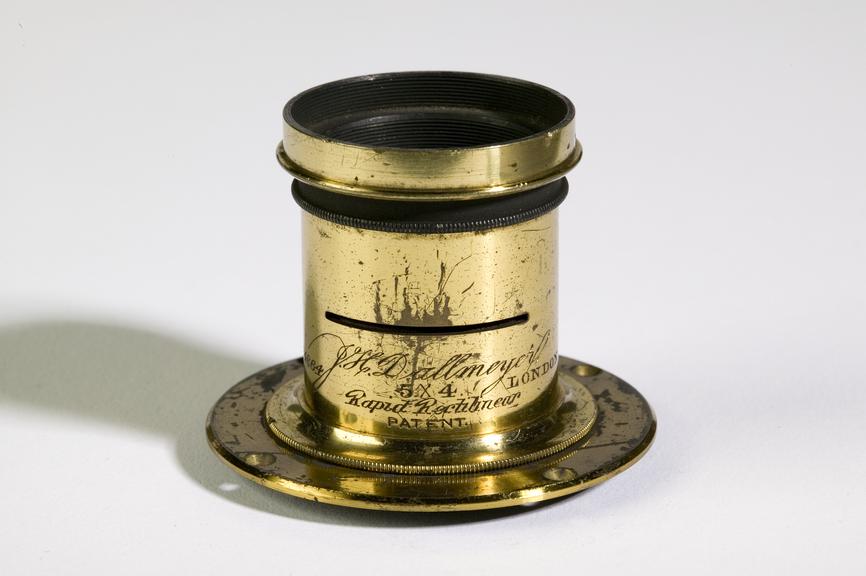
“Rectilinear” describes the intended geometric result: straight subject lines remain comparatively straight in the photograph. It does not mean uniformly high resolution. The design could still leave spherical aberration, astigmatism, or field curvature at levels that mattered, depending on aperture and field angle. This is the same distinction you used in the previous lesson: correctly positioned image points need not be tightly focused image points.
Anastigmats: correcting the oblique image on a flat plate
By the late nineteenth century, lens designers wanted more than acceptable center sharpness and low distortion. A useful general-purpose lens needed oblique bundles to form sharp images across the flat recording surface. This required addressing astigmatism—the separation of sagittal and tangential best focus—while also controlling where those best-focus positions fell as field angle increased.
It helps to state the target without implying an impossible perfection. At a given off-axis image position, denote the sagittal and tangential best-focus distances by and . Reducing astigmatism brings and closer. Making a flat photograph sharp also requires both to lie near the fixed plate position over the intended field. Thus:
- Correcting astigmatism alone need not flatten the field.
- Flattening one focal surface need not make the sagittal and tangential surfaces coincide.
- Achieving both at a useful aperture is more demanding than correcting axial color or distortion alone.
The anastigmat designs that emerged around 1890 addressed this combined off-axis problem. Paul Rudolph’s Protar was an influential early example. Its development depended not just on adding elements, but on new optical glasses that offered combinations of refractive index and dispersion unavailable to earlier designers. In particular, higher-index crown glasses without a correspondingly large rise in dispersion broadened the range of powers and curvatures a designer could choose while retaining chromatic correction. That freedom made a less symmetrically constrained, more comprehensively corrected layout viable.
History of photographic lens design - Wikipedia
Read the Protar account for the connection between new glass properties and improved correction of the oblique image.
Skip the preceding telephoto discussion. Under “Anastigmat lens designs (1890–1950),” find the subsection “Zeiss Protar.” Read from its opening paragraph through the naming of the Protar, then read from “The Protar is considered” through the description of the older and newer glasses in its two groups. Focus on why glass choice changed the design space, rather than treating “anastigmat” as a guarantee of zero aberration.
Anastigmat is a statement about a major improvement in correction, especially of astigmatism; it is not a claim that every aberration vanishes at every aperture, wavelength, and field angle. Manufacturing precision still matters, as do choices about speed, coverage, and cost. The historical change was that designers could now pursue a substantially sharper whole photographic frame rather than relying chiefly on a fast center or a distortion-controlled but moderately stopped-down image.
The design constraints in one view
| Design | Constraint it notably addressed | Important remaining limitation |
|---|---|---|
| Achromatic doublet | Color-dependent axial focus | Secondary spectrum and monochromatic aberrations remained |
| Petzval portrait lens | Light-gathering speed with a sharp central portrait area | Limited well-corrected field on a flat plate |
| Rapid Rectilinear / Aplanat | Distortion and useful general-purpose coverage | Residual blur aberrations, particularly away from the center or at larger apertures |
| Early anastigmat, such as the Protar | Oblique sharpness across a flatter photographic field | Correction remained conditional on aperture, field, wavelength, and manufacture |
The deeper pattern is one of degrees of freedom. Selecting two element powers can satisfy a desired total power and a first-order achromatic condition, but leaves other demands unresolved. Air spaces, additional surfaces, stop placement, and symmetry provide further ways to influence ray bundles. New glass compositions change the available combinations of refractive power and dispersion. None of these tools acts in isolation: changing a curvature to improve an oblique image can worsen axial aberration, and making a lens faster admits pupil zones whose errors were previously hidden by a narrow stop.
Conclusion
Achromats made focus less dependent on color. Petzval designs prioritized enough irradiance and central correction to make portrait exposures more practical. Rapid rectilinear lenses used paired groups around a stop to improve geometric fidelity at useful apertures. Anastigmats drew on expanded glass and design choices to bring the off-axis image much closer to sharp focus on a flat recording surface. Each advance is best understood by naming both the constraint it relieved and the one it left for later designers.
In the next lesson, we will move from these foundational lens forms to anti-reflection coatings, aspherical elements, floating groups, and zoom mechanisms—developments that changed not only which aberrations could be corrected, but how a lens could perform across focusing distances and focal lengths.