Recommended resources
The freely available resources this lesson will direct you to.
Welcome back to our journey through Moroccan corporate accounting.
In the previous lesson, we focused on measuring a company's performance by constructing the Compte de Produits et Charges (CPC). We learned to take the accounts from Class 6 (Charges) and Class 7 (Products) from a trial balance and arrange them to calculate the company's profit or loss—the Résultat Net.
This lesson addresses a crucial new learning outcome: Describe the structure and components of the Moroccan Balance Sheet (Bilan). While the CPC tells us how a company performed over a period, the Bilan gives us a snapshot of its financial position at a single point in time. We will now explore what to do with the remaining accounts from our trial balance—Classes 1 through 5. You will learn the architecture of the Bilan, a foundational document for any financial analysis.
1. The Purpose and Equation of the Balance Sheet (Bilan)
The Bilan is one of the five core financial statements (états de synthèse) in Morocco. Its purpose is to present a structured picture of what a company owns and what it owes on a specific date, typically the last day of the financial year (e.g., December 31st).
It is the physical representation of the fundamental accounting equation you learned at the very beginning of this course:
Assets = Liabilities + Equity
In the Moroccan context, this is presented as:
Here, the Passif side encompasses both Equity (Capitaux Propres) and Liabilities (Dettes).
- Actif (Assets): Represents the economic resources controlled by the company, which are expected to provide future economic benefits. Think of these as the company's uses of funds (what it bought with its money).
- Passif (Liabilities & Equity): Represents the company's financial obligations and the owners' stake. Think of this as the sources of the company's funds (where the money came from).
2. The Structure of the Moroccan Bilan
The Moroccan Bilan is presented in a two-column format. The left side is the Actif, and the right side is the Passif. Each side is organized into large categories called masses, which are further broken down into rubriques (headings) and finally postes (line items).
The main "masses" of the Bilan are defined by the Code Général de la Normalisation Comptable (CGNC).
A Comparison between IFRS and Moroccan Accounting ...
To understand the official structure, please read a brief section from the paper 'A Comparison between IFRS and Moroccan Accounting Standards'. This will introduce you to the main sections of the Bilan.
In the document, find section 3.2, titled 'Moroccan balance sheet'. Focus on the bulleted lists that outline the main masses for 'Equity and liabilities (Passif)' and 'Assets (Actif)'. This provides the high-level skeleton of the Bilan.
As you saw in the reading, the Bilan is organized into three main masses on each side, based on their function and stability:
| Actif (Uses of Funds) | Passif (Sources of Funds) |
|---|---|
| Actif Immobilisé (Fixed Assets) | Financement Permanent (Permanent Financing) |
| Actif Circulant (hors trésorerie) (Current Assets) | Passif Circulant (hors trésorerie) (Current Liabilities) |
| Trésorerie - Actif (Cash Assets) | Trésorerie - Passif (Cash Liabilities) |
The image below provides a simplified visual representation of this structure.

3. A Deeper Look at the Components
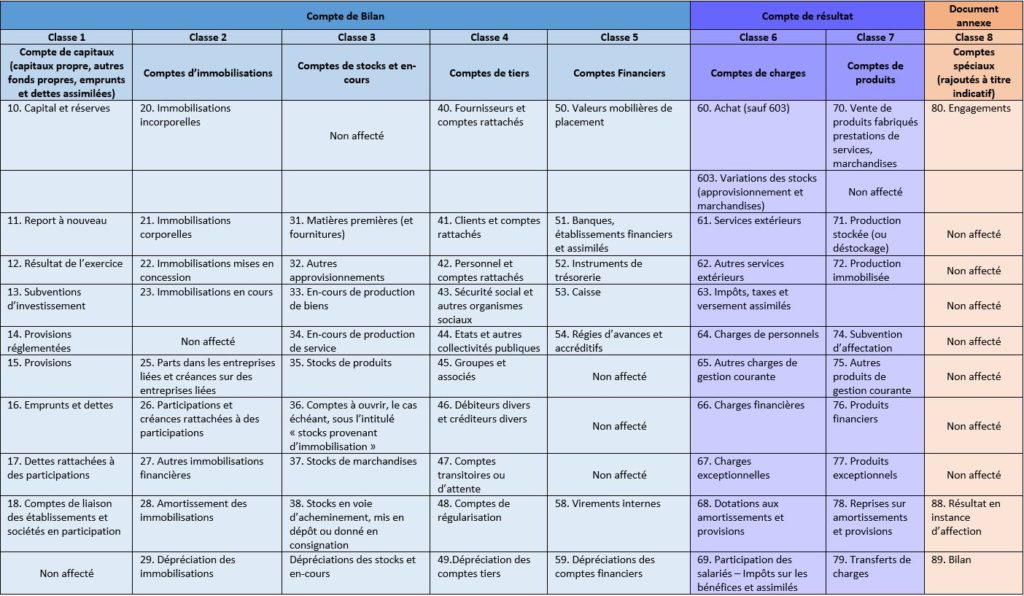
Let's break down each mass of the Bilan and see which accounts they contain. To help with this, we'll refer to a video that explains the account classes of the Moroccan chart of accounts.
Le plan comptable marocain (فهم طريقة إستعمال)
The following video by Imad Hamdis provides a clear, practical explanation of the main account classes that form the Bilan. The explanations are in Moroccan Darija and French, which will help connect the concepts to the local professional environment. We will watch it in segments as we analyze each part of the Bilan.
We will reference specific parts of this video throughout the next section. For now, simply be aware of it as our guide.
A. Le Passif: The Sources of Funds
The Passif side explains where the company's financing comes from. It's ordered from the most stable, long-term sources at the top to the most short-term at the bottom.
1. Financement Permanent (Class 1)
This mass includes all resources that are available to the company for more than one year. It's the stable foundation of the company's financing.
- Capitaux Propres (Equity): Funds belonging to the owners.
Capital Social: The initial and subsequent funds contributed by the shareholders.Réserves: Profits from previous years that were retained in the company.Résultat Net de l'Exercice: The profit or loss for the current year, calculated in the CPC. This is the critical link between the CPC and the Bilan. A profit increases equity, while a loss decreases it.
- Dettes de Financement (Long-term Debt):
Emprunts: Bank loans and other debts with a maturity of more than one year.
Le plan comptable marocain (فهم طريقة إستعمال)
Let's watch the segment of the video that explains Class 1 accounts.
Watch the video from timestamp 08:00 to 09:07. The instructor explains that Class 1 contains the company's own capital ('Capital') and long-term financing ('dettes de financement').
2. Passif Circulant (Class 4)
This includes all debts and obligations that the company expects to settle within one year. These are typically related to the company's operating cycle.
Dettes Fournisseurs: Money owed to suppliers for goods or services.Dettes Fiscales et Sociales: Taxes owed to the state (e.g., VAT, corporate tax) and contributions owed to social security organizations (e.g., CNSS).
3. Trésorerie - Passif (Class 5)
These are short-term, negative bank balances.
Crédits d'escompteandCrédits de trésorerie: Bank overdrafts or other short-term credit facilities.
B. L'Actif: The Uses of Funds
The Actif side shows how the company has used its funds. It's ordered by liquidity, from the least liquid assets at the top (those hardest to turn into cash) to the most liquid at the bottom.
1. Actif Immobilisé (Class 2)
These are long-term assets acquired for use in the business, not for resale, and expected to be held for more than one year.
Immobilisations Incorporelles(Intangible Assets): Non-physical assets like software, patents, or afonds commercial(goodwill).Immobilisations Corporelles(Tangible Assets): Physical assets liketerrains(land),constructions(buildings), andmatériel et outillage(machinery and equipment).Immobilisations Financières: Long-term financial investments, such as shares in other companies.
Le plan comptable marocain (فهم طريقة إستعمال)
Now, let's understand Class 2, the Fixed Assets.
Watch from 09:07 to 17:13. The instructor gives examples of assets that a company buys to keep for more than a year ('plus d'un an'), such as land, buildings, and machinery, and also introduces the concept of intangible assets.
2. Actif Circulant (Classes 3 & 4)
These are short-term assets that are expected to be converted into cash, sold, or consumed within one year.
- Stocks (Class 3):
Marchandises: Goods purchased for resale.Matières Premières: Raw materials to be used in production.
- Créances (Receivables - Class 4):
Clients et comptes rattachés: Money owed to the company by its customers for goods or services already delivered.Créances Fiscales: For example, a VAT credit owed to the company by the state.
Le plan comptable marocain (فهم طريقة إستعمال)
Next, let's look at stocks (Class 3) and receivables (Class 4), which form the bulk of the Actif Circulant.
Watch the segment on Class 3 from 17:13 to 19:06, which explains inventories. Then, watch the brief introduction to Class 4 from 19:06 to 19:46, which mentions accounts with suppliers ('fournisseurs') and customers ('clients').
3. Trésorerie - Actif (Class 5)
This mass contains the company's most liquid assets—its available cash.
Banques: Cash held in bank accounts.Caisse: Physical cash held on the premises.
Le plan comptable marocain (فهم طريقة إستعمال)
Finally, let's cover the treasury accounts in Class 5.
Watch from 19:46 to 24:23. This section explains that Class 5 represents the company's treasury ('trésorerie'), including bank and cash accounts.
Test your understanding!
For each of the following accounts, identify the correct "mass" of the Bilan where it belongs. Choose from:
- Actif Immobilisé
- Actif Circulant
- Trésorerie - Actif
- Financement Permanent
- Passif Circulant
- Compte "Clients"
- Compte "Emprunts auprès des établissements de crédit"
- Compte "Matériel de transport"
- Compte "Capital social"
- Compte "Fournisseurs"
- Compte "Stock de marchandises"
- Compte "Caisse"
Show answer
- Compte "Clients": Actif Circulant (it's a short-term receivable)
- Compte "Emprunts auprès des établissements de crédit": Financement Permanent (it's a long-term debt)
- Compte "Matériel de transport": Actif Immobilisé (it's a long-term tangible asset)
- Compte "Capital social": Financement Permanent (it's part of equity)
- Compte "Fournisseurs": Passif Circulant (it's a short-term payable)
- Compte "Stock de marchandises": Actif Circulant (it's a short-term asset intended for sale)
- Compte "Caisse": Trésorerie - Actif (it's cash)
4. Important Moroccan Specifics
It's important to be aware of a few key principles that govern how the Moroccan Bilan is presented.
-
Classification by Function: Unlike the IFRS framework which strictly separates assets and liabilities into "Current" and "Non-Current" based on a 12-month rule, the Moroccan CGNC classifies items by their economic function (exploitation, financier, etc.). This is a significant difference you will explore more as you learn about financial analysis.
-
"Image Fidèle" (True and Fair View): The ultimate goal of the Bilan, and all financial statements, is to provide an image fidèle—a true and fair view—of the company's patrimony and financial situation.
PRESENTATION DU REFERENTIEL COMPTABLE MAROCAIN (LE CGNC)
This document from CRMEF provides high-level context on the philosophy behind the Moroccan financial statements.
Quickly read the paragraph under 'Analyse de la situation : le bilan (BL)' to see the official mention of classification by 'fonction économique et financière'. Then, skim the section 'Finalités et nature des états de synthèse' to understand the importance of the 'image fidèle' concept.
Conclusion
In this lesson, you have dissected the Moroccan Balance Sheet. You now understand its purpose as a snapshot of financial position and can identify its core structural components.
Key Takeaways:
- The Bilan is the detailed expression of the equation
Actif = Passif. Actifrepresents the company's assets (uses of funds), andPassifrepresents its equity and liabilities (sources of funds).- The Bilan is organized into major masses:
- Passif: Financement Permanent, Passif Circulant, Trésorerie-Passif.
- Actif: Actif Immobilisé, Actif Circulant, Trésorerie-Actif.
- Each mass corresponds to specific account classes from the PCG (Classes 1-5).
- The Résultat Net from the CPC is a crucial component of the
Capitaux Propresin theFinancement Permanent, linking the two statements.
Preview of the Next Lesson:
You have mastered the theory and structure. The next logical step is application. In our next lesson, Prepare a classified Balance Sheet from an adjusted trial balance, you will take the same trial balance we used for the CPC, isolate the Bilan accounts (Classes 1-5), and assemble them into a complete, balanced Bilan document, putting today's structural knowledge into practice.