Recommended resources
The freely available resources this lesson will direct you to.
Hello! In our previous lesson, we learned how to evaluate a company's performance by calculating and interpreting key profitability ratios from the Compte de Produits et Charges (CPC) and Bilan. We saw how measures like Net Profit Margin and Return on Equity tell a story about a company's efficiency and value creation.
However, a company can be profitable on paper but still face a critical shortage of cash. This is because accrual accounting, which we use for the CPC, recognizes revenue when it's earned and expenses when they're incurred, not necessarily when cash changes hands. This brings us to the third and final core financial statement.
This lesson addresses the learning outcome: Explain the purpose and structure of the Statement of Cash Flows. In the Moroccan context, this is called the Tableau des Flux de Trésorerie (TFT). We will explore why this statement is essential for understanding a company's financial health and break down its three main components.
1. Why Do We Need a Statement of Cash Flows?
The Bilan gives us a snapshot of financial position at a single point in time, and the CPC tells us about profitability over a period. But neither statement directly answers questions like:
- "We made a profit of 1,000,000 DH, so why did our bank account balance decrease?"
- "Where did the company get the cash to buy that new machine?"
- "How much cash did we actually generate from our day-to-day operations?"
The Statement of Cash Flows was created to answer exactly these questions. It bridges the gap between accrual-based profit and actual cash movements.
To start, let's watch a short video that clearly explains the problem that the Statement of Cash Flows solves.
The CASH FLOW STATEMENT for BEGINNERS
The first part of this video from Accounting Stuff provides an excellent explanation of why the accrual-based Income Statement isn't enough to understand a company's cash position.
Watch the video from the beginning until 02:05. Focus on the distinction between the cash method and the accrual method of accounting.
As the video highlights, since IFRS and Moroccan GAAP require the accrual method, a separate statement is needed to track cash. The primary purpose of the Tableau des Flux de Trésorerie is to provide a detailed summary of all cash inflows (receipts) and cash outflows (payments) during a specific period.
Let's explore this purpose in more detail by consulting a short article.
Statement of cash flows and the purpose of its preparation
This article from Accounting For Management outlines the key purposes of preparing a Statement of Cash Flows.
Read the section titled 'Purposes of the statement of cash flows'. As you read, think about how this information would be valuable to a manager, a banker, or an investor.
To summarize, the key purposes of the TFT are to:
- Explain changes in cash: It details exactly why the cash balance went up or down.
- Assess future cash generation: It helps predict a company's ability to generate positive cash flows in the future.
- Evaluate solvency and liquidity: It shows if a company can meet its obligations, such as paying debts, suppliers, and dividends.
- Reconcile Net Income and Cash Flow: It explains the difference between the
Résultat Netfrom theCPCand the actual cash generated by operations. - Inform stakeholders: It provides crucial information for managers, bankers, and investors to make informed decisions.
Essentially, while profit is an opinion (based on accounting rules like depreciation), cash is a fact. The TFT deals in facts.
2. The Structure of the Statement of Cash Flows
The power of the TFT comes from its structure. It doesn't just list all cash transactions; it classifies them into three distinct categories. This helps users understand where a company's cash is coming from and where it is going.
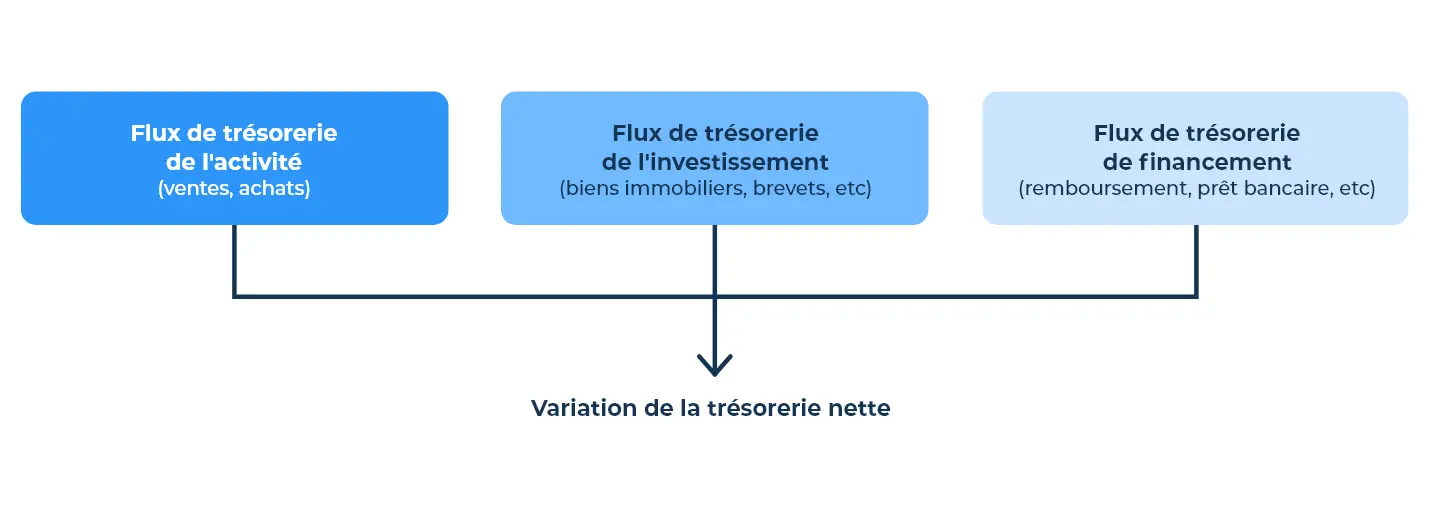
The three categories are:
- Cash Flow from Operating Activities (
Flux de Trésorerie liés à l'Activité - FTA) - Cash Flow from Investing Activities (
Flux de Trésorerie liés à l'Investissement - FTI) - Cash Flow from Financing Activities (
Flux de Trésorerie liés au Financement - FTF)
Let's watch a video that defines these three sections and provides clear examples for each.
Cash Flow Statement Basics Explained
This video by Leila Gharani provides a clear, practical breakdown of the three sections of the cash flow statement.
Watch the sections from 01:48 to 03:51, from 10:33 to 11:14, and from 11:14 to 12:24. Pay close attention to the types of transactions that fall into each of the three categories.
Now, let's solidify this with definitions and examples, incorporating the French terminology you'll use professionally.
1. Operating Activities (FTA)
These are the cash flows generated from a company's principal revenue-producing activities. In short, they relate to the day-to-day operations of the business.
- Cash Inflows (+): Cash received from customers for the sale of goods or services.
- Cash Outflows (-): Cash paid to suppliers for inventory, to employees for salaries, for rent, utilities, taxes, and other operating expenses.
A healthy company should consistently generate positive cash flow from its operations.
2. Investing Activities (FTI)
These are cash flows related to the acquisition and disposal of long-term assets (immobilisations) and other investments that are not part of day-to-day operations.
- Cash Inflows (+): Cash received from selling fixed assets (e.g., machinery, vehicles, buildings) or financial investments.
- Cash Outflows (-): Cash paid to purchase fixed assets or financial investments.
This section tells you how the company is investing in its future growth.
3. Financing Activities (FTF)
These are cash flows that result from changes in the size and composition of the company's equity and borrowings. They show how the company is funded.
- Cash Inflows (+): Cash received from issuing shares (capital increase) or from taking out loans.
- Cash Outflows (-): Cash paid to repurchase shares, pay dividends to shareholders, or repay the principal on loans.
Test your understanding!
For a Moroccan manufacturing SME, classify each of the following transactions into one of the three categories: Operating (FTA), Investing (FTI), or Financing (FTF).
- Payment of employee salaries.
- Purchase of a new delivery truck.
- Receipt of a bank loan.
- Cash received from a customer for a sale made last month.
- Payment of dividends to the company's owners.
- Sale of an old, unused piece of machinery.
Show answer
- Operating (FTA): Salaries are a core operational expense.
- Investing (FTI): A delivery truck is a long-term asset (
immobilisation). - Financing (FTF): Taking out a loan is a financing activity to raise capital.
- Operating (FTA): This is the collection of cash from a primary business activity (sales).
- Financing (FTF): Dividends are a return of capital to owners.
- Investing (FTI): The sale of a long-term asset falls under investing activities.
3. Putting It All Together: The Complete Statement
The final statement aggregates the net cash flow from each of the three activities to calculate the total net change in cash for the period. This net change is then used to reconcile the beginning cash balance with the ending cash balance.
Beginning Cash + Net Change in Cash = Ending Cash
The beginning and ending cash balances must match the cash amounts shown on the Bilan for the respective periods. This provides a powerful check for the accuracy of your accounting.
Let's look at a complete, albeit simplified, example of a Tableau des Flux de Trésorerie.

Let's walk through the structure of this example:
- Flux de trésorerie d'exploitation (Operating): Notice it starts with
Résultat net(Net Profit). It then makes adjustments for non-cash items likeAmortissements(Depreciation) and changes in working capital (Variation du BFR). This is called the indirect method, which is the most common way to prepare the TFT. We will not detail the calculations today, but it's important to see that this section reconciles profit back to cash. - Flux de trésorerie d'investissement (Investing): This section clearly shows a cash outflow for
Acquisitions d'immobilisations(CAPEX), meaning the company invested in new assets. - Flux de trésorerie de financement (Financing): This shows cash inflows from capital increases and outflows for dividend payments.
- Reconciliation: At the bottom, the
Variation de trésorerie(Net Change in Cash) is calculated by summing the three sections. This amount is added to theTrésorerie initiale(Beginning Cash) to arrive at theTrésorerie finale(Ending Cash).
Conclusion
In this lesson, we have demystified the third major financial statement. You now understand that the Statement of Cash Flows, or Tableau des Flux de Trésorerie, is vital for assessing a company's ability to generate and manage cash, which is the lifeblood of any business.
Key Takeaways:
- Purpose: The TFT explains the change in a company's cash balance over a period by detailing all cash inflows and outflows. It bridges the gap between accrual-based profit and actual cash.
- Structure: It is structured into three distinct categories:
- Operating Activities (FTA): Cash from core business operations.
- Investing Activities (FTI): Cash used for or generated from long-term assets.
- Financing Activities (FTF): Cash from or paid to owners and lenders.
- Reconciliation: The sum of the net cash flows from the three activities explains the total change in cash from the beginning to the end of the period.
Preview of the Next Lesson:
Now that you understand the "why" and "what" of the Statement of Cash Flows, our next step is to learn the "how". The most complex part is calculating the cash flow from operating activities. In the next lesson, we will focus entirely on mastering the indirect method to calculate cash flow from operating activities, starting from net income and making the necessary adjustments.