Recommended resources
The freely available resources this lesson will direct you to.
Welcome to the first lesson of Module 4, "Financial Statements and Analysis." In the previous module, you mastered the crucial process of period-end adjustments, culminating in the preparation of a complete and balanced Adjusted Trial Balance (Balance après inventaire). That document is our verified starting point for communicating the company's financial story.
This lesson begins that storytelling process by focusing on our first major financial statement. We will address the learning outcome: Explain the structure and purpose of the Moroccan Income Statement (Compte de Produits et Charges - CPC). The CPC answers the most fundamental question for any business: "Did we make a profit or a loss?" By the end of this lesson, you will understand not just the final result, but how Moroccan accounting standards structure the CPC to provide deep insights into a company's performance.
1. The Purpose of the CPC: A Film of Your Business Activity
The Adjusted Trial Balance you learned to prepare is a list of all account balances at a single point in time. From this list, we will create two main statements: the Balance Sheet (Bilan) and the Income Statement (Compte de Produits et Charges or CPC).
A common analogy is that the Balance Sheet is a photograph—it shows the company's financial position (assets, liabilities, equity) on a specific day. The CPC, on the other hand, is a film—it shows the company's performance over a period of time (e.g., a month, a quarter, or a year).
The primary purpose of the CPC is to calculate the company's net result for the period by summarizing all its revenues (produits) and expenses (charges). The fundamental equation is simple:
To create the CPC, we will use all the accounts from the Adjusted Trial Balance that fall into Class 6 (Charges) and Class 7 (Products) of the Moroccan Chart of Accounts.
Le compte de produits et de charges CPC
The following document provides a concise definition of the CPC. Pay attention to its description as the 'film of the company's activity'.
Read the introduction and the section titled '1. Définition'. This will formally introduce the CPC as a primary financial statement ('état de synthèse') that details the components of the final result.
2. The Structure of the CPC: A Story in Three Acts
A simple Revenues - Expenses = Profit calculation is useful, but it doesn't tell the whole story. Was the profit from core business operations, or from a one-time sale of an asset? To provide this insight, the Moroccan CPC is structured in a "cascading" format based on the nature of the activity. It breaks down the company's activities into three distinct levels or cycles.

Let's examine these three levels:
-
Operating Level (Le cycle d'exploitation): This relates to the company's core, day-to-day business activities.
- Produits d'exploitation (Operating Revenues - Class 71): Revenue from the main purpose of the business, such as sales of goods or services.
- Charges d'exploitation (Operating Expenses - Class 61): Costs incurred to generate operating revenues, like the cost of goods sold, salaries, rent, utilities, and depreciation.
The difference between these gives the Résultat d'exploitation (Operating Result), a key indicator of the company's core profitability.
-
Financial Level (Le cycle financier): This relates to the company's financing and investment decisions.
- Produits financiers (Financial Revenues - Class 73): Income from financial activities, such as interest received on bank deposits or discounts obtained from suppliers for early payment (escomptes obtenus).
- Charges financières (Financial Expenses - Class 63): Costs related to financing, like interest paid on loans or discounts given to customers for early payment (escomptes accordés).
The difference gives the Résultat financier (Financial Result).
-
Non-Current Level (Le cycle non courant): This level is for exceptional, unusual, or infrequent events that are not part of the regular business activities.
- Produits non courants (Non-Current Revenues - Class 75): Gains from non-recurring events, such as the profit from selling a piece of machinery.
- Charges non courantes (Non-Current Expenses - Class 65): Losses from non-recurring events, like fines, penalties, or a loss on the sale of a fixed asset.
The difference gives the Résultat non courant (Non-Current Result).
To deepen your understanding of the specific accounts that fall into each category, please study the following material.
Le compte de produits et de charges CPC
This document lists the specific types of accounts that make up each category of products and charges within the CPC.
Read sections '2. les comptes de produits' and '3. les comptes de charges'. As you read, try to connect the examples (e.g., 'ventes de marchandises', 'charges de personnel', 'intérêts des emprunts') to the three levels described above.
3. The Cascade of Results: From Operating Profit to Net Income
The true power of the CPC's structure lies in how these results are combined in a cascading sequence to tell a clear financial story. The layout progressively combines the results from each level.
Here is the standard structure, which you will use to build the CPC in our next lesson:
| N° | Ligne | Calcul |
|---|---|---|
| I | Produits d'exploitation | |
| II | Charges d'exploitation | |
| III | Résultat d'exploitation | (I - II) |
| IV | Produits financiers | |
| V | Charges financières | |
| VI | Résultat financier | (IV - V) |
| VII | Résultat courant | (III + VI) |
| VIII | Produits non courants | |
| IX | Charges non courantes | |
| X | Résultat non courant | (VIII - IX) |
| XI | Résultat avant impôts | (VII + X) |
| XII | Impôts sur les résultats | |
| XIII | Résultat net | (XI - XII) |
Let's break down the key subtotals:
- Résultat Courant (Current Result): This is the result from all normal, recurring business activities (Operating + Financial). It's a very important measure of sustainable profitability.
- Résultat Avant Impôts (Result Before Tax): This is the total profit before the government takes its share.
- Résultat Net (Net Result or Net Income): This is the final "bottom line" profit or loss after all charges, including taxes, have been deducted. This is the amount that belongs to the company's owners.
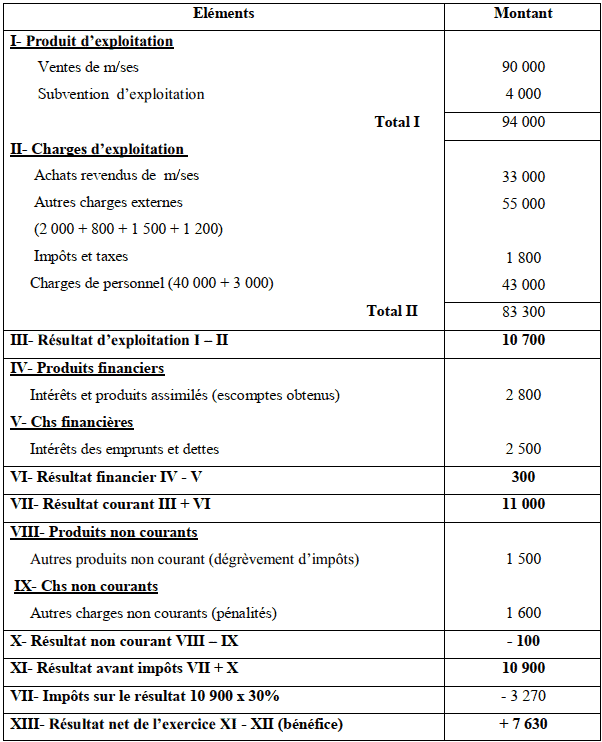
The image below shows a complete, populated CPC. Take a moment to trace the calculations from top to bottom and identify the different results we've just discussed.
Test your understanding!
For a small Moroccan SME, classify each of the following items into one of the six main categories of the CPC:
- Produits d'exploitation
- Charges d'exploitation
- Produits financiers
- Charges financières
- Produits non courants
- Charges non courantes
Items:
- Payment of employee salaries
- Revenue from selling artisanal leather bags (the company's main product)
- Interest paid on a bank loan
- A fine for late tax payment
- Rent for the workshop
- Interest received from a savings account
- The gain realized from selling an old delivery van
Show answer
- Payment of employee salaries: Charges d'exploitation
- Revenue from selling artisanal leather bags: Produits d'exploitation
- Interest paid on a bank loan: Charges financières
- A fine for late tax payment: Charges non courantes
- Rent for the workshop: Charges d'exploitation
- Interest received from a savings account: Produits financiers
- The gain realized from selling an old delivery van: Produits non courants
Conclusion
In this lesson, you have learned the "what" and the "why" behind the Moroccan Income Statement. You now understand its critical role in measuring business performance and the logic behind its specific, cascading structure.
Key Takeaways:
- The Compte de Produits et Charges (CPC) is a financial statement that summarizes revenues and expenses over a period to calculate the net result.
- It acts as a "film" of the company's activity, contrasting with the Balance Sheet's "photograph."
- Its structure is built around three levels of activity: Operating (exploitation), Financial (financier), and Non-Current (non courant).
- This cascading structure produces key performance indicators like the Résultat d'exploitation, Résultat courant, and the final Résultat net.
Preview of the Next Lesson:
You have now mastered the theory and structure of the CPC. In our next lesson, we will move from theory to practice. You will learn how to prepare a simple CPC from an adjusted trial balance, taking the final balances you learned to calculate in the last module and organizing them into the formal CPC structure we've explored today.