Recommended resources
The freely available resources this lesson will direct you to.
- Teachers Pay Teachers SEO: How to Rank Your Products Higher!www.youtube.com
- Start A TPT Store In 2026 | Step-By-Step Guide To Make Money On Teachers Pay Teacherswww.youtube.com
- How to Do Keyword Research for TPT: A Step-by-Step Guide for 2026seolumina.com
- Best Selling Resources Teachers Pay Teachers: 2026 Analysis - Acciowww.accio.com
In our last lesson, we established the financial framework for your Teachers Pay Teachers (TPT) business by analyzing the fee structures and concluding that a Premium account is the strategic choice for your goals. Now, with the "how" of getting paid settled, we turn to the most important question: what should you sell?
This lesson is your introduction to market research on TPT. We will move from broad ideas to a specific, defensible market position. You will learn how to identify high-demand, low-competition niches using TPT's own search functionality and strategic analysis. This process is not about guesswork; it's a systematic method to find where teacher needs are high and the supply of quality resources is low. Mastering this will be the foundation of your entire product strategy.
The TPT Marketplace: Red Oceans and Blue Oceans
Before diving into the specifics of search, it's helpful to understand the overall market landscape. TPT is a vast marketplace, but it's not uniform. Some areas are incredibly crowded, while others are relatively untapped. In business strategy, these are often called "Red Oceans" and "Blue Oceans."
- Red Oceans: These are highly competitive markets with many sellers fighting over the same customers. Think of general topics like "1st-grade phonics" or "classroom decor." While demand is high, it's very difficult for a new seller to get noticed.
- Blue Oceans: These are uncontested or less crowded market spaces. They often represent more specialized needs where competition is low, allowing a new seller to become a go-to expert more easily.
The following market analysis provides an excellent overview of this concept applied to TPT.
Best Selling Resources Teachers Pay Teachers: 2026 Analysis - Accio
This analysis gives a high-level view of different TPT market segments, classifying them by their competitiveness.
First, read the three deep dives into different product categories: Math, Health, and Elementary Literacy. Pay close attention to the "Verdict" for each, which assesses its viability for a new seller. Next, focus on the Scenario Analysis table. This table explicitly uses the Red Ocean/Blue Ocean framework to classify niches and recommends actions for each. This will help you understand the strategic difference between entering a crowded market versus a specialized one.
As the analysis shows, your best opportunity as a new seller isn't to compete in the most saturated "Red Ocean" categories. Instead, your goal is to find a "Blue Ocean"—or at least a less crowded corner of a Red Ocean—where your products can stand out. The tool for finding these opportunities is keyword research.
Finding Your Niche Through Keyword Research
A "niche" on TPT is simply a specific solution for a specific teacher. "Math resources" is not a niche. "Gamified Pythagorean theorem activities for 8th grade" is a niche. The way you find these specific, in-demand topics is by learning to think like a teacher who is searching for a solution. This is the essence of keyword research.
The following guide provides a comprehensive, step-by-step process for TPT keyword research. We will refer back to its principles throughout your journey as a seller.
How to Do Keyword Research for TPT: A Step-by-Step Guide for 2026
This article is your foundational text on using keywords to find product ideas and assess their potential.
Read through the guide from the beginning until the end of "Step 5," focusing on these core ideas: Why keywords are crucial: Understand that aligning with teacher search terms is more important than almost any other factor. Seed keywords: Grasp the concept of a "seed keyword" as your starting point. Using TPT's search suggestions: See how the search bar itself helps you find variations that real teachers are using. Broad vs. long-tail keywords: This is a critical distinction. Learn why a specific, "long-tail" keyword like neutral rainbow classroom decor editable has much higher buyer intent than a broad one like classroom decor. Analyzing the competition: This section gives you a checklist for manually evaluating how competitive a keyword is. The sweet spot: This summarizes the goal of your research—finding a keyword that is specific, relevant, realistic, and commercial.
A Practical Workflow for Niche Discovery
Now, let's turn these concepts into an actionable workflow you can use immediately. Your goal is to generate a list of 3-5 potential "micro-niches" that seem to have a good balance of demand and opportunity.
Step 1: Brainstorm Broad "Seed" Ideas
Since you don't have a teaching background, start by looking at the broad, successful categories mentioned in the "Accio" market report:
- Secondary Math (e.g., Algebra, Geometry)
- Secondary Health & Life Skills (e.g., Nutrition, Personal Finance)
- Elementary Literacy (e.g., Reading Comprehension, Phonics)
- Classroom Management & Decor
Pick one or two of these that you feel you could create visually appealing resources for using your Adobe Illustrator skills. For example, you might be drawn to the geometric nature of math resources or the visual potential of classroom decor.
Step 2: Use the TPT Search Bar to Find "Long-Tail" Keywords
Go to the TPT website. Start typing a broad idea (a "seed keyword") into the search bar, but don't press enter. Pay close attention to the dropdown list of suggestions. These are real searches from real teachers.
For example, if you type "reading comprehension," TPT might suggest:
reading comprehension passages 3rd gradereading comprehension with questionsnonfiction reading comprehension
These suggestions are gold. They show you the modifiers (grade level, format, sub-topic) that teachers care about. Write down 5-10 of these longer, more specific phrases.

Step 3: Analyze the Competition
For each long-tail keyword you wrote down, perform the search on TPT. Look at the first page of results and ask the questions from the keyword research guide:
- What types of products are ranking? Are they all huge, 200-page bundles, or are they smaller worksheets?
- Are the results dominated by giant sellers? Do the top sellers have hundreds of thousands of followers?
- How many ratings do the top products have? If the top 10 results all have over 5,000 ratings, that keyword is likely a "Red Ocean."
- Does this look like something I could create? And more importantly, can I make something better or different?
A promising niche is one where the search results are relevant, but the top products don't all have thousands of reviews, and you see an opportunity to create a higher-quality or more visually engaging resource.
Step 4: Validate Demand and Competition
This process can be accelerated with specialized tools. While manual research is essential, seeing how these tools work can clarify the concepts of "demand" and "competition."
Watch this short video clip where a TPT seller demonstrates how she researches niches and keywords.
Start A TPT Store In 2026 | Step-By-Step Guide To Make Money On Teachers Pay Teachers
Molly Wheatley's video offers a very clear, beginner-friendly take on finding a "micro-niche."
First, watch her explanation of what a micro-niche is and why it's so important for new sellers. Then, watch her method for researching market demand by sorting by "most popular" and analyzing bestsellers.
Molly's method of sorting by "Most Popular" is a great way to confirm demand. But what about competition? Some SEO tools provide data points to estimate this.
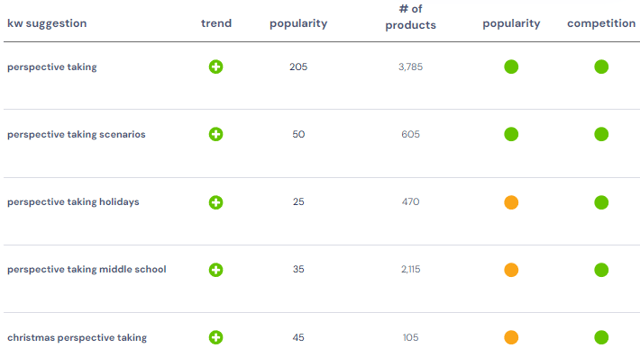
The image above illustrates what you are looking for: a keyword with good "popularity" (demand) but low "competition." In this example, "perspective taking scenarios" is more promising for a new seller than "perspective taking," which has more products and higher competition.
This is the "sweet spot" you're hunting for: a topic teachers want, but one that isn't already saturated with thousands of existing products.
Conclusion
In this lesson, you've learned the fundamental strategy for finding your place in the TPT marketplace. You now have a repeatable process for identifying profitable niches.
The key takeaways are:
- Successful selling on TPT starts with finding a high-demand, low-competition niche. Avoid "Red Oceans" where possible.
- Keyword research is the primary skill for discovering what teachers are searching for.
- Your goal is to find long-tail keywords (specific phrases) that show clear buyer intent.
- A viable niche is one where you can not only compete but also offer a unique or higher-quality product.
Your task now is to perform this research and identify 3-5 potential micro-niches that you feel you could build a product for.
In the next lesson, we will build directly on this work. You will choose your starting niche from the list you've created, and we will move on to the next critical step: defining the ideal customer for that niche.