Recommended resources
The freely available resources this lesson will direct you to.
In our previous lesson, we analyzed what makes a Teachers Pay Teachers (TPT) store successful by studying top sellers. You learned that strategic decisions about branding, product listings, and catalog size are crucial. Now, we shift from observing others to laying the financial foundation for your own business.
This lesson directly addresses a critical first step: understanding the platform's fee structure. You will learn the specific differences between a Basic and a Premium seller account on TPT. The goal is not just to know the numbers, but to analyze them from a business perspective. This will enable you to make an informed decision that aligns with your goal of building a profitable online store, directly impacting every dollar you earn.
The Two TPT Seller Memberships
TPT offers two primary account types for creators like you: Basic Seller and Premium Seller. Before we break down the business implications, let's get the official details directly from TPT.
The following resource from the TPT Help Center provides the most accurate, up-to-date information on the features and costs of each membership.
What types of Seller accounts are offered on TPT?
This official TPT article is the definitive source for the fee structure.
Please read the first part of the article, focusing on the comparison table. This table neatly summarizes the core differences in membership fees, payout rates, and transaction fees.
To visualize this information, here is a helpful comparison chart that summarizes the key differences you'll need to consider.
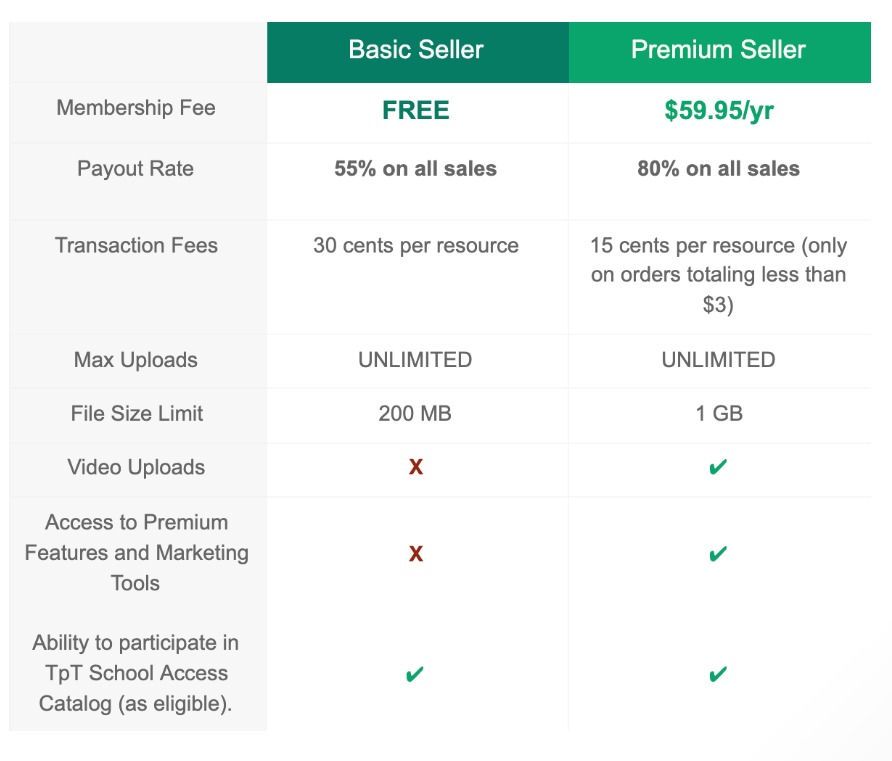
As you can see, the two most significant differences are the payout rate and the fees. Let's analyze what these numbers mean for your bottom line.
Analyzing the Financial Impact
Your objective is to build a business that generates passive income. Therefore, choosing an account type is a financial decision that must be based on a cost-benefit analysis. The blog post "Premium vs Basic Teachers Pay Teachers Seller Accounts" does an excellent job of breaking down the math.
Premium vs Basic Teachers Pay Teachers Seller Accounts
This article provides a clear, practical analysis of the earnings potential and break-even point for a Premium account.
Read the following sections to understand the real-world financial difference: Start with the breakdown of costs. Note the distinction in transaction fees: Basic is per resource, while Premium is per transaction (and only for small orders). Next, review the section Let's Do the Math. This demonstrates how much more you earn on a single sale with a Premium account. Finally, focus on the crucial question in the section When Does Premium Pay for Itself?. This calculation will help you determine the return on investment.
The Break-Even Point: Making Your Decision
As the analysis shows, the core of the decision lies in the trade-off between the upfront cost of a Premium membership and the significantly higher payout rate.
Let's summarize the key financial points:
- Membership Fee:
- Basic: A one-time $29 fee.
- Premium: An annual $59.95 fee.
- Payout Rate:
- Basic: You keep 55% of the sale price.
- Premium: You keep 80% of the sale price.
- Transaction Fees:
- Basic: You pay a $0.30 fee on each resource sold. If a customer buys three separate $1 items from your store in one order, you are charged this fee three times.
- Premium: You pay a $0.15 fee only on total orders under $3. For any order of $3 or more, there is no transaction fee.
The 25% difference in the payout rate is the most critical factor. Let's use the example from the article to calculate the break-even point for the annual Premium fee of $59.95.
Imagine you sell a resource for $5.00.
- With a Basic account: Your earning is () - = = $2.45.
- With a Premium account: Your earning is = $4.00.
The difference in profit on a single $5.00 sale is = $1.55.
To find the break-even point, you divide the annual Premium fee by the extra profit per sale:
This means you would need to sell approximately 39 units at $5.00 each over the entire year to cover the cost of the Premium membership. Any sales beyond that generate significantly more profit than you would have made with a Basic account.
Given your goal to build a serious business and your commitment to dedicating significant time to it, selling 39 products in a year is a very achievable goal.
Recommendation Based on Your Goals
- A Basic Seller account is suitable for someone who wants to "test the waters" of TPT, perhaps by uploading a few old resources with no serious commitment to building a business. It's a low-risk entry point.
- A Premium Seller account is an investment for those who are serious about generating income. The higher payout rate is essential for maximizing profit and scaling your business. The additional features, such as larger file size limits (1 GB vs 200 MB), video uploads, and access to marketing tools, are also built for sellers focused on growth.
Given your plan to launch and grow your store quickly, the Premium Seller account is the logical business choice. The initial fee should be viewed as a startup cost that will quickly be recouped through higher profit margins on every sale.
A Note on Publisher Accounts
TPT's documentation also mentions a "Publisher" account. This is designed for companies or entities selling content they did not personally create. It involves a 50/50 revenue split. Since you are the creator of your own resources, this account type does not apply to you.
Conclusion
In this lesson, you've moved from market observation to a critical business decision. You have learned the precise fee and payout structures for TPT's Basic and Premium accounts and, more importantly, how to analyze them to determine a break-even point.
The key takeaways are:
- TPT offers a Basic (55% payout) and Premium (80% payout) account.
- The Premium account carries an annual fee of $59.95, but the 25% higher payout rate means this fee is quickly recovered by an active seller.
- For anyone serious about building a profitable TPT business, the Premium account is a necessary startup investment that maximizes long-term earnings.
Now that you understand the financial mechanics of your future store, the next logical question is: what should you sell? In our next lesson, we will begin answering that by diving into practical market research techniques to identify high-demand, low-competition niches on TPT.