Hello! Welcome back to our module on Editing and Polishing Your Manuscript.
In our previous lessons, we built a solid foundation. First, we used AI to fix major structural and logical errors. Then, you learned human editing techniques to make the manuscript flow smoothly and coherently. Your text is now technically sound and easy to read.
But there's one crucial element missing: personality. Right now, your manuscript might sound like it was written by a committee—correct, but generic. This lesson is about transforming that generic text into something that sounds uniquely like you. Our goal is to infuse the manuscript with a unique authorial voice that goes beyond the AI's default style. This is what connects with readers, builds your author brand, and makes your books memorable.
1. Why AI Sounds Robotic and What to Look For
To fix a problem, you first need to understand its root cause. Large Language Models (LLMs) like ChatGPT are designed to predict the most statistically probable next word based on a vast dataset of internet text. This process naturally favors common, average language, filtering out the quirks, emotions, and unique experiences that define a human voice. The result is often grammatically perfect but emotionally sterile.
To begin developing your editorial eye for voice, let's explore a framework for identifying these AI-isms.
Is That a Robot Writing? When and how to use AI wi...
The article 'Is That a Robot Writing?' from ServiceNow's community blog offers a brilliant deep dive into why AI text feels robotic and what to do about it. We'll focus on the specific tells that signal a lack of human voice.
Please read two key sections from this article: Start with the section 'Why AI Sounds Robotic' to understand the core reasons for the generic output. Then, jump down to the heading 'Level 4: The Human Touch (Tone, Voice, and Punctuation)'. Read both the 'How to Spot It' and 'How to Fix It' parts carefully. This is the heart of today's lesson.
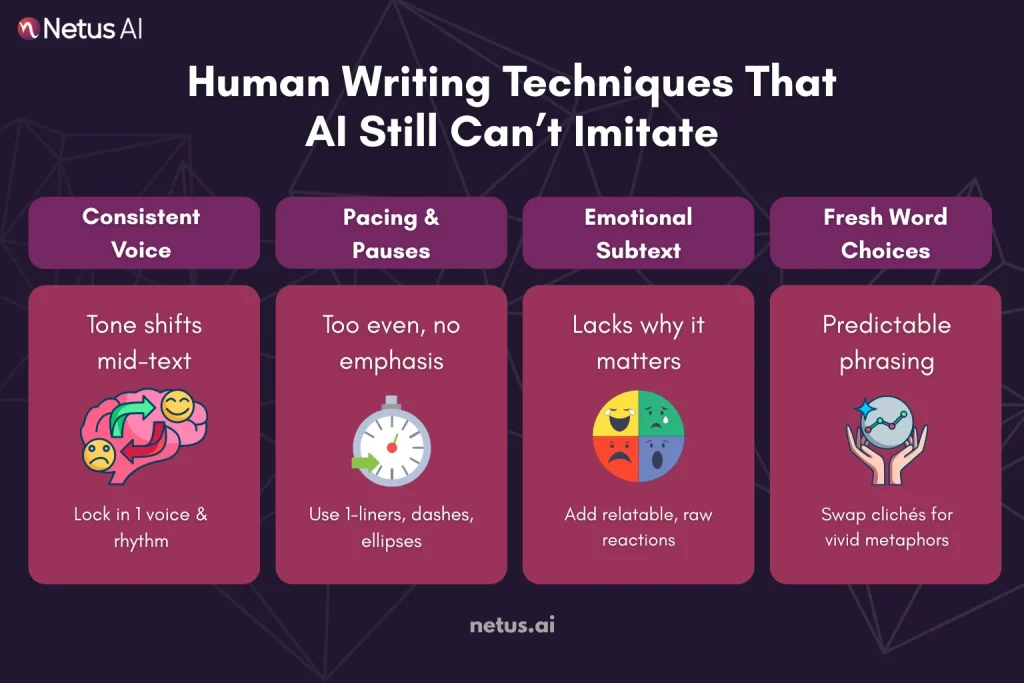
As the article points out, the "human touch" is about injecting a point of view, grounding abstract ideas in reality with personal stories, using a natural cadence with contractions, and having a distinct personality. The absence of these "rough edges" is the biggest giveaway of AI-generated content.
2. Method 1: Proactively Training the AI on Your Voice
Instead of editing a generic draft, you can guide the AI from the start. A powerful technique is to "train" the AI on your existing writing, teaching it to mimic your style before it generates a single word of your book.
For the mentoring and tech books you plan to write, you can use samples of your professional writing—emails, reports, or even blog comments where you explain a concept from your 10 years of IT experience. If you don't have ready samples, simply free-write 500-1000 words on a topic you know well.
This video demonstrates the process clearly.
How to Train Chat GPT to Write Like You 🖌️
Jason West's video 'How to Train Chat GPT to Write Like You' provides a practical, step-by-step walkthrough of this technique. He shows how to feed your own content to the AI and have it analyze your style.
Watch from the beginning to 06:45. Pay attention to: The initial prompt used to prepare ChatGPT to learn a writing style (00:30). How he provides samples of his writing (in his case, a YouTube transcript) (01:15). The AI's analysis of his style (02:10). How he then prompts the AI to create new content using that learned style (03:30).
The article "How to make artificial intelligence (AI) write in your voice & style" by Keith Roberts (LINK) provides a great text-based summary of this same process, which you can use as a quick reference.
The core workflow is:
- Prime the AI: Tell the AI its goal is to learn your writing style from examples.
- Provide Samples: Copy and paste several hundred words of your own writing.
- Confirm Understanding: Ask the AI to summarize your style. This confirms it has "learned" correctly.
- Generate New Content: Instruct the AI to write new text in your specific, learned style.
3. Method 2: The Collaborative Interview
This method shifts the dynamic: you are not asking the AI to be a writer, but a collaborator or an interviewer. This is incredibly effective for your non-fiction books, where your expertise is the main selling point.
Instead of prompting "Write a chapter about X," you can prompt:
"I want to write a chapter about [Your Topic]. My goal is to [Your Goal], and my audience is [Your Audience]. I want the tone to be [Your Desired Tone]. Now, act as an interviewer. Ask me questions and follow-up questions until you have enough information to organize MY thoughts and words into a chapter outline. Use my language as much as possible."
This turns a daunting writing task into a simple conversation. You can even use voice-to-text on your phone or computer to make it feel more natural.
After the AI generates a draft based on this "interview," you can take it a step further.
Humanize ChatGPT Content (Free Prompt That Works)
The YouTube channel RightBlogger shows a brilliant follow-up technique in the video 'Humanize ChatGPT Content'. It demonstrates how to make the AI help you find opportunities to inject your personal experience.
Please watch from 04:54 to 06:28. The key idea is to ask the AI to generate specific questions that prompt you to add your opinions, thoughts, and stories into the text.
By asking the AI, "Give me specific questions to help me weave my personal opinions, thoughts, and stories into this text," you create a personalized checklist for injecting your voice.
4. Method 3: The "Human Touch" Editing Pass
Whether you train the AI beforehand or use the interview method, a final editing pass focused purely on voice is essential. This is where you transform the manuscript from "sounds like me" to "is me."
Here is your checklist for this editing pass, based on the "How to Fix It" section from the ServiceNow article (LINK):
- Inject a Point of View: Is the text neutral and objective? Change it. Take a stand. Are you enthusiastic about a technology? Skeptical of a business trend? Frustrated by a common mistake? Let that opinion show.
- Ground Abstractions in Reality: Find every generic statement (e.g., "This strategy can improve efficiency.") and replace or support it with a specific example from your IT career. "At my last company, we implemented a similar system. It failed at first, but then we realized... That's a lesson that saved us $50,000 on the next project." This is your unique value.
- Adopt a Natural Cadence: Read the text aloud. Does it sound like a person talking?
- Use contractions (
it's,don't,you'll). - Replace formal words with conversational ones (
utilize->use,commence->start). - Break up long, academic sentences.
- Use contractions (
- Punctuate with Intent: Use punctuation for rhythm and emphasis. A short, punchy sentence can drive a point home. An em-dash can create a conversational aside—much like this one.
Test your understanding!
Here's a generic, AI-generated paragraph for a tech mentoring book:
"It is crucial for junior developers to embrace the concept of continuous learning. The technology landscape is in a perpetual state of evolution, necessitating a proactive approach to skill acquisition. By dedicating time to exploring new frameworks and languages, developers can ensure their career trajectory remains positive and that they provide ongoing value to their organization."
Rewrite this paragraph to infuse it with a distinct authorial voice. Choose a point of view (e.g., enthusiastic, pragmatic, a bit cynical) and add a personal touch or anecdote.
Show answer
There are many great ways to rewrite this. Here are two examples with different voices:
Voice 1: Enthusiastic & Encouraging
"If there's one piece of advice I hammer home with every junior dev I mentor, it's this: never stop learning! The tech world moves at lightning speed, and it's a blast to keep up. I still remember the weekend I spent diving into React for the first time; it completely changed how I thought about front-end development. Don't think of it as a chore. See it as your ticket to staying relevant and having fun while you build amazing things."
Voice 2: Pragmatic & Direct (Leveraging IT experience)
"Look, let's be blunt: if you're a developer who isn't learning, you're becoming obsolete. I've seen it happen. We once had a senior engineer who refused to move beyond his favorite legacy framework. Within two years, he went from being the go-to expert to being a liability on new projects. You don't have to learn everything, but you have to be learning something. Your career literally depends on it."
Both versions convey the same core message but are far more engaging because they have a clear voice and personality.
Conclusion
In this lesson, you've learned to move beyond the technical aspects of editing and into the art of voice. A manuscript that is coherent and flows well is good, but a manuscript that has a compelling, authentic voice is what sells books and creates loyal readers.
Key Takeaways:
- Authorial voice is your unique fingerprint on the text, composed of your perspective, tone, and stylistic choices.
- AI text is inherently generic because it's based on statistical averages; it lacks lived experience and a genuine point of view.
- You can infuse your voice using three main methods:
- Proactive Training: Teach the AI your style using your own writing samples.
- Collaborative Interviewing: Position the AI as an interviewer to pull your own thoughts and words onto the page.
- Human Touch Editing: Edit the draft specifically to inject opinions, personal stories, natural language, and intentional punctuation.
- Your personal expertise and anecdotes, especially from your IT background, are your most valuable assets in making your books unique.
Preview of the Next Lesson:
Your manuscript now has structure, flow, and voice. The final step in the editing process is a technical polish. In the next lesson, we will cover how to "Use free tools like the Hemingway App or Grammarly's free version to check readability and grammar," ensuring your book is not just engaging but also professional and error-free.