Recommended resources
The freely available resources this lesson will direct you to.
Hello! In our previous lesson, we explored how to call functions and use their return values as expressions, allowing us to write more concise and powerful code. We always followed one rule: we defined the function before the main function where it was called.
This lesson addresses the natural follow-up question: What if we want to organize our code differently, perhaps by placing the main function at the top for readability? Today, you'll learn how to use function prototypes to declare functions before their full definition, giving you complete control over your code's structure. This is a fundamental concept for writing clean, organized, and scalable C programs.
1. The Problem: Order Matters to the Compiler
The C compiler reads your source code file from top to bottom, one line at a time. When it encounters a function call, it needs to already know that function's "signature"—its name, the type of value it returns, and the number and types of parameters it expects.
If you call a function before you've defined it, the compiler will stop with an error because it has no information about the function you're trying to use. Let's see this in action.
Function Basics | C Programming Tutorial
The video "Function Basics" from Portfolio Courses provides a perfect demonstration of this exact problem and its solution.
Please watch the section from the function definition. The instructor first shows a working program, then moves the function definition below the main function. Pay close attention to the compiler error that results. The instructor then introduces the solution: a function declaration, also known as a function prototype.
As you saw in the video, placing the function definition after main causes an "implicit declaration" error. The compiler is essentially saying, "You're calling a function named add, but I haven't seen it defined yet, so I don't know what it is or how to use it."
The solution is to provide a "heads-up" to the compiler. This is the role of a function prototype.
2. What is a Function Prototype?
A function prototype is a declaration statement that tells the compiler about a function's signature without providing the function's body (the code inside the curly braces). It's a promise that the full function definition will appear later in the file.
The syntax for a prototype is simply the function's header followed by a semicolon:
return_type function_name(type1 param1, type2 param2, ...);
It's also valid to omit the parameter names in the prototype, as the compiler only needs their types:
return_type function_name(type1, type2, ...);
Let's dig into a textual resource to solidify this concept.
The GeeksforGeeks article on function prototypes offers a clear definition, syntax guide, and a complete code example.
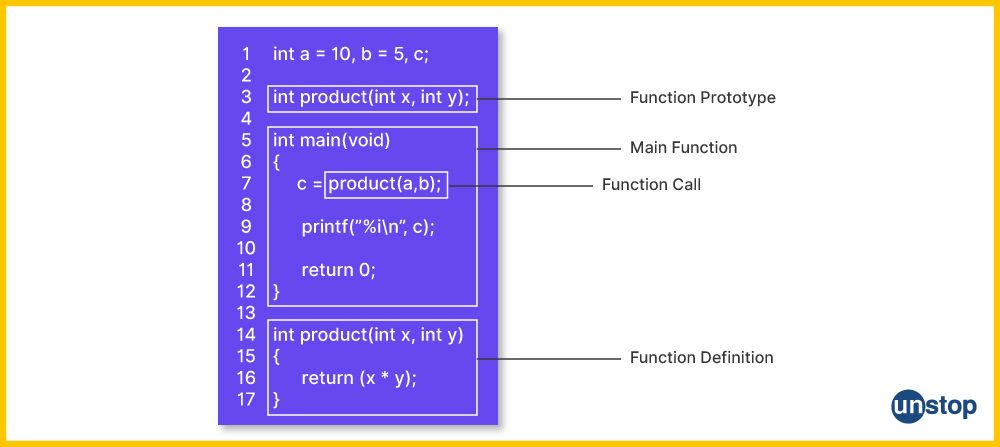
Start by reading the introductory section to understand the formal definition. Then, focus on the "Syntax For Function Prototype in C" and the "Example" that follows. Notice how the prototype int sum(int x, int y); is placed before main, allowing sum to be called inside main even though its full definition is at the end of the file.
To visualize how these pieces fit together, consider this breakdown:
3. Declaration vs. Definition
It's important to be precise with our terminology. While "declaration" and "prototype" are often used interchangeably for functions, there is a subtle but important distinction between declaring something and defining it in C.
- A declaration introduces an identifier (like a function or variable name) and its type to the compiler. A function prototype is a declaration.
- A definition provides the full implementation for that identifier. For a function, this means providing the code in its body. For a variable, it means allocating memory.

Using prototypes is considered good practice for several reasons:
- Organization and Readability: Placing
mainat the top of the file allows a reader to see the program's primary logic immediately, like a table of contents. - Error Checking: Prototypes allow the compiler to perform type-checking, ensuring you're calling functions with the correct number and types of arguments.
- Modularity: They are essential for splitting your code across multiple files (a topic for later), where functions in one file need to be called from another.
4. Your Turn: Practice with Prototypes
Now it's time to put this into practice. Your task is to write a program that uses a function to check if a number is even or odd. The key requirement is to place the function definition after the main function.
Problem:
- Write a function named
is_eventhat takes one integer argument (int num). - The function should return
1if the number is even and0if it is odd. (Hint: use the modulo operator%). - In
main, callis_evenwith a number and use anif-elsestatement to print whether the number is "even" or "odd". - Crucially, place the entire definition of the
is_evenfunction after themainfunction. - Add the necessary function prototype before
mainto make the code compile and run correctly.
You can use the problem from the resource below as a guide. Try to solve it yourself first!
C Programming Functions Exercises: 25 Coding Problems ...
This resource from pynative.com provides a hands-on coding exercise that perfectly matches our goal.
Refer to "Exercise 4: Function Prototype/Declaration". It includes the problem statement, a hint, and the complete solution. Use it to check your work or if you get stuck. Pay attention to how the solution has three parts: the prototype, the call in main, and the definition after main.
Conclusion
Today, you've added a crucial tool to your C programming toolkit: the function prototype. By separating a function's declaration from its definition, you've gained the flexibility to structure your code for maximum clarity and organization.
Key Takeaways:
- The C compiler processes files sequentially from top to bottom.
- A function must be declared before it can be called. Placing the function's definition before the call is one way to achieve this.
- A function prototype is a forward declaration that tells the compiler a function's name, return type, and parameter types, allowing you to define the function later.
- The syntax for a prototype is the function header followed by a semicolon:
return_type function_name(types...);. - Using prototypes is standard practice for creating readable, organized, and maintainable C programs.
Preview of the Next Lesson:
We've now thoroughly covered how to define functions, call them, and organize them in a file. Our next step is to understand how functions handle data. We'll explore the concept of variable scope, distinguishing between variables that are "local" to a function and those that are "global" and accessible everywhere. This will be key to managing data and avoiding bugs in more complex programs.