Recommended resources
The freely available resources this lesson will direct you to.
Welcome to the first lesson of our third module, "Modular Programming with Functions." In our last session, we wrapped up control flow by mastering nested loops and the critical skill of tracing code execution on paper. That skill will prove invaluable as we start building more complex programs.
So far, we've written all our code inside a single function: main. This works for small programs, but as problems get bigger, this approach quickly becomes messy, repetitive, and hard to manage. This lesson introduces the fundamental solution: functions. Our goal is to understand the purpose of functions for code organization, reuse, and abstraction, which together form the foundation of structured programming.
1. The "Why": Organization, Reuse, and Abstraction
Imagine writing a program that's thousands of lines long, all inside the main function. It would be like trying to read a book with no chapters or paragraphs—a giant wall of text. Finding a specific part, fixing an error, or adding a new feature would be a nightmare.
Functions allow us to solve this by breaking a large program down into smaller, self-contained, and logical pieces. This approach has three primary benefits:
- Organization (Modularity): Dividing the program into manageable chunks, where each chunk (function) is responsible for a single, specific task.
- Code Reuse: Writing a piece of code once and using it multiple times throughout your program, avoiding repetition. This is often called the "Don't Repeat Yourself" (DRY) principle.
- Abstraction: Hiding the complex details of how a task is done, allowing you to focus on what is being done.
Let's start with a short video that introduces these core ideas.
Function Basics | C Programming Tutorial
The video "Function Basics" by Portfolio Courses provides a great introduction to the reasons for using functions.
Watch the first part of the video, from the beginning to the motivation. Pay attention to how the speaker explains the benefits of grouping functionality and breaking down large problems.
2. Organization and Reusability in Practice
The video highlighted two key benefits: breaking down a program into smaller, logical parts (organization) and being able to call a block of code repeatedly (reusability).
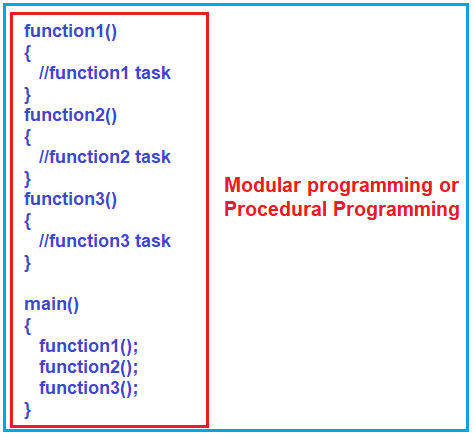
Let's look at this visually. Instead of a single, monolithic main function, a well-structured program looks more like an organizational chart, where main directs the work of other specialized functions.
To deepen our understanding of these benefits, let's read a short article that explicitly lists them.
Organizing Your Programs with Functions in C
This guide from spsanderson.com clearly outlines the advantages of using functions.
Please read the section titled "Benefits of Using Functions in C". Focus on the explanations for Modularity, Reusability, and Maintainability. Notice how maintainability is a direct result of good organization and reuse.
Let's see a simple code example. Imagine you want to print a decorative header at multiple points in your program.
Without functions (repetitive):
#include <stdio.h>

int main(void) {
    // Print a welcome header
    printf("====================\n");
    printf("     WELCOME\n");
    printf("====================\n\n");

    printf("Program is running...\n\n");

    // Print a closing header
    printf("====================\n");
    printf("      GOODBYE\n");
    printf("====================\n");

    return 0;
}
Now, let's "refactor" this code to use a function.
With a function (organized and reusable):
#include <stdio.h>

// A function to print a header
void print_header(void) {
    printf("====================\n");
}

int main(void) {
    print_header();
    printf("     WELCOME\n");
    print_header();
    printf("\n");

    printf("Program is running...\n\n");

    print_header();
    printf("      GOODBYE\n");
    print_header();

    return 0;
}
In the second version, the logic for printing a line of = is defined in one place (print_header).
- Organization: The task of "printing a header line" is neatly contained within its own function.
- Reusability: We call
print_header()four times without rewriting theprintfstatement. - Maintainability: If we wanted to change the header style (e.g., to use asterisks
*instead of equal signs=), we would only need to change it in one place: inside theprint_headerfunction.
3. The Power of Abstraction
Abstraction is arguably the most powerful concept that functions enable. It means separating the interface (what a function does) from the implementation (how it does it).
You use abstraction all the time. When you call printf("Hello, world!\n");, you are using abstraction.
- What it does: It prints the string "Hello, world!" to the console.
- How it does it: The internal details are incredibly complex, involving operating system calls, screen buffers, and hardware drivers.
Thankfully, all that complexity is hidden (abstracted away). You only need to know what the function does and how to call it. This allows you to build complex programs by standing on the shoulders of pre-existing, abstracted functionality.
Let's explore this idea with a non-programming analogy.
High level programming - Explaining abstraction
This article from DEV Community explains abstraction by separating the "what" from the "how."
Read the first section, "Abstraction as thinking about 'what' and not 'how'." Focus on the table that shows different levels of abstraction for making a cup of coffee. This perfectly illustrates how we can describe a process without getting lost in the low-level details.
Just like "Prepare a cup of coffee" is a high-level abstraction, a function call like calculate_final_grade() in a student information system is also an abstraction. The main function can simply call it to get the result, without needing to know the specific weighting of assignments, exams, and participation that happens inside the function.
This makes the main function act like a high-level summary of the program's logic, making it far easier to read and understand.
A Conceptual Example: A Simple Banking App
Let's tie these three concepts together. Imagine designing a simple ATM program. Without functions, your main function might look like this (in pseudocode):
main() {
    // Code to display main menu
    // ...
    // Get user choice
    // ...

    if (choice is 'check balance') {
        // Code to access account
        // ...
        // Code to retrieve balance
        // ...
        // Code to display balance
        // ...
    } else if (choice is 'deposit') {
        // Code to access account
        // ...
        // Code to ask for amount
        // ...
        // Code to update balance
        // ...
        // Code to display new balance
        // ...
    } else if (choice is 'withdraw') {
        // ... lots more code ...
    }
}
Now, let's rethink this using functions:
display_menu() { ... }
get_balance() { ... }
make_deposit() { ... }
make_withdrawal() { ... }

main() {
    display_menu();
    get user choice;

    if (choice is 'check balance') {
        get_balance();
    } else if (choice is 'deposit') {
        make_deposit();
    } else if (choice is 'withdraw') {
        make_withdrawal();
    }
}
See the difference?
- Organization: The logic for each action is in its own function.
- Reusability: The code to
get_balance()might be called from withinmake_deposit()andmake_withdrawal()to show the updated balance, reusing that functionality. - Abstraction: The
mainfunction is now a clean, high-level summary. It orchestrates the program's flow without being cluttered by the details of how each task is performed.
Conclusion
In this lesson, we focused on the fundamental reasons why we use functions in C. Understanding their purpose is the first and most important step toward writing clean, efficient, and maintainable code.
Key Takeaways:
- Organization: Functions break large, complex programs into small, manageable, and single-purpose modules.
- Reusability: Functions allow you to define code once and use it many times, adhering to the DRY (Don't Repeat Yourself) principle.
- Abstraction: Functions hide implementation complexity behind a simple interface, allowing you to focus on the high-level logic of your program.
Preview of the Next Lesson:
Now that we've covered the "why," the next lesson will dive into the "how." We will learn the specific C syntax for defining a function with parameters and a return value, and how to call functions and use the values they give back.