Recommended resources
The freely available resources this lesson will direct you to.
- Directing, Editing & Collaborationwww.youtube.com
- Pro Editor's First Steps To Editing A Movie - Lucas Hargerwww.youtube.com
- The Rule of Six — Walter Murch's In the Blink of an Eye - StudioBinderwww.studiobinder.com
- Editing as Emotion Engineering: How Video Production Companies ...www.soundideavideoproduction.co.za
Hello! Welcome back.
In our last lesson, we explored how experimental filmmakers deliberately break cinematic conventions to disrupt expectations and create new meanings. We looked at techniques like jump cuts and non-diegetic inserts and saw how an artist like Rebecca Horn uses the physical act of editing to construct powerful conceptual arguments.
Today, we'll build directly on that foundation. Knowing how to break the rules is one thing; shaping that disruption into a coherent and emotionally powerful film is another. This is rarely a solo endeavor. This lesson focuses on the crucial creative partnership between a director and an editor. Your learning outcome is to collaborate on the picture edit to refine pacing, rhythm, and emotional impact. We will explore how this dialogue works, from establishing a shared vision to giving effective feedback, transforming raw footage into a polished, emotionally resonant work of art.
1. The Goal of the Edit: Engineering Emotion
Before diving into the "how" of collaboration, we must be clear on the "why." The primary goal of the picture edit is not just to assemble a story, but to construct an emotional experience for the audience. Every cut, every pause, and every transition is a decision that shapes how the viewer feels.
Given your background in design, you can think of the editor as an architect of time and feeling. They take the building blocks you've provided (the shots) and structure them to create flow, tension, and release.
To understand these core principles, let's start with a short reading that frames editing as a form of "emotion engineering."
Editing as Emotion Engineering: How Video Production Companies ...
The article 'Editing as Emotion Engineering' provides a fantastic theoretical framework for our lesson. It breaks down how editing techniques directly influence an audience's psychological and even physiological state.
Please read the following sections: Editing as Emotion Engineering: Focus on Walter Murch's philosophy that emotion is the foremost priority. Pace: The Pulse of Emotional Engagement: Note the distinction between fast and slow pacing. Breath: The Power of Pause and Silence: Understand how lingering on a shot creates space for reflection and tension. Emotional Continuity: Beyond Spatial and Temporal Logic: This is especially relevant for experimental film. It argues that feeling can be the glue that holds disparate shots together. Collaborative Emotion: Editor as Audience Proxy: This section perfectly introduces the collaborative aspect of editing.
The article references Walter Murch, a legendary editor and sound designer. His "Rule of Six," from his book In the Blink of an Eye, is a foundational concept in editing. He created a hierarchy of priorities for what makes a good cut. The list is weighted, and the values are his ideal percentages for what an editor should prioritize:
- Emotion (51%): Is the cut true to the emotion of the moment?
- Story (23%): Does the cut advance the story?
- Rhythm (10%): Does the cut occur at a rhythmically interesting and "right" moment?
- Eye-Trace (7%): Does the cut respect the audience's focus of attention within the frame?
- 2D Plane of Screen (5%): Does the cut respect the 180-degree rule and spatial continuity?
- 3D Space (4%): Is the cut true to the physical and spatial relationships within the scene?
Murch's crucial point is that emotion is more important than everything else combined. If a cut serves the emotion but breaks spatial continuity (rules 5 and 6), it's a good cut. This hierarchy provides a shared language and value system for you and your editor. Your discussions will often revolve around whether a choice serves the film's emotional truth, even if it breaks a technical "rule."
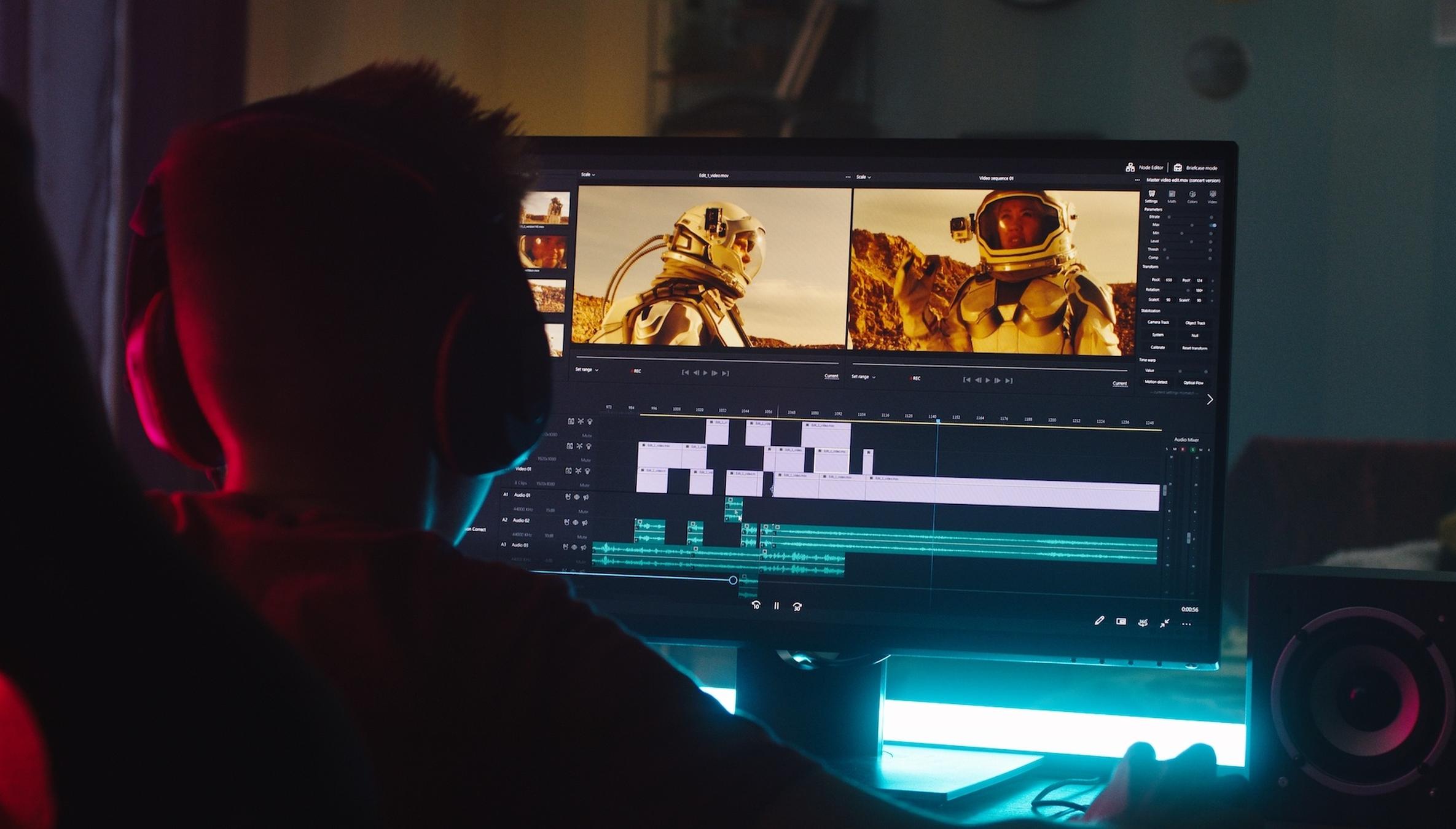
2. The Editor as Your First Audience and Creative Partner
For an artistic filmmaker, the editor is not a technician who simply assembles a puzzle you've already solved. They are your first, most critical audience and a vital creative partner. They come to the footage with fresh eyes, free from the baggage of the shoot. This perspective is invaluable, especially in experimental work where the final form is often discovered, not just executed.
The following video features two professional editors discussing this dynamic. One explains his process when starting a new project.
Pro Editor's First Steps To Editing A Movie - Lucas Harger
In 'Pro Editor's First Steps To Editing A Movie,' editor Lucas Harger offers insight into the editor's mindset. Understanding this perspective is key to building a successful collaboration.
Watch the following clips: 00:04 - 01:04: Listen to why Harger insists on watching all the footage alone first, acting as the 'first audience.' 02:04 - 03:21: Focus on his description of documentary editing as a partnership where '1+1=3' and the goal is to discover the film together. 05:10 - 05:54: Pay attention to his analogy of editing as 'sculpting with clay.' This should resonate with your design background—the process is iterative, moving from a rough form to a refined sculpture.
Harger's "1+1=3" concept is the essence of great collaboration. Your vision plus the editor's interpretation creates something new and more potent than either of you could have made alone. To achieve this, you must grant your editor the trust and creative freedom to experiment.
This next video explores this idea further, with a director encouraging his editor to "go crazy" and surprise him.
Directing, Editing & Collaboration
In 'Directing, Editing & Collaboration,' director Abian Acuña, who started as an editor, discusses the value of giving an editor creative license.
Watch from 07:16 to 09:33. Notice the dialogue about how the editor initially felt 'precious' about the director's vision, but the director pushed him to go further, restructure scenes, and 'surprise' him. This is where unexpected magic can happen.
For the kind of surrealist, metaphorical films you want to create, this willingness to be surprised is paramount. Your script or concept is the starting point, but the final emotional and rhythmic structure will be found through this collaborative exploration in the edit.
3. The Practicalities of Collaboration: Giving Notes
Trust and creative freedom are the foundation, but a successful collaboration also requires clear and constructive communication. The most common point of interaction is when you review a cut and provide feedback. How you give these notes can make the difference between a frustrating process and a fruitful one.
A common mistake for first-time directors is to state what's wrong without offering a way forward. Phrases like "It's just not working for me" or "The pacing feels off" are unhelpful because they identify a problem without diagnosing its cause or suggesting a solution.
Let's return to the "Directing, Editing & Collaboration" video, where the speakers provide excellent advice on how to give effective notes.
Directing, Editing & Collaboration
Here, the speakers discuss the art of giving and receiving notes—a critical skill for any director.
Watch these two key segments: 05:35 - 07:16: The most important advice is here. A strong director says, 'Here's what I don't like... and here's the direction I'd like you to go.' Always try to offer a solution or a new idea to try. 09:33 - 10:21: Listen to the advice about not rushing an editor. Pushing to see an unfinished 'rough cut' can damage the process, as you may react to problems the editor already plans to fix.
Another common challenge is what to do when there's a disagreement—for example, when you love a beautiful shot that the editor feels is hurting the film's rhythm. In these moments, refer back to Murch's hierarchy. Is the shot serving the emotion and the story, or is it just a "darling" you need to "kill"?
The "Pro Editor's First Steps" video has a great segment on this exact scenario.
Pro Editor's First Steps To Editing A Movie - Lucas Harger
This clip addresses a classic director-editor conflict: the beautiful but non-functional shot.
Watch from 08:54 to 10:48. The editor argues that every shot must be 'functional first and then beautiful second.' It must push the narrative (or in your case, the emotional or thematic idea) forward. This is the framework for negotiating such creative differences.
4. Practical Exercise: Crafting Collaborative Feedback
Let's put this into practice. Imagine you are working on your short film, which blends performance art and surrealist imagery. You've just received the first assembly of a key scene from your editor.
The Scene: A performer, wearing one of your sculptural costume designs, moves slowly through a dense forest. Your intention for the scene is for it to feel both tense and meditative, like a ritual.
The Editor's Cut: The current cut feels a bit flat. The editor has used mostly long, continuous takes. The pacing is slow, but it feels more sleepy than meditative. The tension is missing.
Your Task:
Write a few bullet points of feedback for your editor. Using the principles we've discussed, frame your notes to be clear, constructive, and collaborative. Don't just state the problem; suggest a new direction to explore.
Think about:
- How can you introduce rhythm or contrast?
- Could you use "breath" or pauses more effectively?
- Are there opportunities for associative editing, perhaps cutting to close-ups of textures (bark, the costume fabric) to enhance the mood?
Take about 5-10 minutes to draft your notes. This will help you internalize the language of effective collaboration.
Conclusion
Today, we've shifted our focus from the "what" of editing to the "who" and "how." We've seen that the picture edit is not a mechanical process, but a dynamic, creative dialogue where the film truly finds its final form.
Key Takeaways:
- Editing is Emotion Engineering: The primary goal is to shape the audience's emotional journey through the deliberate control of pacing, rhythm, and breath.
- The Editor is a Creative Partner: Trust your editor's fresh perspective and give them the freedom to experiment and surprise you. The best results often come from discoveries made together in the edit suite.
- Communicate Constructively: When giving feedback, diagnose the issue and propose a solution or a new avenue to explore. Frame your notes as a shared problem to solve.
- Prioritize Emotion: Always return to Walter Murch's core principle. Does the cut serve the feeling of the moment? This is your ultimate guidepost in any creative discussion.
What's Next?
With this lesson, we conclude our module on "The Art of the Edit." You now have a comprehensive understanding of editing, from its foundational rules to its experimental possibilities and the collaborative process of refinement.
But a film is experienced with the ears as well as the eyes. In our next module, "Finishing the Film: Sound and Color," we will begin with a crucial topic: analyzing how sound design creates mood, texture, and emotional atmosphere in a scene. You will discover how sound can reinforce, contradict, and transform the images you have so carefully assembled.