Recommended resources
The freely available resources this lesson will direct you to.
- Marx's Law of Value: Intro to Marxist Economics | Socialism 101www.youtube.com
- Fundamentals of Marx: Surplus Labor and Valuewww.youtube.com
- The Labor Theory of Value and Surplus Value - Red Starredstarcaucus.org
- Surplus value is the class struggle: An introduction - Liberation Schoolliberationschool.org
Introduction
In our previous lesson, we explored the socialist critique that capitalism inherently generates unjust levels of economic inequality. We saw that this argument isn't just an observation about wealth gaps but a moral claim rooted in specific ideas about justice. We ended by noting that this critique of unequal outcomes is connected to a deeper, more fundamental charge: that the very relationship between employer and employee is one of exploitation.
To understand this powerful accusation, we must now delve into the core of Karl Marx's economic thought. This lesson will introduce two of his most foundational concepts: the Labor Theory of Value and surplus value. These ideas are the essential building blocks for the entire Marxist analysis of capitalism. By grasping them, you'll be able to see exactly how a Marxist would argue that profit is generated and why they believe it comes at the expense of the worker, a topic we will explore fully in the next lesson.
What Determines Value?
In a market economy, everything seems to have a price. A car costs more than a bicycle, and a smartphone costs more than a cup of coffee. But what fundamentally determines these relationships?
As we learned in our economics module, prices in a marketplace are typically explained by supply and demand. However, Karl Marx and the classical economists before him, like Adam Smith and David Ricardo, sought a more fundamental answer. They asked: what underlying quality do all these different goods share that allows them to be compared and exchanged in the first place?
Marx begins his analysis by defining a commodity: an item produced not for personal use, but specifically for exchange in the market. He argues that every commodity has two distinct aspects:
- Use-Value: This is the utility of an object, what it's used for. The use-value of a coat is to provide warmth; the use-value of bread is to provide nourishment. This is qualitative and depends on the physical properties of the thing.
- Exchange-Value: This is what a commodity can be traded for on the market. It is typically expressed as its price. For example, the exchange-value of a coat might be $100. This is quantitative.
The central puzzle is this: how can the use-values of a coat and $100, which are completely different things, be seen as equivalent? Marx's answer is that they share a common substance: they are both products of human labor. The following video provides a concise introduction to these foundational concepts.
Marx's Law of Value: Intro to Marxist Economics | Socialism 101
The video "Marx's Law of Value" from the channel Marxism Today begins by explaining these essential distinctions between a commodity, its use-value, and its exchange-value.
Please watch the opening section from 00:39 to 2:04. Focus on how the narrator defines a commodity and differentiates between its usefulness (use-value) and its price (exchange-value).
Socially Necessary Labor Time
As the video concludes, it raises the key question: what determines the ratio at which commodities are exchanged? Marx's answer is what has come to be known as the Labor Theory of Value (LTV).
The LTV states that the value of a commodity is determined by the amount of labor time required to produce it. However, Marx added a crucial qualification: it is not the actual time an individual worker took, but the socially necessary labor time (SNLT). This is the average time required to produce a commodity using the average level of skill and technology prevalent in a society at a given time.
This refinement is important for two reasons:
- It means a slow or inefficient worker doesn't create more value just by taking longer.
- It accounts for technological progress. When a new machine halves the time needed to make a shirt, the socially necessary labor time—and thus the value—of a shirt is also halved.
Let's continue with the same video to see how this concept is explained.
Marx's Law of Value: Intro to Marxist Economics | Socialism 101
This next segment of the video clarifies the concept of "value" and explains why it's defined as "socially necessary labor time."
Watch from 2:04 to 4:37. Pay close attention to the distinction between simple labor and socially necessary labor, as well as the explanation of how the value of the chair is determined by the average production time.
To reinforce these ideas, the following reading offers a detailed textual explanation of the Labor Theory of Value, including how money serves as a universal equivalent for value and how the value of tools and machines is transferred to the final product.
The Labor Theory of Value and Surplus Value - Red Star
This article from Red Star provides a systematic breakdown of the core components of the LTV.
Please read Part I, from the beginning down to the break. Focus on understanding the definitions of use-value and exchange-value, and how socially necessary labor time acts as the underlying determinant of a commodity's value.
The Origin of Profit: Surplus Value
We have now established the first pillar of Marx's theory: value comes from socially necessary labor. This leads to a profound puzzle. If all commodities, on average, are bought and sold at their true value (i.e., you exchange a product representing 10 hours of labor for money representing 10 hours of labor), where does profit come from? If everything is exchanged for an equivalent, it seems impossible to end up with more value than you started with. This is what Marx called the general formula for capital: , where a sum of money (M) is used to buy commodities (C) which are then sold for a larger sum of money (M'). Where does the "prime" ('), the extra bit, come from?
Marx's solution to this puzzle is his theory of surplus value. He argued that the capitalist, Mr. Moneybags, is able to find one very special commodity on the market—a commodity whose use-value is its unique ability to create new value.
This special commodity is labor-power.
- Labor-power is a worker's capacity to work for a given period. When you are hired, you are not selling your finished labor (a finished product), but your ability to labor for a set number of hours.
- Like any other commodity, the value of labor-power is determined by the socially necessary labor time required to produce it. This means the value of the food, clothing, shelter, and other necessities required to keep the worker alive and able to come back to work the next day.
- The key is that the value created by using labor-power is greater than the value of labor-power itself.
The capitalist pays the worker a wage that corresponds to the value of their labor-power (e.g., enough to live on). Let's say this value is equivalent to 4 hours of labor. However, the capitalist has purchased the worker's labor-power for an entire workday, say, 8 hours.
In those 8 hours, the worker produces value.
- For the first 4 hours, the worker creates value equivalent to their own wage. Marx calls this necessary labor.
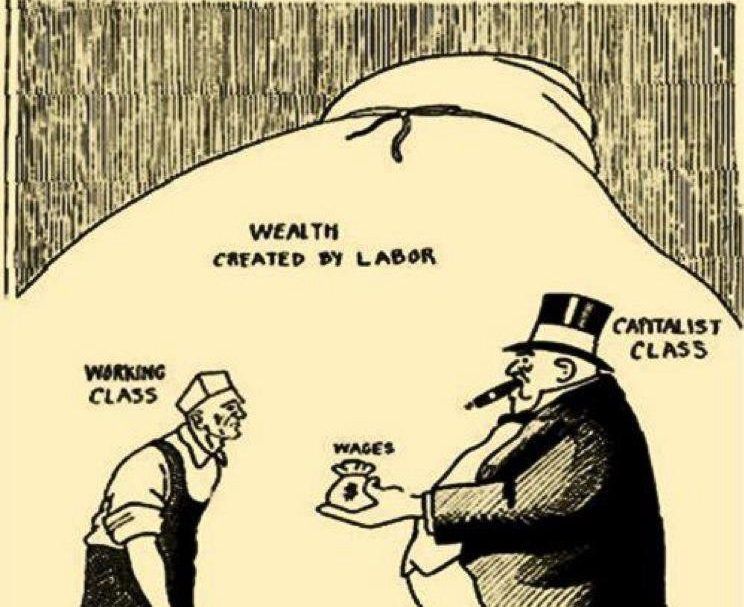
- For the remaining 4 hours, the worker continues to create value. This additional value, for which the worker is not paid, is surplus value. This surplus value is the source of the capitalist's profit.
This entire process is laid out with a clear numerical example in the next, most crucial segment of the video.
Marx's Law of Value: Intro to Marxist Economics | Socialism 101
This section explains the origin of surplus value by introducing labor-power as a unique commodity and walking through the process of capitalist production.
This is the core of the lesson, so please watch this segment carefully, from 5:04 to 11:57. Pay close attention to the expanded formula for capital, the numerical example of making the chair, and how the final profit of €40 is identified as the "unpaid labor of the worker."
The process described in the video can be visualized as a circuit.

The logic of surplus value suggests that the wealth of the capitalist class is built upon the unpaid labor of the working class. This is the central claim of the Marxist critique.
The Rate of Exploitation
From this analysis, Marx derives a formula to measure the degree of this process. He divides the working day into two parts:
- Necessary Labor Time: The portion of the day when the worker produces value equivalent to their wages.
- Surplus Labor Time: The portion of the day when the worker produces surplus value for the capitalist.
The rate of surplus value, which Marx considers the rate of exploitation, is the ratio of surplus value (s) to the capital spent on wages, which he calls variable capital (v).
In the video's example, the surplus value was €40 and the wages were €40. The rate of exploitation is therefore , or 100%. This means for every hour the worker labored to earn their own wage, they labored another hour for the capitalist for free.
Driven by competition, capitalists constantly seek to increase this rate. The video briefly mentions two primary methods:
- Absolute Surplus Value: Increasing the length of the working day.
- Relative Surplus Value: Increasing worker productivity (making them produce more in the same amount of time) or decreasing the value of labor-power (e.g., by making necessities cheaper).
Marx's Law of Value: Intro to Marxist Economics | Socialism 101
This final clip explains the two main ways capitalists seek to increase the rate of surplus value.
Watch from 11:57 to 14:31 to understand the distinction between absolute and relative surplus value.
Conclusion
In this lesson, we have unpacked the theoretical engine of the Marxist critique of capitalism. It is a systematic attempt to look beneath the surface of market exchange and uncover what Marxists believe to be the true source of profit.
Let's summarize the key takeaways:
- Labor Theory of Value (LTV): In this theory, the economic value of a commodity is determined by the socially necessary labor time required to produce it.
- Labor-Power: Marx identified labor-power (the ability to work) as a unique commodity whose use-value is the creation of new value.
- Surplus Value: This is the value a worker produces beyond what is necessary to cover the cost of their own wages. Marx argues that this surplus is appropriated by the capitalist and is the sole source of profit, rent, and interest.
- Exploitation: The rate of surplus value () is seen as a direct measure of the rate of exploitation of the worker.
It is crucial to understand that, in this view, exploitation is not about being underpaid or treated cruelly (though that may also happen). It is a structural feature of the wage-labor relationship itself. Even in a "fair" exchange where the worker is paid the full value of their labor-power, exploitation occurs because the value created by that labor-power belongs to the capitalist.
Now that we have established the concepts of the Labor Theory of Value and surplus value, we are ready to build upon them. In our next lesson, we will explore the full Marxist concept of exploitation and see how it is used to argue that the freedom of the worker in capitalism is an illusion.