Recommended resources
The freely available resources this lesson will direct you to.
- Marx's Law of Value: Intro to Marxist Economics | Socialism 101www.youtube.com
- Fundamentals of Marx: Surplus Labor and Valuewww.youtube.com
- 4: The Marxian Theory of Class Exploitation - Social Sci LibreTextssocialsci.libretexts.org
- SOCY 151 - Lecture 13 - Marx's Theory of Class and Exploitationoyc.yale.edu
Introduction
In our last lesson, we established the foundations of Karl Marx's economic theory: the idea that the value of a commodity comes from the socially necessary labor time required to produce it, and the concept of surplus value. We saw how a capitalist, by purchasing the unique commodity of labor-power, can end a production cycle with more value than they started with. The key insight was that the value created by labor-power in a workday is greater than the value of the labor-power itself (the wage).
This lesson builds directly on that foundation to explore one of the most powerful and controversial concepts in the socialist tradition: exploitation. We will see that for Marx, exploitation is not simply a moral accusation of mistreatment or underpayment. It is a technical description of the fundamental relationship between capital and labor. By the end of this lesson, you will be able to describe precisely what Marxists mean by exploitation and understand why they argue it is an inescapable feature of the capitalist system, regardless of how "free" the labor contract appears to be.
The Logic of Capitalist Production
To understand exploitation, we must first grasp the purpose of production in a capitalist system. Marx distinguishes between two fundamental circuits of exchange.
-
Petty Commodity Production: C-M-C
This circuit stands for Commodity → Money → Commodity. An independent artisan, like a shoemaker, makes a pair of shoes (a commodity), sells them for money, and then uses that money to buy other commodities they need, like bread. The primary goal here is the satisfaction of needs; money is just a means of exchange. -
Capitalist Production: M-C-M'
This circuit is Money → Commodity → More Money. The capitalist starts with a sum of money (M), uses it to buy commodities (labor-power and means of production), and produces a new commodity, which is then sold for a larger sum of money (M', where ' represents the surplus value). The primary goal here is not the satisfaction of needs, but the generation of profit and the endless accumulation of capital.
As Professor Iván Szelényi explains in his Yale lecture, this distinction is crucial. It marks the difference between a simple market society and a truly capitalist one.
SOCY 151 - Lecture 13 - Marx's Theory of Class and Exploitation
This excerpt from a lecture transcript by Professor Szelényi explains the difference between production for need (C-M-C) and production for profit (M-C-M').
Please read the section titled "Theory of Exploitation." Focus on the distinction Professor Szelényi draws between petty commodity production and the capitalist alternative. Think about why, in the M-C-M' circuit, the capitalist must end up with more money.
The central puzzle, which we began to solve in the last lesson, is where this "more money" (M') comes from. If all commodities exchange at their value, one cannot get rich simply by buying and selling. The source of new value must be found within the production process itself.
The "Free" Worker
Marx's solution lies in the existence of a class of people who have a specific commodity to sell: their labor-power. For labor-power to become a widely available commodity, Marx argues that a specific set of historical conditions must be met. The worker must be "free in a double sense."
- Legally Free: Workers must be legally recognized as the owners of their own labor-power, free to enter into contracts and sell it to whomever they choose. They are not slaves bound to a master or serfs bound to the land.
- "Freed" from the Means of Production: Workers must also be separated from the means of producing their own livelihood. They do not own land, factories, or significant capital. Because they have no other way to survive, they are compelled to sell their labor-power to those who do own the means of production—the capitalists.
This "double freedom" is the crux of the Marxist critique of the labor contract. While the exchange between the worker and the capitalist appears to be a voluntary agreement between equals, Marxists argue it takes place under conditions of profound structural inequality. The choice for the worker is not simply whether to work, but for which capitalist to work—or face destitution.
The following text explains this crucial historical precondition for capitalism.
4: The Marxian Theory of Class Exploitation - Social Sci LibreTexts
This reading from LibreTexts discusses the historical origins of labor-power as a commodity.
Read the paragraphs explaining how labor-power became a commodity, focusing on the section where Marx asserts that workers became "free in a double sense."
The Mechanism of Exploitation Explained
With this context, we can now define exploitation precisely. As we learned previously, the capitalist purchases the worker's labor-power at its value—that is, a wage sufficient to cover the worker's means of subsistence (food, shelter, etc.). This wage allows the worker to reproduce their labor-power and return to work the next day.
However, the amount of value the worker creates during the workday is greater than the value of their wage. This difference is the surplus value, which the capitalist appropriates as profit.
Exploitation, in the Marxist sense, is the process by which capitalists appropriate the surplus value produced by the unpaid labor of workers.
Let's break down the working day:
- Necessary Labor Time: The portion of the day in which the worker produces value equivalent to their own wage. If a worker earns $120 for an 8-hour day and creates $30 of value per hour, their necessary labor time is 4 hours ($120 / $30 per hour).
- Surplus Labor Time: The remaining portion of the day. In our example, this is the other 4 hours. During this time, the worker is performing unpaid labor, creating surplus value for the capitalist.
This diagram provides a simple visual summary of how value flows from the worker to the capitalist.
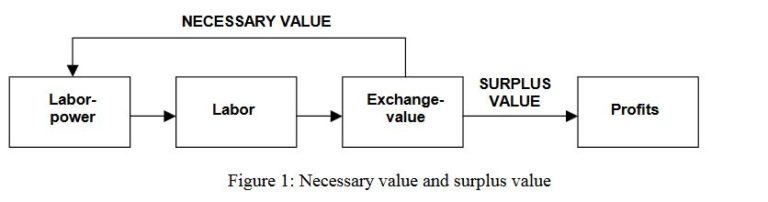
It is absolutely crucial to understand that in this model, the worker is not being cheated. The capitalist is paying the fair market price for the commodity they bought—labor-power. The "magic" of capitalism, from this perspective, is that this specific commodity has the unique ability to produce more value than its own cost. Exploitation is thus an objective, structural feature of the system, not a subjective feeling of being wronged or an act of fraud.
The following video provides a concise and clear explanation of this entire process, culminating in the definition of exploitation.
Marx's Law of Value: Intro to Marxist Economics | Socialism 101
This video, "Marx's Law of Value," which we used in our previous lesson, provides an excellent summary of how the purchase of labor-power leads to the creation of surplus value and exploitation.
Please watch from 5:23 to 11:21. This segment is the heart of the Marxist argument. Focus on: The distinction between selling labor and selling labor-power. The expanded formula for capital (M-C...P...C'-M') and where profit appears. The numerical example of the chair, tracking how the initial €60 investment becomes €100. The final explanation of exploitation as the "appropriation of the proletariat's unpaid labour."
The Rate of Exploitation
Marx provided a formula to measure the degree of exploitation, which he called the rate of surplus value. This rate is the ratio of surplus value (s) to variable capital (v)—the amount of capital spent on wages.
In the video's example, the surplus value was €40 and the wages were €40. The rate of exploitation is therefore , or 100%. This means that for every hour the worker labored to reproduce their own wage, they labored another hour for the capitalist.
From a Marxist viewpoint, the entire dynamic of capitalism is driven by the capitalist class's need to maximize this rate of exploitation in the face of competition. As we briefly covered, this is done by increasing absolute surplus value (e.g., lengthening the workday) or relative surplus value (e.g., increasing productivity through new technology or pushing down wages).
Conclusion
In this lesson, we have moved from the mechanics of surplus value to the full concept of Marxist exploitation. This concept is one of the most significant challenges to the libertarian vision of a free society based on voluntary contracts.
Let's review the key takeaways:
- Marxist Exploitation is the appropriation by capitalists of the surplus value created by the unpaid labor of workers.
- It is a structural feature of the wage-labor relationship, not an issue of individual cheating or unfairness. The worker receives the fair market value for their labor-power.
- This relationship is possible because workers are "free in a double sense": they are free to sell their labor, but also "freed" from any other means of survival, compelling them to enter the labor market.
- The rate of exploitation () is a technical measure of the ratio of unpaid to paid labor, and maximizing it is the core dynamic of capitalist production.
From a Marxist perspective, the freedom celebrated by libertarians—the freedom to own property and enter into contracts—is an illusion for the working class. It is the freedom to choose one's exploiter. The formal equality of the contract masks a fundamental inequality in power rooted in the ownership of the means of production.
Having explored this foundational critique, our next lesson will broaden the scope. We will examine the more general argument that libertarianism fails to account for the real-world power imbalances between employers and workers, a critique that builds on the idea of structural exploitation but is also shared by many non-Marxist socialists.