Recommended resources
The freely available resources this lesson will direct you to.
Introduction
In our last lesson, we examined the socialist critique that libertarianism's emphasis on voluntary contracts overlooks the significant power imbalances inherent in the employer-employee relationship. We saw how concepts like "private government" and the illusory "freedom to quit" suggest that for many, the labor market is not a realm of true freedom but one of necessity and subordination.
This lesson delves into another profound challenge to libertarian thought: the collective action problem. This problem arises in situations where even if everyone is perfectly free and equal, individually rational decisions can lead to outcomes that are disastrous for the entire group. This phenomenon questions the core libertarian faith that voluntary cooperation and self-interest are always sufficient to produce beneficial social outcomes. Our goal is to understand what a collective action problem is, why it occurs, and why it represents a significant hurdle for a political philosophy that seeks to minimize or eliminate the state.
What is a Collective Action Problem?
At its heart, a collective action problem (sometimes called a social dilemma) describes a situation where all individuals would be better off if they cooperated, but they fail to do so because of conflicting individual interests.
This Wikipedia article provides a concise definition and historical context for the collective action problem.
Please read the first few paragraphs of the article, from the beginning down to the end of the quote from David Hume. Pay attention to the core definition and Hume's classic example of draining a meadow.
As Hume's example illustrates, cooperation is easy in small groups where everyone knows each other and individual contributions are obvious. However, as the group gets larger, the incentive changes. Each person thinks, "My individual contribution is just a drop in the bucket. The project will probably succeed (or fail) without me. So why should I bear the cost and effort when I can just enjoy the benefit if others do the work?"
When everyone thinks this way, no one contributes, and the beneficial project never happens. This is the essence of the collective action problem. It's a conflict between individual rationality and group rationality.
There are several classic forms of this problem. We will explore two of the most famous: the Tragedy of the Commons and the Free-Rider Problem.
The Tragedy of the Commons
Imagine a shared resource that is available to everyone, but is also finite. The "Tragedy of the Commons" describes how such a resource is likely to be depleted, even when it is in everyone's long-term interest to preserve it.
The following animated video from TED-Ed provides a brilliantly simple explanation of this concept.
What is the tragedy of the commons? - Nicholas Amendolare
This video, "What is the tragedy of the commons?", uses a simple thought experiment about a shared fish pond to illustrate the core logic of this problem.
Please watch from the beginning to 3:59. As you watch, focus on these points: Why is catching only one fish per day the optimal long-term strategy for the whole village? Why does each individual villager have an incentive to catch more than one fish? How do real-world examples like overfishing, antibiotic resistance, and pollution follow this same pattern?
The tragedy occurs because the benefits of over-consumption are concentrated in the hands of the individual (the extra fish I catch are all mine), while the costs are spread across the entire group (the decline in the fish population affects everyone). Each person's rational calculation is to take an extra fish before their neighbor does. When everyone follows this logic, the commons is destroyed, and everyone loses.
This isn't just a hypothetical. As the video and the OpenStax text below explain, this dynamic is at the heart of many of our most pressing environmental problems.
6.4 Collective Action Problems: The Problem of Incentives - OpenStax
This section from the OpenStax textbook, Introduction to Political Science, provides further examples of the tragedy of the commons.
Read the section titled The Tragedy of the Commons. Note how global climate change is presented as a quintessential example of this problem.
For libertarians, the tragedy of the commons poses a difficult question. If voluntary self-restraint is unlikely to work, what can prevent the depletion of shared resources like oceans, clean air, or stable climates? The most common answer is a governing authority that can enforce rules (e.g., fishing quotas, pollution limits). But this, of course, means granting the state coercive powers that many libertarians are reluctant to accept.
The Free-Rider Problem and Public Goods
A closely related issue is the free-rider problem. This occurs when individuals can benefit from a good or service without contributing to its creation or maintenance. This problem is especially acute for a special category of goods called public goods.
In economics, a public good has two key features:
- Non-excludable: It is impossible or very costly to prevent people who don't pay for the good from using it.
- Non-rivalrous: One person's use of the good does not diminish the ability of others to use it.
Think of national defense, a lighthouse, or clean air. If a country has an army, it protects all citizens, whether they paid their taxes or not (non-excludable). And one person being protected doesn't reduce the protection available to others (non-rivalrous).
The free-rider problem emerges because if people can get the benefit for free, many will choose not to pay.
6.4 Collective Action Problems: The Problem of Incentives - OpenStax
This section from the OpenStax textbook uses the familiar example of a group project to explain the free-rider problem.
Read the section titled The Free Rider Problem. The school group project is a perfect analogy for the incentive to free-ride.
If a public good like a new park or a local fireworks display had to be funded by purely voluntary donations, it would likely be underfunded or not funded at all. Everyone might want the park, but each person hopes that other people will donate enough to build it, allowing them to enjoy it for free.
This dynamic creates a powerful argument for the existence of the state. The state can solve the free-rider problem by using its power of taxation to force everyone who benefits from a public good to contribute to its cost. This is a primary justification for the state's role in providing things like national defense, a legal system, and basic infrastructure—all services that libertarians agree are necessary, but which anarcho-capitalists believe the market could provide.
The Prisoner's Dilemma: The Logic of Non-Cooperation
Game theory provides a formal model to understand why two rational individuals might not cooperate, even if it appears that it is in their best interests to do so. This model is called the Prisoner's Dilemma.
Let's walk through the classic scenario.
6.4 Collective Action Problems: The Problem of Incentives - OpenStax
This final section from the OpenStax text clearly explains the setup and the paradoxical outcome of the Prisoner's Dilemma.
Read the section titled The Prisoner's Dilemma. Focus on the payoff matrix and the logical steps each prisoner takes. Why is "accusing" (defecting) the dominant strategy for each individual, regardless of what the other does?
Let's break down the logic from Prisoner A's perspective:
- "If Prisoner B stays silent, my best move is to accuse them. I would go free instead of serving 1 year."
- "If Prisoner B accuses me, my best move is also to accuse them. I would serve 5 years instead of 8."
Since Prisoner B faces the exact same set of choices and payoffs, they will reason in the exact same way. Therefore, both prisoners will rationally choose to accuse the other, leading to them both serving 5 years. The paradox is that if they had both cooperated (by staying silent), they would have only served 1 year each. Their individual pursuit of self-interest leads to a worse outcome for both of them.
This simple game models countless real-world situations, from arms races between countries to price wars between companies, and it starkly illustrates the core logic of collective action problems.
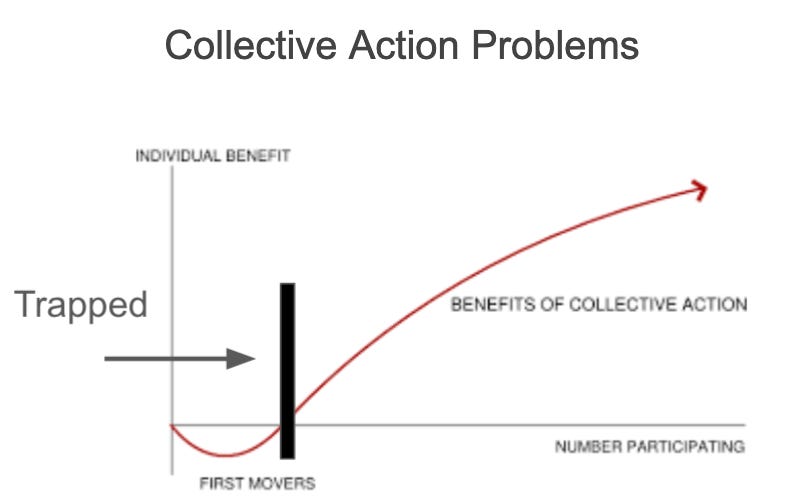
The following graph visualizes the barrier to initiating cooperation.
Conclusion: A Challenge to Voluntary Order
The family of collective action problems we've explored—the Tragedy of the Commons, the free-rider problem, and the Prisoner's Dilemma—presents a formidable challenge to libertarianism. It suggests that Adam Smith's "invisible hand" may not always guide individual self-interest toward collectively good outcomes. In many crucial areas, from environmental protection to the provision of public goods, voluntary action seems prone to failure.
Here are the key takeaways from this lesson:
- Collective Action Problem: A situation where rational, self-interested individuals have incentives to act in ways that produce a suboptimal outcome for the entire group.
- Tragedy of the Commons: When a shared, finite resource is depleted because each individual has an incentive to take as much as they can, spreading the negative effects across the group.
- Free-Rider Problem: Individuals can enjoy the benefits of a good or service (especially public goods) without contributing, leading to the under-provision of those goods.
- Prisoner's Dilemma: A formal model showing how a lack of trust and an inability to coordinate can lead rational actors to "defect" rather than "cooperate," to the detriment of both.
- The Challenge to Libertarianism: These problems provide a powerful rationale for a state with coercive powers (like taxation and regulation) to change incentives and force cooperation for the common good, challenging the libertarian ideal of a purely voluntary society.
Libertarians have responses to these challenges, often involving the privatization of common resources or the development of complex contractual solutions. But the simple existence of these problems demonstrates that achieving a prosperous and stable society is more complex than simply letting individuals make free choices.
In our next and final lesson of this module, we will examine the socialist argument that true freedom requires more than just the absence of coercion—it requires access to the material resources necessary to live a flourishing life.