Recommended resources
The freely available resources this lesson will direct you to.
- Positive and Negative Liberty: Who has more Freedom?www.youtube.com
- Positive and Negative Liberty (Isaiah Berlin - Two Concepts of Liberty)www.youtube.com
- Negative & Positive Freedom (Liberalism) | Reference Library | Politicswww.tutor2u.net
- Two Types of Liberty - Sprouts - Learning Videos - Social Sciencessproutsschools.com
Introduction
In our last lesson, we explored the collective action problem, which demonstrates how rational, self-interested individuals might fail to cooperate for their mutual benefit, suggesting a potential need for a state to provide public goods and regulate common resources. This challenged the libertarian faith that voluntary action is always sufficient to produce a good society.
Today, we will examine the final and perhaps most profound critique from the socialist tradition. This argument shifts the focus from the problem of coordinating free individuals to the very definition of freedom itself. We will explore the argument that freedom defined merely as the absence of coercion—what libertarians champion as negative liberty—is an incomplete and hollow concept. Socialists argue that for freedom to be meaningful, an individual must also possess the actual capacity and resources to achieve their goals. This is the concept of positive liberty.
By the end of this lesson, you will be able to summarize the socialist argument that negative liberty is meaningless without the material resources to exercise it.
Two Concepts of Liberty: "Freedom From" vs. "Freedom To"
The debate at the heart of today's lesson revolves around two different ways of understanding liberty, famously articulated by the philosopher Isaiah Berlin.
- Negative Liberty: This is freedom from external interference. It means no one is actively stopping you from doing something. This is the concept of liberty central to libertarianism. The core question is: "What am I free from?"
- Positive Liberty: This is the freedom to act upon one's own will and achieve one's potential. It is about having the power and resources to fulfill your goals. The core question is: "What am I able to do?"
To begin, let's watch a short video that introduces this crucial distinction.
Positive and Negative Liberty (Isaiah Berlin - Two Concepts of Liberty)
The video "Positive and Negative Liberty" from the Tom Richey channel provides a concise introduction to these two concepts.
Watch the opening segment from the beginning. Pay close attention to the key phrases: "freedom from outside interference" versus "freedom to act upon one's will." Note the examples "I am no one's slave" (negative) versus "I am my own master" (positive).
The following infographic provides a helpful summary of the key differences between these two concepts. You can refer back to it throughout the lesson.
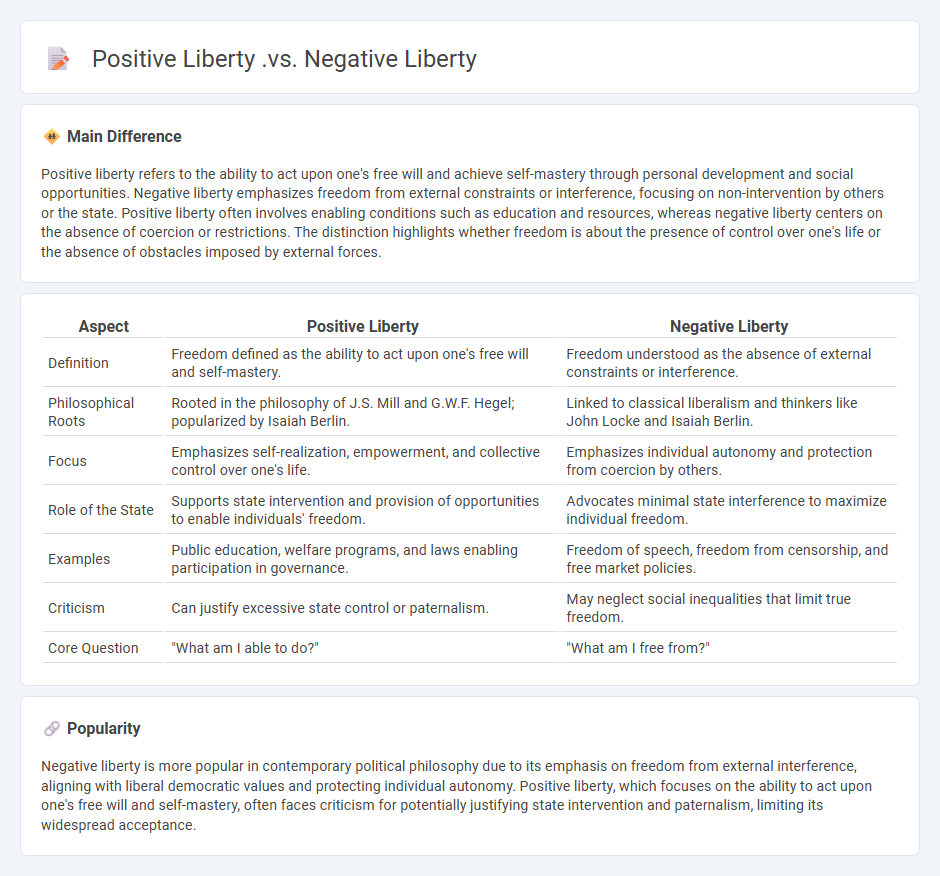
The socialist critique of the purely libertarian view of freedom can be captured in a single, powerful statement by the British social reformer William Beveridge, an architect of the modern welfare state.
Negative & Positive Freedom (Liberalism) | Reference Library | Politics
This article from tutor2u provides a concise overview and highlights a famous quote that gets to the heart of the matter.
Please read the first four paragraphs, from the beginning down to the quote by William Beveridge. Focus on how negative and positive freedom relate to the role of the state.
Beveridge’s assertion that "a starving man is not free" is the essence of the argument. In a libertarian society, the starving man has negative liberty—no law prevents him from getting food. But without money, property, or opportunity, is his freedom to get food meaningful? The advocate of positive liberty would say no; he is not truly free because he lacks the ability to overcome his hunger.
The Limits of Negative Liberty: Two Scenarios
To make this abstract debate more concrete, let's examine two scenarios that illustrate why critics argue that negative liberty, on its own, is not enough.
Scenario 1: The Freed Slave
The first example is historical. After the American Civil War, the Emancipation Proclamation granted millions of former slaves their freedom. They were no longer the legal property of a master. They had, in a profound sense, gained negative liberty. But what happened next?
Positive and Negative Liberty (Isaiah Berlin - Two Concepts of Liberty)
This section of the Tom Richey video uses the powerful example of newly freed slaves to illustrate the gap between negative and positive liberty.
Please watch the segment from 04:31 to 07:09. As you watch, consider the question the video raises: after the initial joy of being declared free, the former slaves faced the question, "What now?" Were they truly free if they had no property, no money, and no marketable skills?
This historical case is a stark illustration of the argument. The former slaves were "free from" a master, but they were not "free to" build a new life, start a farm, or educate their children because they lacked the necessary resources. Their negative freedom was of limited value without the positive freedom to act. This leads critics to argue that for freedom to be real, society (often through the state) must ensure people have access to basic necessities like education, healthcare, and economic opportunity.
Scenario 2: Lilly's Dream
Now, let's consider a modern, fictional scenario that highlights the same dynamic in a contemporary context.
Two Types of Liberty - Sprouts - Learning Videos - Social Sciences
This article from Sprouts uses the story of a character named Lilly to illustrate the desire for positive liberty.
First, read the introductory paragraphs that define the two concepts. Then, skip down to the section titled "Positive Liberty" and read the story of Lilly, from her accident to her decision to move.
Lilly lives in a society with a high degree of negative liberty—low taxes and few regulations. No law prevents her from becoming a judge. However, her dream is unattainable because she comes from a disadvantaged family and cannot afford the education. Furthermore, she lacks "freedom to recover appropriately" from her injury because she cannot afford decent healthcare.
Lilly's story demonstrates that even in a society that a libertarian might praise, structural limitations—like the high cost of education and healthcare—can be just as effective at preventing someone from achieving their goals as an explicit government ban. From the socialist perspective, Lilly is not truly free.
The Political Implications: From Rights to Entitlements
The argument for positive liberty has significant political consequences. It implies that if society is committed to freedom, it must do more than simply refrain from interfering with people. It must actively provide the conditions for freedom to flourish.
This shifts the focus from natural rights (which primarily require non-interference) to entitlements of living in a civilized society. President Franklin D. Roosevelt's famous "Four Freedoms" speech is a classic example of this thinking.
Positive and Negative Liberty (Isaiah Berlin - Two Concepts of Liberty)
This part of the Tom Richey video explains how FDR's speech blended the two types of liberty.
Watch the segment from 07:09 to 08:09. Notice how the first two freedoms (speech and worship) are negative liberties, while the second two—"freedom from want" and "freedom from fear"—are positive liberties. "Freedom from want" is essentially a right to a basic standard of living.
This call for positive liberty is the philosophical justification for the welfare state. Proponents argue that by providing public education, universal healthcare, social safety nets, and other services, the state isn't violating freedom but rather creating it for those who would otherwise be trapped by circumstance.
The Inevitable Conflict
Of course, libertarians have a powerful response to this line of reasoning. Providing these "positive" freedoms requires resources. To fund public schools and hospitals, the state must collect taxes. Taxation, in the libertarian view, is the coercive taking of property.
Therefore, a fundamental conflict arises: providing positive liberty for one person (e.g., Lilly's education) often requires infringing on the negative liberty of another (e.g., Frank's property, taken via taxes).
Positive and Negative Liberty (Isaiah Berlin - Two Concepts of Liberty)
The video now presents the libertarian counter-argument.
Watch from 08:09 to 09:16 to understand this core tension. The central point is that positive liberty cannot be created out of thin air; it typically requires the redistribution of wealth and resources, which libertarians see as a violation of fundamental rights.
This is one of the most fundamental divides in modern political thought. Is freedom the absence of coercion, or the presence of capacity? The socialist tradition argues for the latter, presenting a powerful challenge to the libertarian ideal by asserting that a society committed only to negative liberty will leave many of its members free in name only.
Conclusion
In this lesson, we have explored the socialist critique that negative liberty is insufficient for a truly free life. This argument rests on the distinction between two concepts of freedom:
- Negative Liberty ("Freedom From"): The absence of external constraints, such as laws or direct coercion. This is the cornerstone of libertarian thought.
- Positive Liberty ("Freedom To"): The possession of the power and resources to act and achieve one's goals.
The core of the socialist argument is that negative liberty is hollow without positive liberty. A person who is legally free but lacks food, education, or health is not meaningfully free. We saw this illustrated through the historical example of emancipated slaves and the modern story of Lilly, both of whom had freedom from legal barriers but lacked the freedom to build the lives they desired.
This argument provides the philosophical basis for the welfare state, which seeks to provide citizens with the material resources (education, healthcare, a social safety net) necessary to exercise their freedom. However, this creates a direct conflict with the libertarian commitment to negative liberty, as providing these positive entitlements requires coercive taxation and redistribution.
This lesson concludes our module on criticisms from the socialist tradition. We've seen arguments that libertarianism may fail to address unjust inequality, exploitation in the workplace, collective action problems, and, finally, that its very definition of freedom is incomplete.
In our next module, we will shift our perspective entirely. We will begin to explore a different set of challenges to libertarianism, those coming from the conservative tradition, which prioritizes community, social order, and tradition over radical individualism.