Recommended resources
The freely available resources this lesson will direct you to.
Introduction
Welcome to the next lesson in our exploration of the economic case for free markets. In our previous lessons, we've engaged with some powerful theoretical arguments. We first encountered Ludwig von Mises's economic calculation problem and F.A. Hayek's knowledge problem, which both contend that central planners can never possess the vast, dispersed information necessary to run a complex economy effectively. Then, we examined public choice theory, which provided a theory of "government failure" by showing how the incentives of voters, politicians, and bureaucrats can lead to inefficient and self-serving outcomes, even with the best of intentions.
These are compelling ideas in the abstract. But do they hold up in the real world? This lesson aims to answer that question by moving from theory to history. Our goal is to describe real-world historical examples that libertarians frequently cite to illustrate the catastrophic failures of central planning. We will investigate what happened when entire nations were reorganized according to the principles of a command economy, providing a concrete backdrop to the theories we've studied.
The Soviet Union: A Grand Experiment in Central Planning
The Union of Soviet Socialist Republics (USSR), which existed from 1922 to 1991, represents the most ambitious and long-running attempt to build a society without private property and market prices. For libertarians and many classical economists, its history is a tragic, large-scale demonstration of the principles laid out by Mises and Hayek.
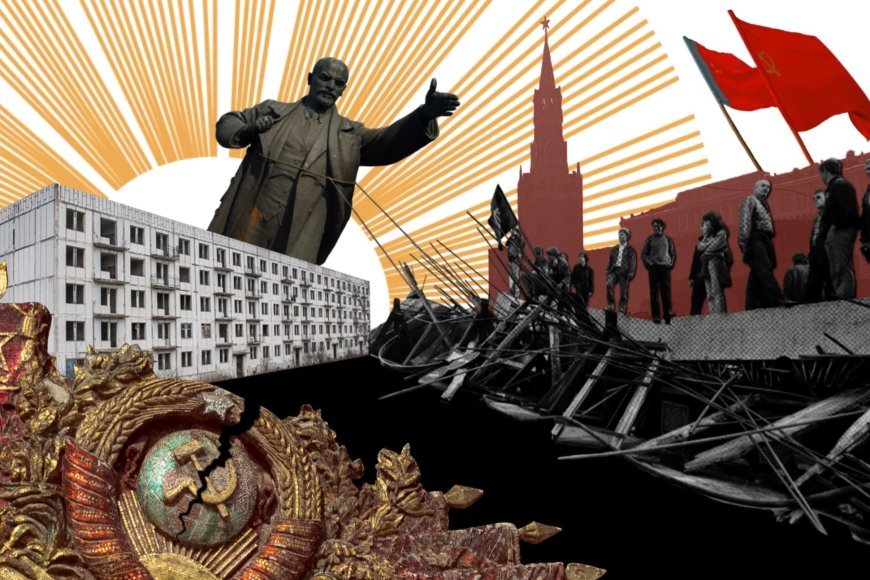
The Soviet economy was directed by a central planning agency in Moscow called Gosplan (the State Planning Committee). As we saw in our brief reading on the topic from the article "The problem with central planning," this approach was pioneered by Joseph Stalin with his infamous "five-year plans," which sought to command economic growth from the top down.
The following documentary provides a detailed, vivid account of how this system worked—and why it failed. It's a long video, but we will break it down into key themes that directly connect to the economic theories we've discussed.
Let's begin with the fundamental challenge Gosplan faced: trying to plan an entire economy with fatally incomplete information.
Inside Soviet Central Planning: The Economic Blunders That Collapsed Nations
This first clip from "Inside Soviet Central Planning" explains the method of "material balance planning" and illustrates the sheer impossibility of the task.
Please watch the segment from "The system is run by the state...". As you watch, notice the staggering gap between the number of distinct items in the economy (24 million) and the number the planners could actually track (around 200,000). This is a real-world illustration of Hayek's knowledge problem and Mises's calculation problem in action.
As the video explains, the planners were "planning blind." They simply could not know what was needed where, in what quantity, and of what quality. Lacking the signals provided by market prices, they had to resort to crude, aggregated targets. This leads us to the next critical failure: perverse incentives.
The Tyranny of the Metric
When you can't measure value, you measure proxies. For Soviet planners, these proxies were simple, quantitative targets like gross output (val) or tonnage. Public choice theory would predict that rational actors (factory managers, workers) would focus on hitting these targets to earn their bonuses and avoid punishment, regardless of whether their actions produced anything useful. The results were often absurd and wasteful.
Inside Soviet Central Planning: The Economic Blunders That Collapsed Nations
This next, longer segment provides a series of powerful stories showing how focusing on arbitrary metrics led to disastrous outcomes.
Watch the section from the discussion on gross output. You don't need to memorize every detail, but focus on the underlying logic in each case: Whaling: How a tonnage target led to the slaughter of whales for which there was no demand. Exploding Televisions: How production quotas were met at the expense of basic safety and quality. Nails: The classic story of how a factory met its quota by producing either millions of tiny, useless pins (for a quantity target) or a few giant, useless spikes (for a tonnage target). Chandeliers: How a weight-based target for lamps resulted in fixtures so heavy they caused ceilings to collapse. This pattern, which economist Charles Goodhart later formulated as "When a measure becomes a target, it ceases to be a good measure," ran through the entire Soviet economy.
The system was not just inefficient; it was actively destructive. It rewarded waste and penalized quality and utility. A factory manager's "customer" was not the citizen who might use the product, but the planning bureaucrat in Moscow who checked if the target was met.
Systemic Consequences: The Shadow Economy and Environmental Ruin
An economy so detached from reality could not function on its own terms. To survive, citizens and even state-run factories came to rely on a vast, illegal shadow economy.
Inside Soviet Central Planning: The Economic Blunders That Collapsed Nations
This clip explains the emergence of the "second economy" and the system of blat (connections or favors).
Please watch from the section on the "new Soviet man". Notice the crucial twist: this corruption wasn't a flaw in the system; it was a necessary feature that kept the rigid official economy from grinding to a complete halt. The illegal "tolkach" or "pusher" was essential to acquiring the materials that the central plan failed to deliver.
Furthermore, the planners' single-minded focus on output targets, combined with a total disregard for local knowledge, led to some of the worst man-made environmental disasters in history.
Inside Soviet Central Planning: The Economic Blunders That Collapsed Nations
This segment details the horrific environmental consequences of Soviet planning.
Watch the part covering the destruction of the Aral Sea and the failure of the Virgin Lands campaign. The planners treated nature as something to be conquered to meet a quota, ignoring scientific warnings and ecological reality, with devastating results.
The Ultimate Test: A Tale of Two Germanys
A critic might argue that Russia's historical and cultural context, not just central planning, was to blame for the Soviet failure. The "natural experiment" of post-WWII Germany provides a powerful counterargument. After the war, the nation was divided. West Germany adopted a market-based economy, while East Germany was organized under a Soviet-style socialist command economy. The people, culture, and pre-war industrial base were largely the same. The primary difference was the economic system.
The results were stark.
Comparing the Economic Growth of East Germany to West ... - FEE.org
This article from FEE.org provides historical context and a vivid contemporary account of the differences between the two Germanys.
Please read the section starting with the discussion of Jaap Sleifer's book up to the end of the indented quotes comparing the two Berlins. Pay close attention to the 1960 description of West and East Berlin—it gives you a sense of the dramatic difference in prosperity and quality of life.
The anecdotal evidence is confirmed by economic data. The graph below, based on OECD data, tracks the per-capita GDP of East and West Germany from the post-war period until reunification.
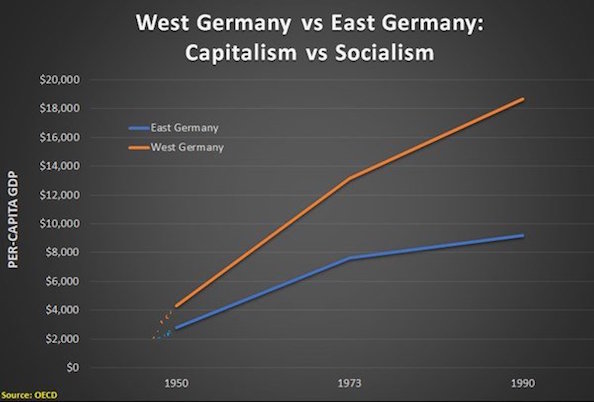
The divergence is undeniable. While West Germany experienced its Wirtschaftswunder ("economic miracle") fueled by market liberalization, East Germany stagnated. This case strongly suggests that the economic system itself was the decisive factor.
A Corroborating Case: China's Great Leap Forward
The pattern of failure was not unique to the Soviet bloc. In 1958, China's leader, Mao Zedong, launched the "Great Leap Forward," a campaign to rapidly transform China from an agrarian economy into a socialist society through collectivization and industrialization. The results mirrored the Soviet experience, but were compressed into a few horrific years.
The Great Leap Forward (1958-62)
This short video from Simple History outlines the policies of the Great Leap Forward and its consequences.
Please watch from the beginning of the policy description. Notice the striking parallels to the Soviet case: Forced collectivization of agriculture. A focus on ideological zeal over expertise. The use of "backyard furnaces" to meet steel quotas, producing useless metal (another "tyranny of the metric" example). Catastrophic agricultural failures based on pseudoscientific ideas (like deep plowing). Local officials falsifying reports, leading to mass famine.
The Great Leap Forward is now recognized as one of the deadliest famines in human history, with estimates of tens of millions of deaths. It stands as another grim testament to the consequences of replacing market coordination and local knowledge with centralized command.
Conclusion
In this lesson, we have moved from the abstract world of economic theory to the concrete realities of history. The experiences of the Soviet Union, East Germany, and Maoist China provide powerful, real-world case studies that libertarians point to as proof of central planning's inherent flaws.
Let's summarize the key takeaways:
- Central planning fails the information test: In practice, as in theory, planners were "flying blind," unable to gather and process the knowledge needed to run an economy. This is the knowledge problem made real.
- Central planning creates perverse incentives: By replacing profit and loss with arbitrary targets (like tonnage), the system rewarded behavior that was wasteful, destructive, and detached from human needs. This is government failure on a grand scale.
- The consequences are catastrophic: These failures led not just to inefficiency, but to widespread shortages, environmental devastation, a reliance on black markets, and, in the worst cases, mass famine and death.
- Natural experiments confirm the pattern: The stark contrast between East and West Germany demonstrates that the economic system itself, not cultural or other factors, was the key variable in producing prosperity versus poverty.
These historical examples form a crucial pillar of the economic argument for libertarianism. They suggest that the alternative to free markets is not a rationally ordered utopia, but chaos, waste, and oppression.
In our next and final lesson of this module, we will bring all these threads together to summarize the comprehensive libertarian argument for why free markets are not only more efficient but also lead to greater overall prosperity than centrally planned or heavily regulated economies.