Recommended resources
The freely available resources this lesson will direct you to.
- Free Markets vs Central Planning | Saifedean Ammous and Lex Fridmanwww.youtube.com
- Milton Friedman - The Myth Of Central Planningwww.youtube.com
- What is a free market economy and how does it help you?americansforprosperity.org
- Why Free-Market Capitalism Best Supports Prosperity | TWE Ep. 155vanceginn.substack.com
Introduction
In our last lesson, we journeyed through some of the darkest chapters of the 20th century, examining the real-world consequences of central planning in the Soviet Union, East Germany, and Maoist China. We saw how the theoretical problems identified by Mises and Hayek—the economic calculation and knowledge problems—manifested as staggering inefficiency, environmental ruin, and human suffering. These historical cases form the backbone of the libertarian critique against command economies.
Now, we turn to the other side of the coin. This lesson addresses the final learning outcome of this module: explaining the positive libertarian argument for why free markets are believed to be the most powerful engine for human prosperity ever discovered. We will move beyond critiquing failure and construct the case for success, exploring the specific mechanisms that, according to this view, allow free societies to generate unprecedented wealth and opportunity.
What is a Free-Market Economy?
Before exploring why free markets are said to work, we must be clear on what they are. At its core, a free-market economy is an economic system based on voluntary cooperation. It stands in stark contrast to a command economy, where economic decisions are dictated by a central authority.
This table provides a useful side-by-side comparison of the two systems along several key dimensions.
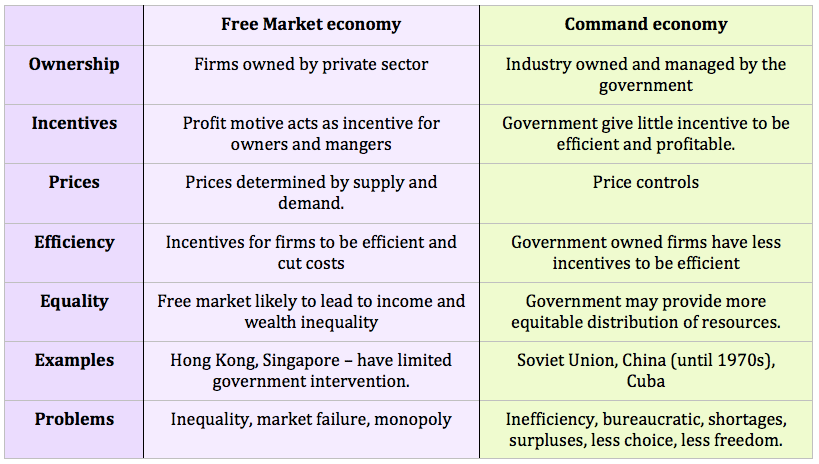
To build on this visual, let's turn to a clear and concise definition.
What is a free market economy and how does it help you?
This article from Americans for Prosperity provides a straightforward definition of a free-market economy and outlines the essential, limited role that government plays within it.
Please read the first two main sections of the article. Start with the introductory paragraphs that define the free market. Then, continue through the next section, "The real advantages of a free market economy," which lists the core functions of government that libertarians see as necessary to support a flourishing market.
As you can see, the libertarian vision of a free market is not one of lawless chaos. Instead, it's a system of clear, predictable rules—protecting property, enforcing contracts, preventing fraud—that create a stable framework within which individuals are free to pursue their own goals. The key is that the government acts as an impartial referee, not a player trying to direct the game's outcome.
The Mechanisms of Prosperity
Why does this combination of individual freedom and limited government lead to prosperity? Libertarians point to three interconnected mechanisms: the solution to the knowledge problem, the power of incentives, and the morality of voluntary choice.
1. Solving the Knowledge Problem
In our previous lessons, we saw how central planners, from Moscow's Gosplan to Mao's cadres, were "flying blind," unable to comprehend the needs of millions. Free markets solve this problem by decentralizing knowledge and communicating it through the price system.
The Nobel laureate Milton Friedman brilliantly explains why central control works for simple, singular goals but fails spectacularly when faced with the complexity of a modern economy.
Milton Friedman - The Myth Of Central Planning
In this clip from "The Myth Of Central Planning," Milton Friedman distinguishes between government planning for a single objective (like winning a war) and the impossible task of planning for the diverse needs of a peacetime society.
Watch the segment from the beginning of the video. Friedman argues it's a "myth" that government planning is inherently efficient, explaining that its apparent success in wartime doesn't translate to a complex economy with countless individual preferences.
This complexity arises from the fact that an economy is not made of inanimate particles, but of conscious human beings, each with their own will, goals, and desires. Economist Saifedean Ammous elaborates on this point, arguing that the hubris of central planning lies in the belief that one can know what is best for others.
Free Markets vs Central Planning | Saifedean Ammous and Lex Fridman
In this conversation with Lex Fridman, Saifedean Ammous explains why economic planning is fundamentally different from a scientific experiment and why no central planner can account for the complexity of individual human choice.
Please watch the clip from Ammous's explanation of why we can't have experiments. He emphasizes the "humility to understand" that every individual has millions of preferences that no planner can possibly know or manage.
In a free market, you don't need a central planner to know these things. Prices do the work automatically. A rising price for lumber signals that it is becoming scarcer, encouraging builders to conserve it and suppliers to produce more of it—all without a single government directive.
2. The Power of Incentives and Competition
While prices provide the information to coordinate economic activity, it is the pursuit of profit—and the avoidance of loss—that provides the incentive.
In a market system, businesses succeed by creating things that consumers value. To earn a profit, a company must offer a product or service that people are willing to pay for, at a price that covers the costs. If they fail, they incur losses and eventually go out of business. This simple mechanism has profound consequences:
- Efficiency: It forces firms to be efficient and minimize waste. Unlike the Soviet manager rewarded for producing heavy chandeliers, a market-based entrepreneur is rewarded for using resources wisely.
- Innovation: Competition pushes businesses to constantly improve their products, lower their prices, and invent new solutions to meet consumer needs.
- Service to Others: In a perhaps counter-intuitive way, self-interest in a market setting channels itself into serving the needs of others. To get what you want (profit), you must provide others with what they want (valuable goods and services). This is the essence of Adam Smith's "invisible hand."
The following reading elaborates on this moral and practical foundation of capitalism, highlighting its incredible track record in reducing global poverty.
Why Free-Market Capitalism Best Supports Prosperity | TWE Ep. 155
This article by economist Vance Ginn lays out the moral argument for free-market capitalism, rooting it in individual dignity and service to others.
Please read the first section, "A Moral Case for Capitalism." Pay close attention to the argument that capitalism "rewards service, not status" and the staggering statistics on the global reduction of extreme poverty.
3. Voluntary Exchange vs. Coercion
The final pillar of the argument rests on a core libertarian value: the distinction between voluntary action and coercion. In a free market, every transaction is a voluntary agreement. A buyer and seller exchange goods, services, or money because both expect to be better off.
Central planning, by its very nature, relies on coercion. It forces people to comply with the state's economic directives. If you refuse to pay taxes for a government project or disobey a regulation, the ultimate consequence is the threat of force.
Free Markets vs Central Planning | Saifedean Ammous and Lex Fridman
Here, Saifedean Ammous makes the stark moral distinction between market action and government planning, arguing that one is based on voluntary agreement and the other on force.
First, watch the segment from where he discusses coercion. He states plainly that "there's no Central planning without coercion." Then, watch the later clip from where he traces this coercion down to its source, arguing that government action is ultimately backed by the threat of jail time ("a gun to the head"), making it fundamentally different from a market transaction.
For libertarians, this distinction is not trivial. They argue that a system based on voluntary, positive-sum exchanges is not only more prosperous but also more ethical than one based on top-down commands backed by force.
What About "Market Failures"?
Critics of free markets often point to problems like monopolies, pollution, or corporate greed as evidence that "capitalism has failed." The libertarian response to this is crucial: they draw a sharp distinction between free-market capitalism and cronyism.
They argue that many of the problems blamed on markets are actually caused by government intervention that distorts the market. For example:
- Monopolies: While some monopolies might arise temporarily through innovation, libertarians argue that most long-lasting monopolies are created and protected by government through regulations, licensing laws, or patents that block competitors from entering the market.
- Bailouts: When the government bails out failing companies ("too big to fail"), it short-circuits the market's discipline of profit and loss. It privatizes profits while socializing losses, rewarding recklessness and punishing responsible competitors.
- Corporate Favoritism: Subsidies and special tax breaks for politically connected industries are seen as a form of corruption that rigs the game in favor of insiders, at the expense of consumers and entrepreneurs.
This article makes the case that these are not market failures, but government failures.
Why Free-Market Capitalism Best Supports Prosperity | TWE Ep. 155
This section of the article directly addresses the libertarian rebuttal to common criticisms of capitalism, arguing that the problem is often political interference, not free markets.
Please read the section titled "Capitalism’s “Failures” Are Often the Result of Government Intervention." Note the distinction it draws between the benefits of a free market (choice, competition) and the distortions created by government (bailouts, regulatory favoritism).
Conclusion
In this lesson, we have constructed the positive libertarian case for the free market. It is an argument built on several key claims:
- Prosperity through Information: Free markets, through the price system, solve the knowledge problem that cripples central planning, allowing for the peaceful and effective coordination of millions of individuals.
- Prosperity through Incentives: The profit and loss system creates powerful incentives for efficiency, innovation, and service to others, while competition disciplines producers to meet consumer demands.
- Prosperity through Freedom: The system is based on voluntary exchange, which respects individual dignity and choice, in contrast to the coercion inherent in a command economy.
- Real Capitalism vs. Cronyism: Many of capitalism's perceived flaws are not failures of the market itself, but distortions caused by government intervention that favors the politically connected.
The historical record, showing a dramatic decline in global poverty coinciding with the spread of market economies, is presented as the ultimate proof of this system's power.
In our next lesson, we will give a name to the phenomenon we've just described—the emergence of a complex, functional system without a central designer. We will dive into Friedrich Hayek's concept of spontaneous order, a powerful idea that extends far beyond economics and provides a deeper theoretical lens through which to understand how free societies function.