Recommended resources
The freely available resources this lesson will direct you to.
- A Comprehensive Guide to Neuro Bass 2025www.youtube.com
- How To Make BASSES Like NOISIA - DIPLODOCUS (Noisia's 'Outer Edges' Remix) | Serum Tutorialwww.youtube.com
- Creating Iconic Bass, Pad, and Lead Sounds Using ...polarity.me
- [PDF] A Content Analysis Study of Distortion's Influence ... - IASPM Journaliaspmjournal.net
Welcome to the first lesson in our module on Neurofunk and Liquid lead synthesis. In our previous module, you successfully built an expressive, gritty lead from scratch, focusing on FM synthesis for texture and performance articulations like glide and pitch bends to create a dynamic, human feel.
Today, we pivot to a different beast altogether: the Neurofunk lead. Where the expressive lead aimed for a sense of performance and emotion, the Neurofunk sound is characterized by technical precision, aggressive processing, and complex, machine-like movement. Our goal is to deconstruct a classic Neurofunk lead, using Noisia as our benchmark, to identify its core components: complex modulation, aggressive filtering, and heavy, layered processing.

1. The Neurofunk Design Philosophy
Before we dive into Serum, it's crucial to understand the philosophy behind Neurofunk sound design. It's less about finding the perfect wavetable and more about creating a framework for movement and transformation. A Neurofunk lead is a living sound, constantly changing its timbral character through heavy modulation and processing.
A Comprehensive Guide to Neuro Bass 2025
The video "A Comprehensive Guide to Neuro Bass 2025" from the Alckemy channel provides an excellent high-level overview of the Neurofunk mindset. While it uses the term "Neuro Bass," the principles are identical for leads.
Watch the segment from the philosophy where the creator defines a Neuro sound as a "heavy movement bass with tons of processing" and emphasizes understanding the mechanics rather than just the tools. Then, jump to the recap section at the end. Pay close attention to the framework he summarizes: A harmonically rich waveform (the starting point). Filtering and distortion to create the "monster" (the core character). Stereo effects for wideness and refinement. OTT/Clipping at the end for control and power. This framework is the blueprint we'll use for our deconstruction.
2. The Core Components of a Neurofunk Lead
A typical Neurofunk lead is built from several key components that work together. Let's break them down.
A. Timbre: Simple Sources, Complex Results
Interestingly, the initial oscillator setup for a Neurofunk lead is often very simple. The complexity doesn't come from an exotic wavetable, but from what you do to it. Frequency Modulation (FM), which you used in the last lesson, is a common starting point for generating rich harmonics from basic sine waves.
B. Aggressive Processing: The Role of Distortion
Distortion isn't just an effect added at the end; in Neurofunk, it's a primary sound design tool used to generate harmonics, add aggression, and shape the timbre at multiple stages of the signal chain. This practice is a defining characteristic of the genre.
[PDF] A Content Analysis Study of Distortion's Influence ... - IASPM Journal
This academic paper from the IASPM Journal provides a fantastic analysis of distortion in DnB. It offers a deep, analytical perspective that aligns with your goal of understanding the "why."
Read the Introduction to understand how Neurofunk evolved from Techstep and established distortion as a key aesthetic. Note the mention of artists like Noisia, Mefjus, and Phace. Then, read the section titled Bass under "Discussion: Professional producers." Although it says "Bass," the techniques described are quintessential Neurofunk sound design. Focus on these points: The use of multiple instances of distortion. Combining a synth's built-in distortion with dedicated plugins like iZotope's Trash 2. The specific mention of Noisia using Trash 2 in multiband mode to add upper harmonics. The concept of resampling—recording the processed audio and processing it again.
This multi-stage, layered approach to distortion is fundamental. A common workflow is an iterative chain of Filter -> Distort -> Filter -> Distort, where each stage adds a new layer of character and harmonic complexity.
C. Complex Modulation & Filtering: Creating Movement
The signature "talking," "ripping," or "squelching" sound of a Neurofunk lead comes from modulating aggressive filter types with fast, complex LFOs. We move beyond simple low-pass filters to filters that create distinct timbral changes.
- Comb Filters: Create a "tearing" or metallic resonance by adding a series of harmonically related peaks and notches.
- Phaser/Flanger Filters: Generate sweeping, "swooshing" movement.
- Formant/Vowel Filters: Impart vocal-like qualities, making the sound appear to speak or form vowels.
- Notch Filters: Carve out very specific frequencies, and when modulated, create phasey, hollowed-out movement.
The key is to use these filters to create movement in the mid and high frequencies while often splitting the frequency bands to keep the low-end clean and powerful.
A Comprehensive Guide to Neuro Bass 2025
Let's return to Alckemy's guide to see these filtering concepts in action. He demonstrates how these techniques build the sound's character.
First, watch the section explaining how filters create vocal phrases. He uses a band-pass and a notch filter, followed by distortion, to shape an initial tone. Next, watch the segment on frequency splitting and comb filtering. Pay close attention to his explanation of why you frequency split (to process the mids/highs without destroying the sub) and his "shortcut" of using a modulated comb filter on the mid-band to get that classic tearing Reese sound.
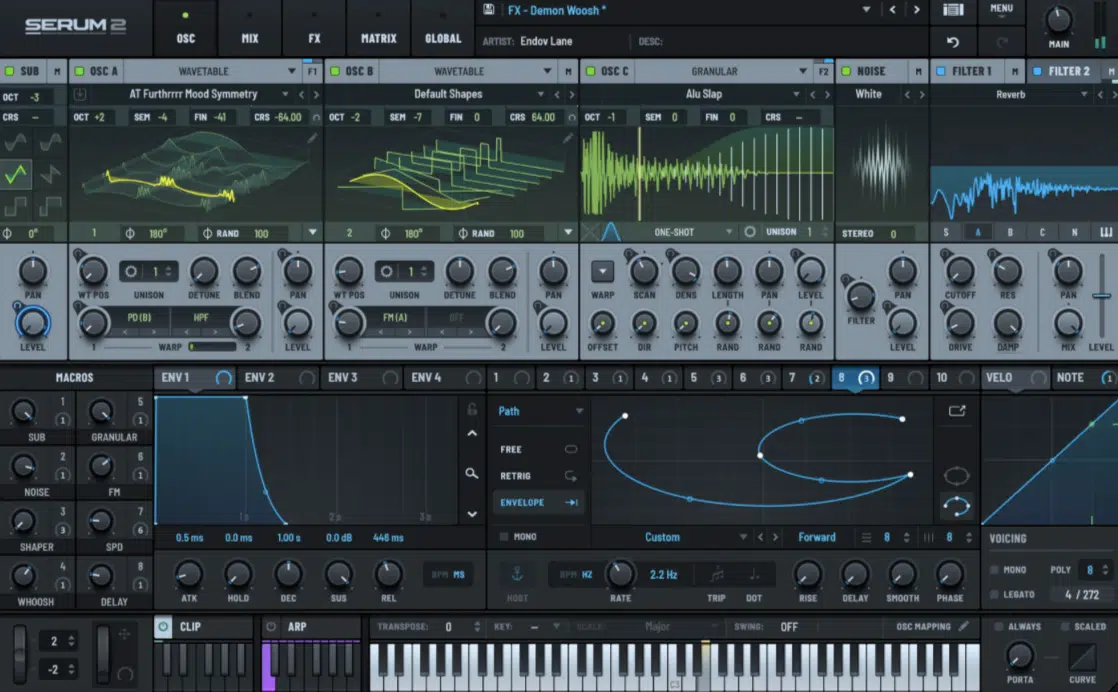
3. Case Study: Deconstructing a Noisia Lead
Now, let's put all this theory together and deconstruct a lead sound inspired by Noisia's remix of "Diplodocus." The following video provides a step-by-step recreation that perfectly illustrates the principles we've just discussed.
How To Make BASSES Like NOISIA - DIPLODOCUS (Noisia's 'Outer Edges' Remix) | Serum Tutorial
This tutorial from DNB Academy, "How To Make BASSES Like NOISIA," is a perfect case study. It builds a complex lead/bass from the ground up, showcasing the exact techniques we've been analyzing.
As you watch, try to identify the concepts from our lesson. I've broken it down for you below.
Step 1: Timbre Generation & Initial Modulation
Watch the first segment, covering the
- Simple Source: Notice how it starts with nothing but sine waves.
- FM Synthesis: The core timbre comes from FM'ing Oscillator A with Oscillator B, which is pitched up. This is exactly the kind of simple source + complex result we talked about.
- Modulation: A plucky LFO (
LFO 4) is immediately mapped to the FM amount, creating the initial dynamic movement. A macro is then used to control the LFO rate, allowing for rhythmic variation. This is our first layer of "complex modulation."
Step 2: Internal Processing & Filtering
Now, watch the section on the
- Layered Distortion: He adds two distortion modules (
Lo-FiandTube). This confirms the multi-stage distortion concept. - Aggressive Filtering: After adding distortion, he enables a
Phaser 48+filter on the main oscillator tab. This is a prime example of using a filter after initial processing to create more complex texture. He then adds another phaser in the FX rack. - Multiband Compression (OTT): As predicted by our framework, an OTT-style compressor is used to squash the sound and enhance the details.
- Subtle Additions: Note the use of EQ for surgical cuts and a final
PPfilter to boost the fundamental and add more drive-based harmonics in parallel.
Step 3: External Post-Processing
Finally, watch the walkthrough of the
- Multiband Distortion: The sound is sent to iZotope Trash 2, set to multiband mode, to saturate the low-mids. This is a direct parallel to the technique described in the
IASPM Journalarticle regarding Noisia's workflow. - More Layered Distortion: A second instance of Trash 2 is added to distort the mids and highs with a different algorithm.
- Final Shaping: The sound is finished with more EQ, another phaser for a different "vowel" tone, and a touch of reverb.
This case study is a perfect embodiment of the Neurofunk workflow: start simple, then build immense complexity through layers of modulation, filtering, and aggressive, often multiband, processing.
Conclusion
In this lesson, we have deconstructed the core elements of a Neurofunk lead. By analyzing the philosophy and breaking down a practical example, you've gained insight into the intentional design choices that define this aggressive, technical sound.
Key Takeaways:
- It's a Process, Not a Preset: Neurofunk sound design is about building a system of movement through iterative filtering and distortion, rather than just selecting a wavetable.
- Distortion is a Creative Tool: Aggressive, multi-stage, and often multiband distortion is used to create harmonics and shape the core character of the sound.
- Movement from Modulation: Fast, complex LFOs modulating aggressive filter types like Combs, Phasers, and Formant filters are the source of the iconic "talking" Neurofunk sound.
- Processing is Paramount: The final sound is a product of heavy processing both inside the synthesizer and with external plugins, with a heavy emphasis on frequency-specific effects.
In our next lesson, you will take these principles and apply them. Your task will be to synthesize your own metallic, modulated Neurofunk lead from scratch, putting this deconstruction into practice.