Recommended resources
The freely available resources this lesson will direct you to.
Introduction
In our previous lessons, we built the foundation for analyzing rocket motion by exploring Newton's laws and deriving the thrust equation from the principle of momentum conservation. We now have a clear understanding of the propulsive force pushing a rocket upwards. This lesson focuses on quantifying the primary force that thrust must overcome: gravity.
While the simple equation is a useful approximation on the Earth's surface, it's insufficient for a rocket whose altitude changes by kilometers. Today, you will learn to apply Newton's Law of Universal Gravitation to calculate the gravitational force on your rocket accurately at any point in its trajectory. This is the final fundamental force we need to define before we can begin modeling a complete rocket launch.
1. Newton's Law of Universal Gravitation
The force of gravity is not a constant; it's a mutual attraction between any two objects with mass. Sir Isaac Newton formulated this relationship into a single, powerful equation that governs everything from a falling apple to the orbit of planets.
This law states that the gravitational force between two bodies is directly proportional to the product of their masses and inversely proportional to the square of the distance between their centers.
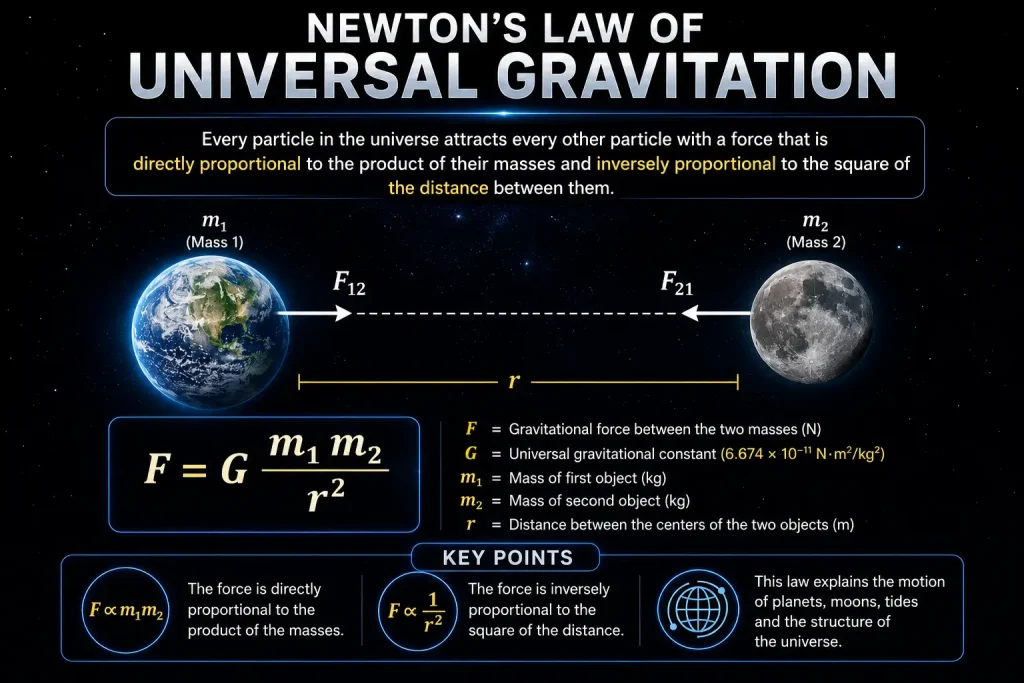
The mathematical expression for this law is:
Where:
- is the gravitational force.
- is the universal gravitational constant, approximately .
- and are the masses of the two objects.
- is the center-to-center distance between the two objects.
To understand the definitions and the critical importance of using the correct units for this equation, let's turn to a more detailed explanation.
The Law of Universal Gravitation: Newton's Theory Explained
This article provides a direct, engineering-focused breakdown of the formula and its components.
Please read the introduction and the first two main sections. Start with the formula section and continue through the section on variables and units. Pay close attention to the table defining each variable and the "Unit tip," as incorrect units are a common source of major errors in physics calculations.
The key takeaway from this reading is the definition of . It is not the altitude above the ground, but the total distance from the center of the Earth to the center of your rocket. This is the most critical detail for applying the law correctly to rocketry.
2. From the Universal Law to Surface Weight
You are likely familiar with calculating weight using the formula , where is the acceleration due to gravity, approximately . This isn't a different law, but rather a convenient simplification of the universal law for objects at or near the Earth's surface.
Let's see how. For a rocket of mass on the launchpad:
- becomes the mass of the Earth, .
- becomes the mass of the rocket, .
- becomes the radius of the Earth, .
Substituting these into the universal equation gives:
If we group the constant terms together, we get:
The term in the parentheses is a constant value derived from the mass and radius of the Earth. This is the precise definition of surface gravitational acceleration, .
This is why we can write . The following NASA resource reinforces this connection.

Weight Equation | Glenn Research Center | NASA
This NASA page explains the relationship between the universal law and the simplified weight equation.
Read the first two sections, Nature of Gravity, and the brief section on Weight. This will confirm how the constant 'g' is derived.
3. Calculating Gravitational Force at Altitude
As a rocket ascends, its distance from the Earth's center increases, so the force of gravity acting on it decreases. To calculate this force accurately, we must use the universal law with the correct distance, .
If a rocket is at an altitude above the Earth's surface, the total distance from the Earth's center is:
Therefore, the gravitational force on the rocket at altitude is:
This equation is fundamental to simulating a rocket's trajectory. The following reading provides a practical method and examples for this exact calculation.
Weight Equation | Glenn Research Center | NASA
This resource provides clear examples of calculating the change in weight with altitude.
Focus on the sections Altitude and Weight and the subsequent example of the Space Shuttle. Notice the method of using a ratio, which is a computationally efficient way to find the new weight.
4. Worked Example: Force on a High-Power Rocket
Let's apply this to a practical scenario relevant to your goals.
Problem:
A large, 25 kg rocket, designed for high-altitude research, reaches an apogee of 120 km. What is the gravitational force acting on it at the peak of its flight?
Constants:
- Gravitational Constant ():
- Mass of Earth ():
- Mean Radius of Earth ():
Given:
- Mass of rocket ():
- Altitude ():
Step 1: Calculate the total distance from the center of the Earth ().
Step 2: Apply the Law of Universal Gravitation.
Step 3: Calculate the result.
Analysis:
Let's compare this to the rocket's weight on the surface:
At an altitude of 120 km, the force of gravity on the rocket has decreased from 245.25 N to 236.5 N, a reduction of about 3.6%. While this may seem small, for a multi-minute flight, this variation has a significant impact on the final trajectory and apogee, which is why your future Python simulations will need to account for it.
Conclusion
In this lesson, you have learned to move beyond the surface-level approximation of gravity and apply Newton's universal law to a rocket in flight. This completes our survey of the primary forces involved in a vertical launch.
Key Takeaways:
- Newton's Law of Universal Gravitation, , provides the exact gravitational force between two masses.
- The simplified weight equation, , is a special case of the universal law where .
- To calculate gravity at altitude , the distance term must be .
- Failing to account for the decrease in gravity with altitude will introduce inaccuracies into trajectory predictions, especially for high-flying rockets.
You now have a solid understanding of the forces that govern a rocket's ascent: thrust, which you can calculate from mass flow rate and exhaust velocity, and gravity, which you can calculate based on altitude. In the next module, we will synthesize these concepts to evaluate a rocket's total performance capability, starting with the single most important metric in rocketry: delta-v ().