Recommended resources
The freely available resources this lesson will direct you to.
- DERIVING and USING the ROCKET EQUATION | Finding the Delta-V of Starship!www.youtube.com
- Rocket Science - How To Calculate Rocket Performancewww.youtube.com
- Rockets & Launch Vehicles – Introduction to Aerospace Flight Vehicleseaglepubs.erau.edu
- Ideal Rocket Equation Interactive Calculator | FIRGELLIwww.firgelliauto.com
Introduction
Welcome to the second module of our course. In the previous module, we established the fundamental forces governing a rocket's flight: thrust, drag, and the force of gravity, which you learned to calculate at varying altitudes. Now that we understand the forces at play, we need a way to quantify a rocket's total performance capability. What makes one rocket capable of reaching orbit while another can only reach a suborbital altitude?
In this lesson, you will be introduced to the single most important metric in aerospace engineering: delta-v (). We will define what it is, why it serves as the universal "currency" for space travel, and how it connects a rocket's physical design to its ultimate mission capability. Understanding delta-v is the first step in moving from analyzing forces to designing missions.
1. Defining Delta-V: A Rocket's Performance Budget
At its core, delta-v (literally "change in velocity") represents the total change in velocity that a rocket could achieve if it burned all its propellant in a straight line in deep space, free from any external forces like gravity or atmospheric drag.
It is not the rocket's final speed or top speed. Instead, think of it as the rocket's performance potential or budget. A car's range is measured in kilometers; a rocket's "range" is measured in meters per second of delta-v.
To get a concise, practical introduction to this concept, watch the beginning of the following video.
DERIVING and USING the ROCKET EQUATION | Finding the Delta-V of Starship!
This video from Science Workshop provides a direct and clear explanation of delta-v and its role in mission planning.
Watch the segment from the beginning to the overview of delta-v. The speaker defines the term and gives concrete examples of the Δv "cost" for different missions.
As the video explains, every maneuver in space has a delta-v cost. A mission is only possible if the rocket's total delta-v budget is greater than the sum of the costs of all the required maneuvers.
2. The Universal Currency of Mission Planning
The reason delta-v is so crucial is that it allows for a direct comparison between a rocket's capability and a mission's requirements, independent of the specifics of the rocket's thrust or burn time.
This "Solar System Subway Map" is a famous visualization that treats space destinations as stations and the delta-v required to travel between them as the fare.

As you can see, launching from Earth's surface to a stable Low Earth Orbit (LEO) requires approximately 9,400 m/s of delta-v. This value accounts not only for the velocity needed to stay in orbit but also for the "costs" of overcoming gravity and atmospheric drag during ascent. If you design a rocket and calculate its total delta-v to be 8,000 m/s, you know immediately, without needing to run a full simulation, that it cannot reach LEO. It simply doesn't have enough "currency" in its budget.
3. The Tsiolkovsky Rocket Equation
So, what determines a rocket's delta-v? The answer lies in one of the most fundamental formulas in rocketry, the Tsiolkovsky Rocket Equation. We will derive this equation in a future lesson, but for now, we will introduce it to understand the factors that define delta-v.
The ideal rocket equation is:
Let's break down the components.
Ideal Rocket Equation Interactive Calculator | FIRGELLI
This page provides a clear, no-nonsense list of the variables in the rocket equation.
Focus on the section Variable Definitions. This will give you a precise understanding of each term in the equation.
To summarize, the key variables are:
- : The rocket's total change in velocity potential (in m/s).
- : The effective exhaust velocity of the engine (in m/s). This is a measure of how efficiently the engine converts propellant into high-speed exhaust. A higher means a more efficient engine.
- : The initial mass of the rocket (in kg), including all structure, payload, and propellant. This is often called the "wet mass."
- : The final mass of the rocket (in kg) after all propellant has been burned. This is often called the "dry mass."
- : The natural logarithm. The presence of this function has profound implications for rocket design.
The ratio is known as the mass ratio, and it is one of the most critical parameters in rocket design. The equation shows that delta-v is directly proportional to exhaust velocity and the natural logarithm of the mass ratio.
4. The "Tyranny" of the Rocket Equation
The natural logarithm in the Tsiolkovsky equation is what leads to what engineers call the "tyranny of the rocket equation." It means that to achieve linear gains in delta-v, you must achieve exponential gains in your mass ratio.
In practical terms, this means that for a rocket to have a high delta-v, its final mass () must be a tiny fraction of its initial mass (). The overwhelming majority of the rocket's takeoff weight must be propellant.
Ideal Rocket Equation Interactive Calculator | FIRGELLI
This resource explains the practical consequences of the logarithmic relationship in the rocket equation.
Read the section Theory & Practical Applications. Pay close attention to the paragraph on "The Tyranny of the Rocket Equation" and the numerical example for reaching LEO.
This principle is visualized in the graph below. The x-axis plots the ratio of the required delta-v to the engine's exhaust velocity. The y-axis shows the "dry percent," which is the percentage of the rocket's mass that is not propellant ().
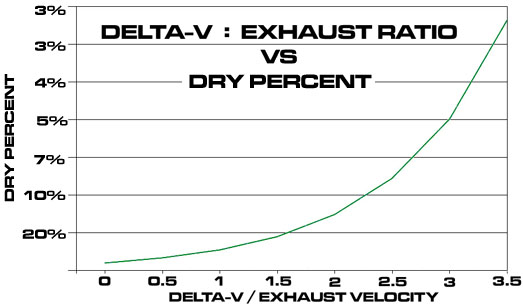
As you can see, for even a moderate delta-v requirement (e.g., a ratio of 2.5), the dry mass can only be about 8% of the total mass. This means 92% of the rocket must be propellant, leaving very little mass for the engines, tanks, avionics, and the payload you actually want to deliver. This is the fundamental challenge of rocket engineering.
5. Ideal vs. Real-World Performance
It is important to remember that the calculated by the Tsiolkovsky equation is an ideal value. It represents the rocket's total performance budget. In a real launch, this budget is "spent" on several things.
The total required for a mission () is the sum of all the "costs":
- : The actual velocity change needed for the orbital maneuver itself.
- : The performance "lost" by the engine having to constantly fight against gravity's pull during ascent.
- : The performance "lost" to overcoming atmospheric drag.
Your rocket's calculated ideal must be greater than this total mission cost.
Rockets & Launch Vehicles – Introduction to Aerospace Flight Vehicles
This textbook chapter provides a more formal discussion of how the ideal delta-v relates to real-world performance losses.
First, read the brief section Effects of Gravity to understand the concept of "gravity loss." Then, skim the section on Total Delta-V to see how these losses are summed up. Finally, review the Summary & Closure section, which provides a concise recap of ideal Δv and the various losses.
Conclusion
This lesson introduced the concept of delta-v, the central metric for rocket performance. You now understand not just what it is, but why it holds such a critical place in mission design and analysis.
Key Takeaways:
- Delta-v () is the maximum change in velocity a rocket can achieve by expending all its propellant, assuming no external forces. It is the rocket's performance "budget."
- Every space mission and maneuver has a "cost." A mission is only possible if the rocket's budget exceeds the mission's cost.
- is determined by the Tsiolkovsky Rocket Equation, which depends on the engine's exhaust velocity and the rocket's mass ratio ().
- The logarithmic nature of the equation creates the "tyranny of the rocket equation," where achieving high requires an exponential increase in propellant mass relative to the rocket's dry mass.
- The ideal from the equation must cover the costs of orbital maneuvers, gravity losses, and drag losses.
In our next lesson, we will dissect the two main components of the rocket equation: specific impulse (Isp), which is a common measure of engine efficiency related to exhaust velocity, and mass ratio. You will learn how engineers work to optimize these two factors to squeeze every possible meter per second of performance out of a design.