Recommended resources
The freely available resources this lesson will direct you to.
Welcome to your first lesson in aerospace engineering. Your goal is to become a rocket builder, and this course is designed to give you the foundational knowledge to design, build, and launch rockets, from small-scale models to understanding the principles behind large launch vehicles.
This lesson begins our journey by establishing the absolute bedrock of rocket science: Newton's three laws of motion. We will explore each law, not as abstract physics concepts, but as direct, practical principles that dictate every aspect of a rocket's flight. Understanding these rules is the first and most critical step toward designing a vehicle that can successfully defy gravity. By the end of this lesson, you will be able to state each law and, more importantly, explain precisely how it applies to a rocket on the launchpad and in flight.
1. Newton's First Law: The Law of Inertia
Newton's first law states that an object at rest will remain at rest, and an object in motion will continue in motion with a constant velocity (constant speed in a straight line), unless acted upon by a net external, or unbalanced, force. The key concept here is inertia, which is an object's inherent resistance to changes in its state of motion.
For a rocket, this law describes two critical phases of its mission:
- On the Launch Pad: Before ignition, a rocket sits stationary. It is in a state of static equilibrium. The force of gravity pulls it down, while the structure of the launch pad pushes it up with an equal and opposite force. These forces are balanced, so the net force is zero. According to the first law, the rocket will not move until an unbalanced force is introduced.
- Coasting Flight: After the engine has shut down, the rocket continues to travel upwards. It doesn't stop instantly. Its inertia keeps it in motion. However, the forces are now unbalanced. Gravity and aerodynamic drag are acting on the rocket, slowing it down. This deceleration continues until the rocket's vertical velocity becomes zero at its highest point, the apogee.
To explore these concepts in greater detail, let's turn to a practical guide from the world of model rocketry.
[PDF] Newton's Laws in the Rocketery World - Apogee Rockets
This article from Apogee Rockets provides a clear, rocketry-focused explanation of Newton's laws. It moves beyond simple definitions to discuss the practical application to flight phases.
Please read the section titled The First Law: Inertia on the Pad and in Coasting Flight. Focus on how the author describes the forces in static equilibrium on the launch pad and what it takes to break this state. Pay close attention to the description of coasting flight and the two unbalanced forces that bring the rocket to its apogee.
2. Newton's Third Law: Action and Reaction
We will jump to the third law now, as it directly explains the origin of the force that overcomes the rocket's inertia: thrust.
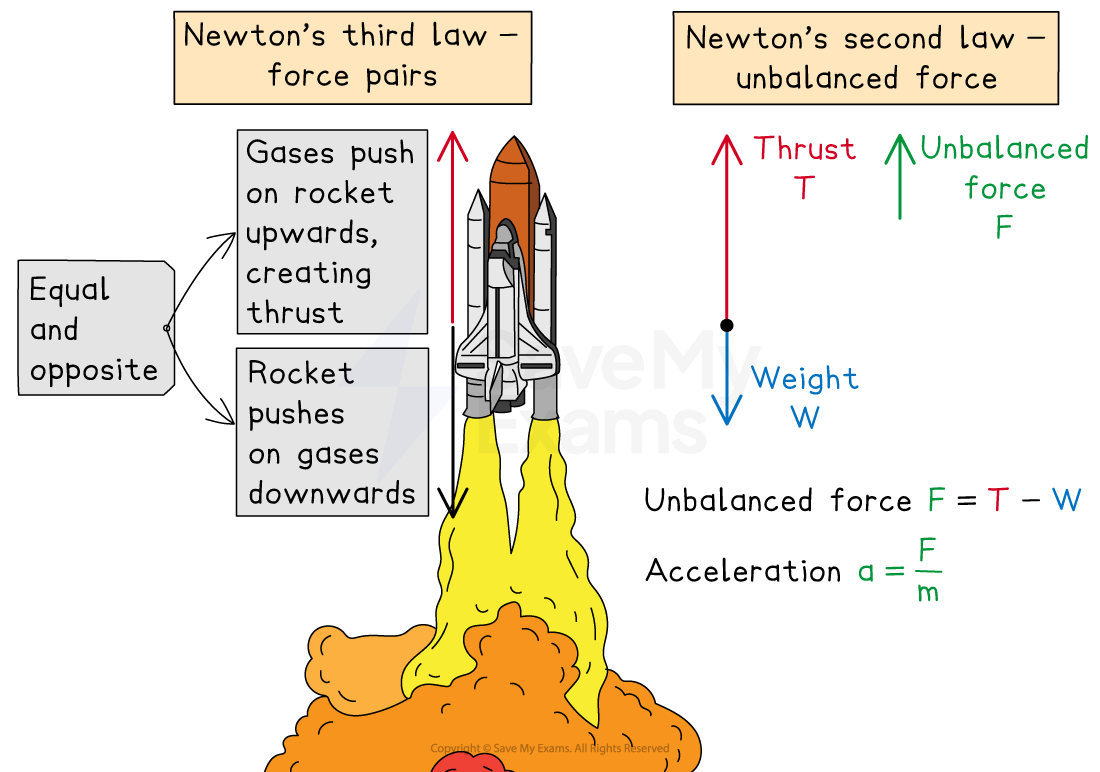
The third law states that for every action, there is an equal and opposite reaction. This is the single most important principle behind all rocket propulsion. A common misconception is that a rocket needs air to "push against." This is incorrect; in fact, rockets operate most efficiently in the vacuum of space.
The action-reaction pair occurs entirely within the rocket system itself.
- Action: The rocket engine rapidly expels a mass of hot gas (exhaust) downwards at high velocity.
- Reaction: The mass of expelled gas exerts an equal and opposite force on the rocket, pushing it upwards.
The force of this reaction is what we call thrust.
To visualize how this works inside the engine, imagine the combustion chamber where propellants are converted into high-pressure gas. These gas molecules fly around in all directions, striking the interior walls of the chamber.
- Forces from molecules hitting the side walls cancel each other out.
- Molecules hitting the front (top) wall of the chamber push the rocket forward.
- At the rear of the chamber, there is an opening—the nozzle. Gas molecules that would have hit a rear wall simply escape.
This creates a pressure imbalance. The continuous forward push on the front wall is not canceled by a backward push, resulting in a net force that propels the rocket.
The following short video provides a clear, animated explanation of this fundamental principle.
Rocket Propulsion Physics & Mass Flow Rate - Newton's 3rd Law of Motion
This video from The Organic Chemistry Tutor uses simple analogies to explain the core concept of action-reaction and then applies it directly to rocket propulsion.
Watch the segment from the beginning until the explanation of how a rocket accelerates upward. Notice how the principle is the same for an astronaut in space as it is for a rocket engine.
For a more rigorous explanation, let's return to our rocketry guide, which discusses the gas dynamics inside the combustion chamber.
[PDF] Newton's Laws in the Rocketery World - Apogee Rockets
This section explains precisely why a rocket doesn't need air to push against.
Read the section The Third Law: Action and Reaction in Gas Dynamics. Focus on the description of what happens at a microscopic level inside the chamber. This is the fundamental source of thrust.
3. Newton's Second Law: Force, Mass, and Acceleration
Now that we know an unbalanced force is needed to create motion (First Law) and how that force is generated (Third Law), Newton's second law tells us how the rocket will behave under that force.
The law is most famously written as:
Where is the net force, is the mass of the object, and is its acceleration. This equation tells us that acceleration is directly proportional to the net force and inversely proportional to the mass.
For a rocket during launch, the primary vertical forces are the upward thrust () and the downward weight (). The net force is therefore . The resulting acceleration is given by:
However, a rocket is a special case because its mass is not constant. It continuously loses mass as it burns and expels propellant. This has a profound effect on its acceleration. As the mass () decreases, even with constant thrust, the acceleration () must increase. This is why a rocket accelerates slowly at first and then faster and faster as it ascends.
Because the mass is changing, the more fundamental expression of Newton's second law is that force is equal to the rate of change of momentum (), where momentum is the product of mass and velocity ().
This formulation correctly accounts for both changes in velocity (acceleration) and changes in mass, making it the true foundation for rocket science. We will explore this in greater detail in a future lesson.
The following resource provides the mathematical context and explains why the changing mass is so crucial.
[PDF] Newton's Laws in the Rocketery World - Apogee Rockets
This section moves beyond the simple F=ma to the more complete, momentum-based version of the second law, which is essential for rocketry.
Read the section titled The Second Law: The True Source of Thrust and Momentum. Focus on how Newton's statement about momentum is more complete than F=ma. Note the explanation of how a rocket's changing mass generates thrust. Finally, understand why the rocket's acceleration must increase as its mass decreases.
Conclusion
In this lesson, we have established the three foundational laws of motion and tied each one directly to the physics of rocketry. These are not just academic exercises; they are the governing rules for every vehicle you will design.
Key Takeaways:
- Newton's First Law (Inertia): A rocket remains at rest until an unbalanced force (thrust) is applied. Its inertia causes it to continue coasting upwards even after the engine burns out.
- Newton's Third Law (Action-Reaction): Thrust is the reaction force generated by the action of expelling high-velocity exhaust gases. This process occurs entirely within the engine and requires no external medium to "push against."
- Newton's Second Law (): The rocket's acceleration is determined by the net force acting on it (thrust, weight, drag) and its mass. Critically, because a rocket's mass decreases as it burns fuel, its acceleration increases over the duration of the burn.
Now that we have a qualitative understanding of these principles, our next step will be to apply them quantitatively. In the next lesson, you will learn to draw a free-body diagram for a rocket, a tool used to identify all forces acting on it. We will then use these diagrams and Newton's second law to calculate the net force and resulting acceleration of a rocket in flight.