Recommended resources
The freely available resources this lesson will direct you to.
Hello! In the previous lesson, you measured cells in biological images. Now the question is how a body makes more cells. This lesson examines how mitotic cell division increases cell number during growth and replaces cells during tissue repair. The most important link for an eAssessment explanation is between what happens to the chromosomes, what cells are produced, and why those cells are useful. Allow about 35 minutes, including the short video and readings.
Why making more cells matters
A growing organism needs more cells to build larger tissues. Individual cells can grow too, but a cell cannot simply keep enlarging to account for the growth of an entire body. Mitotic cell division increases cell number: one parent cell ultimately produces two daughter cells, each of which can grow and, if appropriate, divide again.
Tissues also lose cells. Some are damaged by injury; others reach the end of their normal lifespan. Division supplies replacement cells, helping a tissue maintain or restore its structure. Growth, routine replacement, and repair therefore use the same basic source of new cells, but answer different needs: building more tissue, maintaining existing tissue, or restoring damaged tissue.
How one cell produces two suitable replacements
Watch FuseSchool’s What is Mitosis? for a visual overview. It briefly mentions meiosis and alleles; you do not need those topics here. Focus instead on the copied chromosomes and the result of the division.
What is Mitosis? | Genetics | Biology | FuseSchool
Watch What is Mitosis? from FuseSchool - Global Education to connect the movement of chromosomes with the production of new cells for growth and repair.
Watch the purpose for the distinction between making more body cells and making reproductive cells. Then watch the division, paying particular attention to DNA being copied before the chromosomes are separated and to the number of daughter cells produced.
The video shows the overall process quickly. Khan Academy’s The cell cycle and mitosis makes an important timing distinction clearer: DNA copying happens before mitosis, during interphase. Mitosis then separates the copied chromosomes into two nuclei. Finally, cytokinesis divides the cytoplasm so that there are two separate cells. In school answers, “mitosis” is often used as shorthand for this whole process, but distinguishing its parts helps you explain why both new cells receive the genetic information they need.
Learn: The cell cycle and mitosis (article) | Khan Academy
Read these short parts of Khan Academy’s The cell cycle and mitosis to put DNA copying, mitosis, and cytokinesis in the right order.
In “Cell division is part of the cell cycle,” read from the opening sentence about all cells being produced by division through the two bullets explaining interphase and the mitotic phase: cell-cycle overview In “The mitotic (M) phase consists of mitosis and cytokinesis,” read the two definition bullets and the paragraph beginning “Note that we often use the term”: precise distinction Stop before the detailed descriptions of prophase, metaphase, anaphase, and telophase; their names are not needed to explain growth and repair here.
The diagram below simplifies the process to two coloured chromosomes. After DNA replication, each chromosome has a copy. The copies are separated, and each daughter cell ends with the same chromosome number as the starting cell. The diagram uses two chromosomes to keep the drawing readable; it does not mean that all cells have only two.
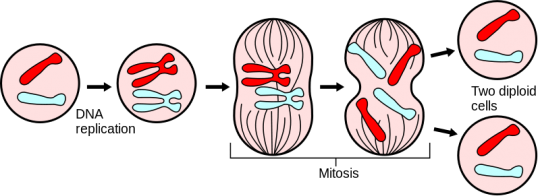
Why is that useful? A replacement cell needs a full set of genetic instructions to function. In normal mitotic division, the daughter cells have the same genetic information as the parent cell, rather than each receiving only half its chromosomes. They need not remain identical in appearance or job forever: cells can develop specialised features as a tissue forms.
Growth, repair, and everyday renewal
Consider the skin. Cells in its lower layer divide to supply new cells. As cells move towards the surface, they replace cells that die and are shed. This is renewal: replacement is happening even without an injury.
If skin is cut, cells must also replace cells lost or damaged at the wound. Mitotic division supplies new cells that can help restore the tissue. Division is part of wound healing, not a complete account of it; the key point for this lesson is that repair requires a supply of new cells.
Khan Academy brings the three uses of the cell cycle together in a short closing section.
Learn: The cell cycle and mitosis (article) | Khan Academy
Return to Khan Academy’s The cell cycle and mitosis for its direct comparison of why tissues need new cells.
In “The cell cycle is essential for tissue growth, renewal, and repair,” read the paragraph beginning “During growth, cells multiply” and ending with the example of old and dying cells: three purposes Notice that the paragraph distinguishes an increase in tissue mass from replacement within an existing tissue.
Turning the mechanism into an explanation
An eAssessment question asking you to explain needs more than “mitosis helps growth” or “mitosis makes identical cells.” Connect the steps to the outcome. For growth, the connection is that repeated divisions increase the number of cells, allowing tissues to become larger. For repair, it is that new cells replace lost or damaged cells, helping restore the tissue.
A strong answer can also state why the new cells are suitable: their DNA was copied before division, and the chromosomes were separated so that each daughter cell received the same chromosome set as the parent. If a diagram shows damaged skin, use that context—identify the cells being replaced rather than giving only a general definition of mitosis.
Keep one distinction in mind: the skin image shows routine renewal, while a wound calls for repair. Both depend on producing new cells, but the reason those cells are needed is different.
Key takeaways
Mitotic cell division produces two daughter cells with the same chromosome number and, normally, the same genetic information as the parent cell. DNA is copied before mitosis; chromosome separation and cytokinesis then produce two separate cells. Repeated division increases cell number for growth, while new cells replace old or damaged cells during renewal and repair.
Next, you’ll place cells within the larger hierarchy of tissues, organs, and organ systems.