Recommended resources
The freely available resources this lesson will direct you to.
Introduction
Welcome to the final lesson of our module on Early Modern philosophy. Over the past few lessons, we've explored the two dominant epistemological traditions of this era. We started with René Descartes, the quintessential rationalist, who sought to build knowledge on the bedrock of pure reason, doubting everything until he arrived at the indubitable certainty of the cogito. More recently, we delved into the work of David Hume, a leading empiricist. We examined his famous "Fork" and saw how his commitment to experience as the sole source of knowledge about the world led him to a profound skepticism about induction—the very foundation of scientific reasoning.
Today, we will bring these two threads together. Our goal is to directly address the learning outcome: to compare rationalist and empiricist approaches to the sources of knowledge and justification. We will systematize the differences between these two worldviews, moving from their core principles to their implications for science and mathematics. This lesson will serve as a capstone to our module, consolidating your understanding of Descartes and Hume and setting the stage for Immanuel Kant, who made it his life's work to resolve the conflict between them.
1. The Core Dispute: A General Overview
At its heart, the debate between rationalism and empiricism is about the ultimate source of our knowledge. Do we gain knowledge primarily through the exercise of our intellect (reason), or through the input of our senses (experience)?
To get a feel for the main lines of argument, let's start with a video that presents the debate as a dialogue.
Rationalism vs Empiricism Debate
The video 'Rationalism vs Empiricism Debate' from the channel Philosophy Vibe provides an excellent overview of the core tenets of each position and the classic arguments they deploy against each other.
Please watch from 00:42 to 07:16 and then from 08:32 to 11:15. As you watch, focus on how each side addresses these key questions: The Mind at Birth: Is the mind pre-loaded with knowledge (innate ideas) or is it a blank slate (tabula rasa)? The Role of Mathematics: Is mathematical knowledge a product of pure reason, or is it grounded in experience? Dealing with Skepticism: Which view provides a better defense against the possibility that our senses deceive us?
This video introduces the fundamental clash:
- Rationalism champions reason, intuition, deduction, and innate knowledge.
- Empiricism champions sensory experience, asserting that the mind is a blank slate at birth.
The dialogue highlights key battlegrounds: the existence of innate knowledge, the nature of mathematical truth, and the reliability of our senses.
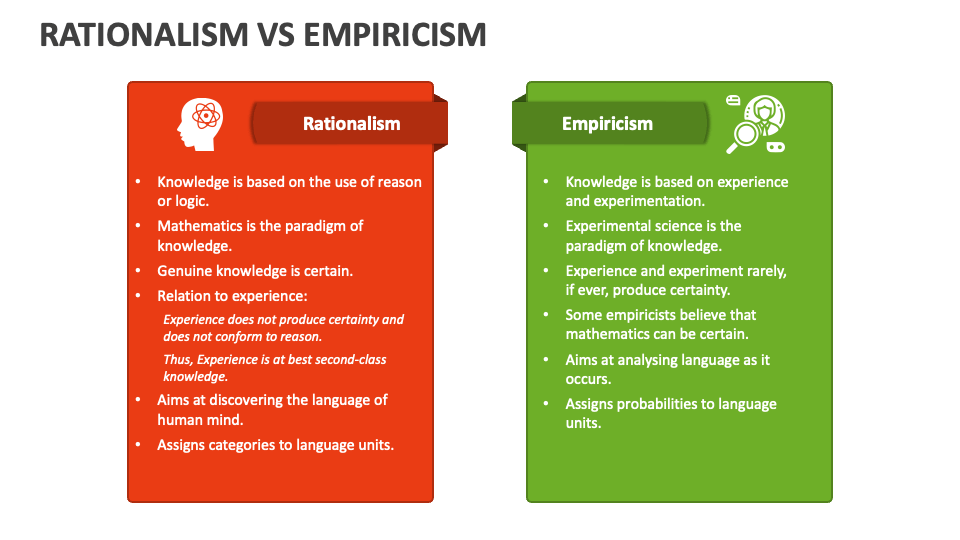
To crystallize these initial ideas, here is a helpful chart summarizing the main contrasts.
2. A More Formal Distinction: Three Key Theses
To add rigor to our comparison, we will now turn to the Stanford Encyclopedia of Philosophy. Philosophers often distinguish between rationalism and empiricism based on their stance toward three specific theses. Your background in mathematics will be useful here, as these distinctions require careful, structured thinking.
The article 'Rationalism vs. Empiricism' from the Stanford Encyclopedia of Philosophy (SEP) is a standard academic resource. We'll use it to break down the debate into three precise claims.
Please read the following parts of the article: Introduction and Section 1: Read from the beginning through the end of Section 1. This will formally introduce the dispute and the three key theses. Skim the definitions of Rationalism and Empiricism: Briefly read sections 1.1 (Rationalism) and 1.2 (Empiricism) to see how the theses are used to define each position.
Let's summarize the key takeaways from that reading. The debate isn't just "reason versus senses"; it's about specific claims regarding how we acquire and justify knowledge.
-
The Intuition/Deduction Thesis: "Some propositions in a particular subject area, S, are knowable by us by intuition alone; still others are knowable by being deduced from intuited propositions."
- Rationalists (like Descartes) believe this thesis applies broadly, including to substantive metaphysical truths about the world (e.g., God exists, the mind is distinct from the body).
- Empiricists (like Hume) accept this thesis but in a much more restricted sense. For them, it only applies to what Hume called relations of ideas (e.g., in mathematics and logic). It tells us about the connections between our concepts, not about the external world.
-
The Innate Knowledge Thesis: "We have knowledge of some truths in a particular subject area, S, as part of our rational nature."
- Rationalists affirm this. Plato believed we recollect knowledge from a past existence; other rationalists proposed God or evolution as the source. The key idea is that this knowledge is in us and just needs to be "triggered" by experience, not learned from it.
- Empiricists strongly reject this, famously articulated by John Locke's argument that the mind is a tabula rasa. If knowledge were innate, why aren't infants and "idiots" aware of it?
-
The Innate Concept Thesis: "We have some of the concepts we employ in a particular subject area, S, as part of our rational nature."
- Rationalists affirm this. Descartes argued that concepts like God, substance, and perfection could not be derived from our finite and imperfect experiences. Therefore, they must be innate.
- Empiricists reject this. They argue that all concepts, even complex ones, are ultimately built up from simple ideas derived from sensory experience (sensation) or our awareness of our own minds (reflection).
The more of these theses a philosopher endorses, and the broader the subject areas they apply them to, the more radical their rationalism. Empiricists, by contrast, are defined by their rejection of the innate knowledge and innate concept theses, and their restricted application of the intuition/deduction thesis.
3. A Case Study for the Mathematician: The Applicability of Mathematics
Given your background, you'll appreciate that mathematics is a central battleground in this debate. It presents a puzzle that strains both philosophies. Rationalism easily accounts for the certainty of mathematics, but struggles to explain why this product of pure reason applies so perfectly to the physical world. Empiricism easily accounts for its applicability (it's abstracted from experience), but struggles to explain its absolute certainty and a priori nature.
The following article frames the entire rationalism-empiricism debate through this mathematical lens.
The blog post 'Rationalism versus empiricism' from Intellectual Mathematics is tailored for someone with your interests. It explores how these epistemologies try to solve the 'mystery' of mathematics.
Please read the first two major sections of the transcript, from the beginning down to the paragraph that starts with 'I think we can agree that rationalism and empiricism both face big challenges.'
As the article argues, the harmony between the mathematical truths discovered in an armchair and the physical workings of the universe demands an explanation.
- The Rationalist Explanation (e.g., Descartes): God is the guarantor. He created the physical world according to mathematical principles and structured our minds with the same innate mathematical ideas. So, of course they match.
- The Empiricist Explanation (e.g., Mill, though not Hume on this point): The feeling of certainty is a delusion. Our mathematical intuitions are just deeply ingrained generalizations from a lifetime of experience with physical objects.
This brings the abstract philosophical debate down to a very concrete and powerful question: what is the source of the "unreasonable effectiveness of mathematics in the natural sciences"?
Test your understanding!
Imagine you're tutoring a high school student in geometry. You prove the Pythagorean theorem ($a^2 + b^2 = c^2$) on a whiteboard using pure deductive logic. The student is convinced. Then, you take out a tape measure and a large wooden right-angled triangle and show them that the measurements confirm the theorem.
How would a rationalist and an empiricist describe the relationship between the whiteboard proof and the physical measurement? Which one represents the real source of knowledge about the theorem?
Show answer
-
A rationalist would argue that the whiteboard proof is the only source of genuine knowledge. The proof provides absolute certainty through deduction from intuited axioms. The physical measurement is merely a contingent, imperfect illustration. It might help the student grasp the concept, but it doesn't justify the theorem. The knowledge is fundamentally a priori.
-
An empiricist would have a more complex view. A strict empiricist like John Stuart Mill would argue that the theorem is actually a generalization from countless physical experiences (drawing lines, seeing shapes, etc.). The whiteboard proof is just a way of codifying and organizing these empirical discoveries. The physical measurement is a confirmation of the general rule derived from past experience. For Hume, the theorem would be a "relation of ideas," certain but telling us nothing about the world until we apply it—at which point its application relies on induction.
For the rationalist, the proof is primary; for the empiricist, experience is primary.
4. The Grand Showdown: Descartes vs. Hume
Let's bring the comparison back to our two main protagonists. Their entire philosophical projects can be seen as embodying the clash between rationalism and empiricism.
This final video directly pits Descartes against Hume, showing how their foundational assumptions lead to radically different philosophical outcomes.
Descartes Vs Hume: Philosopher Showdown - Is Anything Undoubtable?
This 'Philosopher Showdown' from More Alex O'Connor frames the debate as a direct confrontation between Descartes and Hume, highlighting their opposing views on doubt, certainty, and the limits of knowledge.
Please watch these three segments: Introduction (00:00 - 01:37): This sets up the fundamental opposition between Descartes' rationalism (innate knowledge) and Hume's empiricism (knowledge from experience). Hume's Problem of Induction (08:28 - 11:43): This recaps the problem we studied last lesson, framing it as a direct consequence of Hume's empiricist starting point. Comparing Skepticism (12:09 - 13:09): This is a crucial point of comparison. Notice the difference between Descartes' methodological skepticism (used to find certainty) and Hume's conclusive skepticism (an end result of his philosophy).
This comparison highlights a key difference in their projects:
- Descartes uses skepticism as a tool to sweep away the unreliable beliefs derived from the senses, aiming to arrive at a foundation of absolute certainty in pure reason. His project is constructive.
- Hume, by consistently applying his empiricist principles, arrives at skepticism as a destination. His analysis reveals the limits of what experience can justify, leading him to doubt the rational basis for induction, causation, and the external world. His project is critical and deconstructive.
Conclusion
In this lesson, we have systematically compared the rationalist and empiricist traditions, which defined much of the philosophical landscape in the 17th and 18th centuries. We have seen that their disagreement is not a simple one, but a deep-seated conflict over the very sources and justification of human knowledge.
Key Takeaways:
- Source of Knowledge: Rationalism prioritizes reason and innate principles; Empiricism prioritizes sensory experience.
- The Mind's Role: For rationalists, the mind actively structures knowledge with innate concepts/truths; for empiricists, it is a passive receiver that builds knowledge from experience.
- Paradigms of Knowledge: Rationalism models all knowledge on the certainty of mathematics; Empiricism models it on the observational methods of the natural sciences.
- Justification: Rationalists seek to deduce truths from self-evident axioms; Empiricists seek to justify beliefs by tracing them back to their origins in experience, a process that relies on problematic inductive inferences.
- Skepticism: Descartes uses doubt as a method to achieve certainty, while Hume's empiricism leads to a profound and lasting skepticism about the rational foundations of our most basic beliefs.
This great debate between the "Continentals" (Descartes, Leibniz) and the "British" (Locke, Hume) set the stage for one of the most significant turning points in the history of philosophy.
Preview of the next lesson:
The German philosopher Immanuel Kant, awakened from his "dogmatic slumber" by Hume's skepticism, saw that both sides held part of the truth. He recognized that empiricism was right to claim that all knowledge begins with experience, but he sided with the rationalists in believing that it does not all arise from experience. His monumental work, the Critique of Pure Reason, is a revolutionary attempt to synthesize rationalism and empiricism. In our next module, we will begin to unpack Kant's "Copernican Revolution" in philosophy and his famous solution to the problems we've discussed: the "synthetic a priori."