Recommended resources
The freely available resources this lesson will direct you to.
Introduction
Welcome to our first lesson on Immanuel Kant. In the last module, we concluded by examining the great standoff between rationalism and empiricism. We saw how René Descartes, the rationalist, sought certain knowledge through pure reason, while David Hume, the empiricist, argued that all substantive knowledge of the world must stem from experience, a principle that led him to deep skepticism about fundamental concepts like causation and induction.
Kant found this standoff intolerable. He was profoundly impressed by the certainty of Newtonian physics and mathematics, yet Hume's arguments seemed to show that such certainty was impossible to justify. This led Kant to propose a "Copernican Revolution" in philosophy, an attempt to synthesize the valid insights of both rationalism and empiricism.
To understand this revolution, we must first learn the new conceptual tools Kant invented. This lesson is dedicated to that task. Our learning outcome is to distinguish between analytic/synthetic judgments and a priori/a posteriori knowledge. These two pairs of distinctions form the fundamental framework for Kant's entire critical project and are essential for grasping his answer to Hume. For you, these concepts are particularly crucial as they lie at the heart of Kant's philosophy of mathematics and became central topics of debate in 20th-century analytic philosophy.
1. Two Fundamental Distinctions
Kant's first move was to clarify two different ways we can classify a statement (or, in his terms, a "judgment"). One distinction is epistemological (about how we know it), and the other is semantic (about what it means).
To begin, let's watch a video that introduces these concepts and explains why Kant felt the need to create them.
Intro to the Philosophy of Mathematics (Ray Monk)
The video 'Intro to the Philosophy of Mathematics' by Ray Monk provides a very clear and concise introduction to Kant's two key distinctions. Pay close attention to the examples he uses.
Please watch from 16:57 to 20:32. This segment defines and provides examples for all four terms: analytic, synthetic, a priori, and a posteriori.
Now, let's break down these two distinctions in more detail.
The Epistemological Distinction: A Priori vs. A Posteriori
This first distinction concerns the justification of a judgment. How do we come to know that it is true?
- A Priori: A judgment is known a priori if its justification does not depend on any particular experience. We can know it through reason or pure thought alone. The classic example is a mathematical truth like "2+2=4". You don't need to conduct experiments to verify this. Kant strongly links the a priori with necessity; if a statement is necessarily true, it must be knowable a priori.
- A Posteriori: A judgment is known a posteriori if its justification does depend on experience—on observation, testimony, or scientific experiment. For example, "It is raining outside" can only be known by looking out the window or checking a weather report. Such truths are contingent; it could have been otherwise.
The following video provides a more thorough explanation with several helpful examples. It also addresses a subtle but important point: the difference between how we learn a concept and how we justify a proposition containing it.
Epistemology: A Priori vs. A Posterior; Analytic vs. Synthetic; Necessary vs. Contingent
This video from the 'teachphilosophy' channel delves deeper into the a priori / a posteriori distinction.
Watch from the beginning (00:14) to 05:13. Focus on the definition of each term and the examples provided. Note the crucial clarification that although you may learn about triangles through experience (e.g., in a class), the truths of geometry are justified a priori.
For a more formal definition, which may appeal to your mathematical background, we can turn to the Stanford Encyclopedia of Philosophy. It defines an a posteriori cognition as one "strictly determined in its form or in its semantic content by sensory impressions," whereas an a priori cognition is one that is not, and is instead "strictly determined... by our innate spontaneous cognitive faculties." You can read more about this in the SEP entry on Kant's Theory of Judgment (resource LINK, section 2.2.1), but the key idea is this formal dependence on either experience or the structure of the mind itself.
The Semantic Distinction: Analytic vs. Synthetic
This second distinction concerns the content of the judgment itself. It's about the relationship between the subject and the predicate.
- Analytic: A judgment is analytic if the predicate concept is already "contained" within the subject concept. These are truths of definition or conceptual analysis. The judgment doesn't add new information; it merely clarifies or "explicates" what is already in the subject. The classic example is "All bachelors are unmarried." The concept
unmarriedis part of the definition of the conceptbachelor. - Synthetic: A judgment is synthetic if the predicate concept is not contained within the subject concept. These judgments add new information, connecting (or "synthesizing") two separate concepts. For instance, "All bachelors are unhappy" is synthetic. The concept
unhappyis not part of the definition ofbachelor. To know if this is true, you would have to go out into the world and check.
Let's return to the teachphilosophy video for a clear explanation of this distinction.
Epistemology: A Priori vs. A Posterior; Analytic vs. Synthetic; Necessary vs. Contingent
We'll now watch the next segment of the same video, which covers the analytic/synthetic distinction.
Watch from 05:13 to 08:54. Again, focus on the definitions and examples, particularly the idea that analytic statements are like Hume's 'relations of ideas' (about words/concepts), while synthetic statements are like 'matters of fact' (about the world).
Test your understanding!
Classify each of the following statements as either a priori or a posteriori, and as analytic or synthetic.
- Every effect has a cause.
- Water is H₂O.
- A square has four sides.
- My computer is on.
Show answer
- Every effect has a cause. This is typically considered analytic a priori. The concept of a 'cause' is arguably contained within the concept of an 'effect'. You know it's true just by thinking about the definitions, not by observation.
- Water is H₂O. This is a tricky one that has generated much debate in later philosophy (e.g., by Saul Kripke)! For Kant, this would be synthetic a posteriori. We had to do empirical chemical analysis to discover this; 'being H₂O' is not part of the everyday concept of 'water'.
- A square has four sides. This is analytic a priori. 'Having four sides' is part of the definition of a square.
- My computer is on. This is synthetic a posteriori. The concept 'being on' is not part of the concept 'my computer', and you can only know if it's true by looking at it (i.e., through experience).
2. Combining the Distinctions: Kant's Grid of Knowledge
By combining these two distinctions, we can create a 2x2 grid that maps the possible types of knowledge.
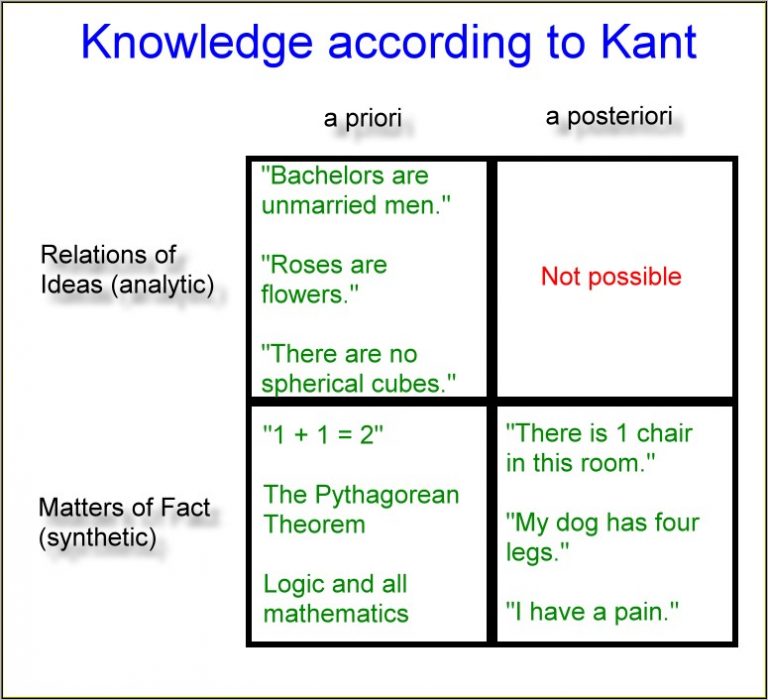
Let's look at the boxes:
- Analytic a priori: Truths of logic and definition. "All bodies are extended." Uncontroversial. Hume called them "relations of ideas."
- Synthetic a posteriori: Truths of experience and empirical science. "This body is heavy." Uncontroversial. Hume called them "matters of fact."
- Analytic a posteriori: This box is empty. If a statement is true by definition (analytic), we don't need experience to justify it.
- Synthetic a priori: This is the crucial, controversial, and most important category for Kant. These are judgments that are necessary and independent of experience (a priori), yet also add new information about the world (synthetic).
Before Kant, most philosophers (like Hume) believed that all a priori truths were analytic, and all synthetic truths were a posteriori. Kant's revolutionary claim was that this fourth category is not empty. In fact, he argued, it is the foundation of our most prized knowledge.
3. The Holy Grail: Synthetic A Priori Knowledge
The central question of Kant's Critique of Pure Reason is "How are synthetic a priori judgments possible?" He believed that the truths of mathematics, as well as the fundamental principles of natural science (like "every event has a cause," when interpreted as a principle structuring reality), belonged in this category.
This was his answer to Hume. Hume argued that since we couldn't justify principles like universal causation from experience, our belief in them was irrational. Kant agreed they couldn't come from experience, but he denied that this made them mere "relations of ideas" (analytic). Instead, they were synthetic a priori—necessary truths that structure our experience of reality.
Let's delve into Kant's primary example: mathematics.
Kant's philosophy of mathematics
The Stanford Encyclopedia of Philosophy article on 'Kant's Philosophy of Mathematics' provides a rigorous account of why he believed mathematical judgments are synthetic a priori. This is the core argument you need to understand.
Please read Section 2.2, titled 'Kant's answer to his question “How is Pure Mathematics Possible?”.' Focus on his famous argument for why '7 + 5 = 12' is synthetic. Try to reconstruct his reasoning: why isn't the concept '12' contained in the concept 'the sum of 7 and 5'?
As the article explains, Kant's argument is that no amount of analysis of the concepts 7, 5, and sum will yield the concept 12. You can't find '12' by simply dissecting the initial concepts. To get to 12, you must go beyond the concepts and perform an act of construction in what he calls intuition—a sort of mental visualization. You start with 7, and then you actively add, one by one, the units that make up 5. It is through this active, synthesizing process that the result, 12, arises.
Because this judgment is not based on mere conceptual analysis, it is synthetic. Yet, because it is necessary and universal, and does not depend on any particular empirical observation, it is a priori. Thus, "7+5=12" is a synthetic a priori judgment. The same applies to geometry. The proposition "a straight line is the shortest path between two points" is synthetic because the concept of 'shortest' is not contained in the concept of 'straight'. It's a truth we grasp by constructing it in our pure intuition of space.
Conclusion
In this lesson, we have unpacked the essential toolkit for understanding Kant's philosophy. We distinguished between two fundamental ways of classifying judgments: one based on justification, the other on meaning.
Key Takeaways:
- A Priori vs. A Posteriori: An epistemological distinction. A judgment is a priori if its justification is independent of experience; it is a posteriori if its justification depends on experience.
- Analytic vs. Synthetic: A semantic distinction. A judgment is analytic if its predicate is contained in its subject (true by definition); it is synthetic if its predicate adds new information to the subject.
- The Four Categories: These distinctions combine to form four possible categories of judgment: analytic a priori (logic), synthetic a posteriori (empirical facts), and the impossible analytic a posteriori.
- The Synthetic A Priori: This fourth category was Kant's revolutionary discovery. He argued it contains judgments that are both necessary (a priori) and informative (synthetic). He located the truths of mathematics and the fundamental principles of science in this category, providing a direct response to Hume's skepticism.
We have now established what Kant believed he needed to explain: the existence of synthetic a priori knowledge. We have seen why he thought mathematics was the prime example. The next logical question is how such knowledge is possible.
Preview of the next lesson:
To answer the "how" question, Kant proposed his "Copernican Revolution." He argued that instead of our knowledge conforming to objects, objects must conform to our knowledge. In our next lesson, we will explore this revolutionary idea and see how it provides the foundation for synthetic a priori judgments by positing that the mind itself imposes certain structures (like space, time, and causality) on all possible experience.