Recommended resources
The freely available resources this lesson will direct you to.
Welcome back. In our previous lesson on IFRS 16, we saw how the standard brings nearly all leases onto the balance sheet to provide a more faithful representation of a company's obligations. This was a prime example of the IFRS framework's emphasis on capturing economic substance over legal form.
Today, we delve into another cornerstone of modern financial reporting: IFRS 9 – Financial Instruments. This standard is particularly crucial for understanding the financial health of banks, investment firms, and any company that holds significant financial assets like investments in stocks and bonds.
Our learning objective is to describe the three classification categories for financial assets under IFRS 9. You will learn the principles-based logic that determines how a financial asset is accounted for, which is a fundamental shift from the more rules-based approach of the previous standard (IAS 39).
1. Why is Classification Necessary?
Before we explore the categories, it's essential to understand why we need to classify financial assets. A financial asset can be anything from simple cash, to a loan given to a customer (a receivable), to an investment in the shares or bonds of another company.
The way a company classifies a financial asset dictates its entire accounting life cycle:
- Initial Measurement: At what value is it first recorded?
- Subsequent Measurement: How is its value updated in the balance sheet at each reporting period?
- Reporting of Value Changes: Are gains or losses in value shown in the main income statement (Profit or Loss) or in a separate section of equity (Other Comprehensive Income)?
Getting the classification right is therefore critical for accurately reflecting the asset's performance and its contribution to the company's financial position. To start, let's watch a brief introduction that explains this concept.
IFRS 9 Financial Assets Classification
This video, 'IFRS 9 Financial Assets Classification' by Ram Meyyappan, provides a clear overview of why classification is a crucial first step in accounting for financial assets.
Please watch the video from the beginning until 03:36. The key idea to grasp is how classification determines the accounting treatment at different stages of an asset's life.
2. The Two Pillars of Classification
IFRS 9 bases the classification of financial assets (particularly debt instruments like loans and bonds) on a principles-based approach that requires assessing two key characteristics.
IFRS 9 explained – the classification of financial assets
The article 'IFRS 9 explained – the classification of financial assets' by BDO offers a concise, professional summary of these two criteria. This will introduce you to the official terminology.
Please read the sections titled 'New rules on adoption of IFRS 9', 'What is the business model test?', and 'What is the SPPI test?'. Focus on understanding the definitions of these two key tests.
As you just read, the two tests are:
-
The Business Model Test: This test looks at how the company manages the financial asset to generate cash flows. It's about the company's intention. The main business models are:
- Hold to Collect: The objective is to hold the asset to collect its contractual cash flows (e.g., principal and interest payments) over its life.
- Hold to Collect and Sell: The objective is achieved by both collecting contractual cash flows and selling the financial asset.
- Other: This includes models where assets are held for trading (i.e., to be sold for a short-term profit) or managed on a fair value basis.
-
The Contractual Cash Flow Characteristics Test (The "SPPI" Test): This test looks at the nature of the cash flows produced by the asset itself. The question is: are the contractual cash flows Solely Payments of Principal and Interest (SPPI) on the principal amount outstanding?
- A standard loan or bond with a fixed or variable interest rate typically passes the SPPI test. Its cash flows are just the return of the principal plus interest for the time value of money and credit risk.
- An investment in shares (equity) fails the SPPI test. Dividends are a share of profits, not interest, and the return of principal isn't guaranteed or scheduled. A derivative also fails this test.
Now, let's watch a more detailed explanation of how these two tests work together.
IFRS 9 | Financial Instruments | Classification Of Financial Assets And Liabilities #acca #accaexam
The video 'IFRS 9 | Financial Instruments' from Vertex Learning Solutions LLC provides an excellent, in-depth explanation of these two criteria, using clear examples.
Please watch the segment from 02:13 to 10:50. Pay close attention to how the speaker distinguishes between a bond (which passes SPPI) and a share (which fails SPPI), and how different business models can apply to the same asset.
3. The Three Classification Categories
By combining the results of the Business Model and SPPI tests, we arrive at the three primary classification categories for financial assets.
Category 1: Amortised Cost
This is the simplest category.
- Conditions: The asset must pass both tests:
- The business model is 'Hold to Collect'.
- The contractual cash flows are SPPI.
- Examples: Trade receivables, loans granted to third parties, or bonds that the company intends to hold firmly until maturity.
- Accounting Treatment: The asset is measured at its cost, adjusted over time for principal repayments and interest recognized using the effective interest method. It is not re-measured to fair value in the balance sheet. The logic is simple: if you have no intention of selling the asset, its day-to-day market price is not relevant.
Category 2: Fair Value Through Other Comprehensive Income (FVOCI)
This is the hybrid category.
- Conditions:
- The business model is 'Hold to Collect and Sell'.
- The contractual cash flows are SPPI.
- Examples: A portfolio of government bonds that a company holds for interest but might sell if it needs liquidity or if a favorable price emerges.
- Accounting Treatment: The asset is measured at Fair Value on the balance sheet. Changes in fair value are recognized in Other Comprehensive Income (OCI). This keeps unrealized gains and losses out of the main profit and loss statement until the asset is sold.
Category 3: Fair Value Through Profit or Loss (FVTPL)
This is the default or "residual" category.
- Conditions: An asset is classified as FVTPL if it does not meet the criteria for the other two categories. This includes:
- Any asset that fails the SPPI test (e.g., equity investments, derivatives).
- Any asset held in a trading business model.
- Examples: Shares held for trading, derivatives used for speculation.
- Accounting Treatment: The asset is measured at Fair Value on the balance sheet. All changes in fair value are recognized directly in the Profit or Loss (P&L) statement for the period.
The table below, adapted from the BDO article, summarizes the classification for debt instruments:
| Business Model → Cash Flow Type ↓ |
Hold to Collect | Hold to Collect and Sell | Other (e.g., Trading) |
|---|---|---|---|
| SPPI | Amortised Cost | FVOCI | FVTPL |
| Not SPPI | FVTPL | FVTPL | FVTPL |
Test your understanding!
A Moroccan SME, "Agri-Export SARL", purchases government bonds with a 5-year maturity. What are the two key questions the company's accountant must ask management to correctly classify this financial asset under IFRS 9?
Show answer
The accountant must ask about the two pillars of classification:
- Business Model: "What is our intention for these bonds? Do we plan to hold them for the full 5 years to collect all interest and principal payments (
Hold to Collect), or might we sell them before maturity if we need cash or if the price is right (Hold to Collect and Sell)?" - Cash Flow Characteristics (SPPI): "Do the bond's contractual terms provide for cash flows that are solely payments of principal and interest?" (For a standard government bond, the answer is almost certainly yes, but the question must be formally considered.)
The answer to the first question will determine if the classification is Amortised Cost or FVOCI.
4. The Special Case of Equity Investments
As mentioned, equity investments (shares) fail the SPPI test. Therefore, their default classification is always FVTPL.
However, IFRS 9 provides an important option. For equity investments that are not held for trading, a company can make an irrevocable election at the time of purchase to classify the investment at FVOCI.
What's the catch?
- FVTPL (Default): Dividends and changes in fair value go to P&L.
- FVOCI (by Election): Dividends go to P&L. However, changes in fair value go to OCI. Crucially, when the investment is sold, the accumulated gain or loss in OCI is never "recycled" to the P&L statement. It is transferred directly from one part of equity (the OCI reserve) to another (retained earnings).
This is a major point of contention. Management must choose wisely: accept P&L volatility (FVTPL) or give up the ability to ever recognize a capital gain in the P&L for that investment (FVOCI). The following video explains this critical choice.
IFRS 9 | Financial Instruments | Classification Of Financial Assets And Liabilities #acca #accaexam
Let's return to the Vertex Learning video, which offers one of the clearest explanations available on this 'irrevocable election' for equity shares.
Please watch the segment from 20:33 to 32:10. Focus on the logic behind why management might want to use the FVOCI option and the consequences of it being 'irrevocable' (no recycling to P&L).
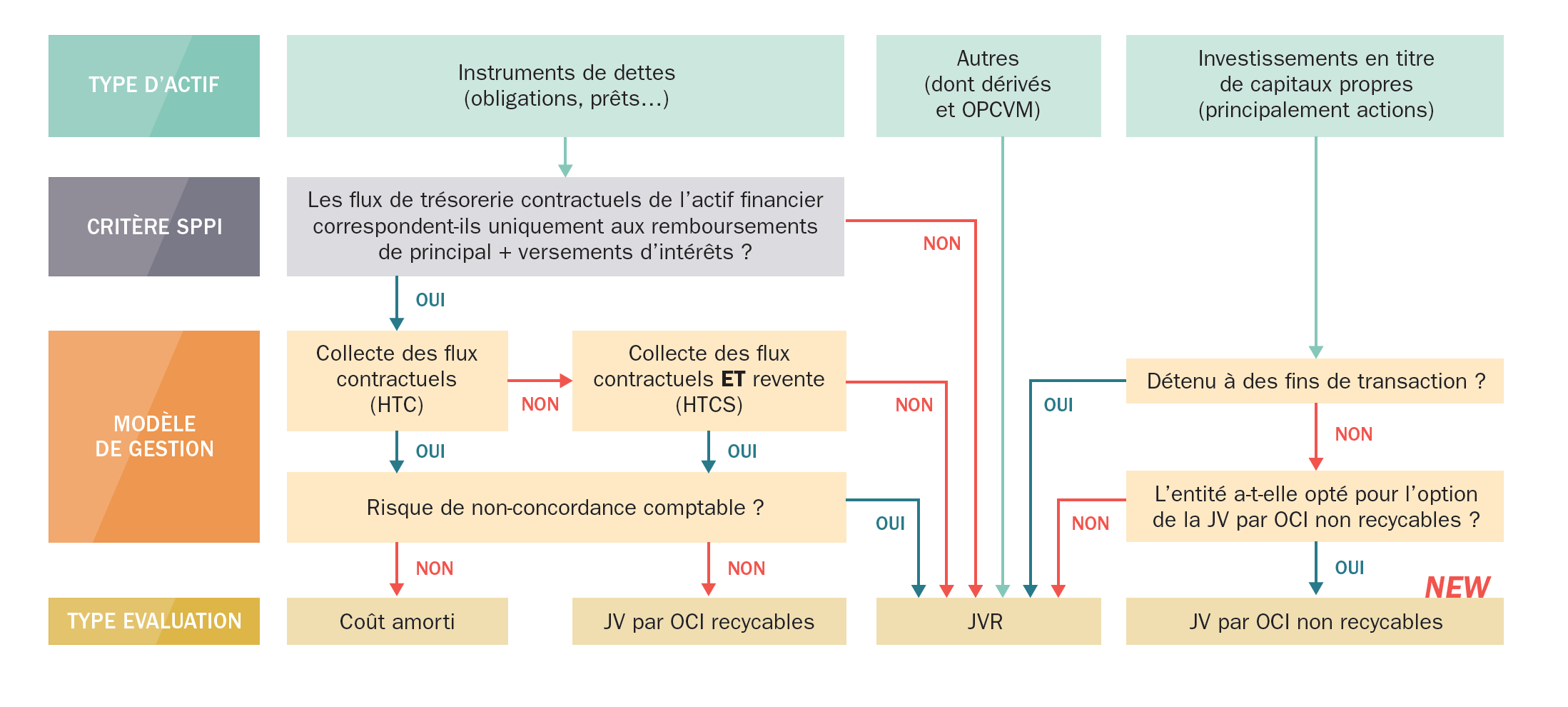
5. Summary Flowchart
The decision process for classifying financial assets can be complex. The following flowchart provides a clear visual map of the logic, from the initial assessment of the asset type down to the final classification. As it's in French, it serves as a practical tool for your professional environment in Morocco.
Conclusion
You have now examined the principles-based framework that IFRS 9 uses to classify financial assets. This approach ensures that the accounting treatment aligns with how an asset is managed and the nature of its cash flows.
Key Takeaways:
- Financial asset classification is driven by two tests: the Business Model test (the 'why') and the SPPI test (the 'what').
- This leads to three categories: Amortised Cost, for simple debt instruments held to collect payments; FVOCI, for debt instruments held to both collect and potentially sell; and FVTPL, the default category for trading assets and those that fail the SPPI test.
- Equity investments default to FVTPL, but an irrevocable election can be made to classify non-trading equities at FVOCI, which prevents any future gains or losses from being recognized in the profit or loss statement.
Preview of the Next Lesson:
In our next lesson, we will tackle another complex but essential topic in advanced accounting: deferred taxes. We will explore why differences between accounting rules (IFRS) and tax rules (Moroccan tax law) create deferred tax assets and liabilities on the balance sheet, and you will learn how to calculate and record these year-end adjustments.