Recommended resources
The freely available resources this lesson will direct you to.
- Understand Direct Object Pronouns in French | Complément d'objet direct (COD)www.youtube.com
- Easy Animated Explanation: Direct Object Pronouns in French for Beginners: how to form, use, place.www.youtube.com
- Me, te, le, la, nous, vous, les - French Direct Object Pronounswww.lawlessfrench.com
- French direct object pronouns: A how-to guide - LingoCulturelingoculture.com
Introduction
Bonjour ! In our last lesson, we concluded our deep dive into past tenses, learning how to weave passé composé and imparfait together to tell a complete story. You now have the tools to understand the difference between the main plot and the background scenery in a French narrative.
Today, we begin a new module that will make your French sound much more natural and less repetitive. We'll be exploring pronouns—the small words that replace nouns. Think of them as shortcuts. Instead of saying "Paul sees the car, and Paul likes the car," we can say "Paul sees the car, and he likes it."
Our focus for this lesson is to identify and place direct object pronouns (le, la, les, me, te, nous, vous) in example sentences. Mastering this is a crucial step toward your goal of understanding fluid, authentic French.
What Does a Direct Object Pronoun Do?
A direct object is the person or thing that directly receives the action of the verb. To find it, you ask the question "what?" or "who?". A direct object pronoun (DOP) is a short word that replaces this noun.
Let's look at a simple visual example.
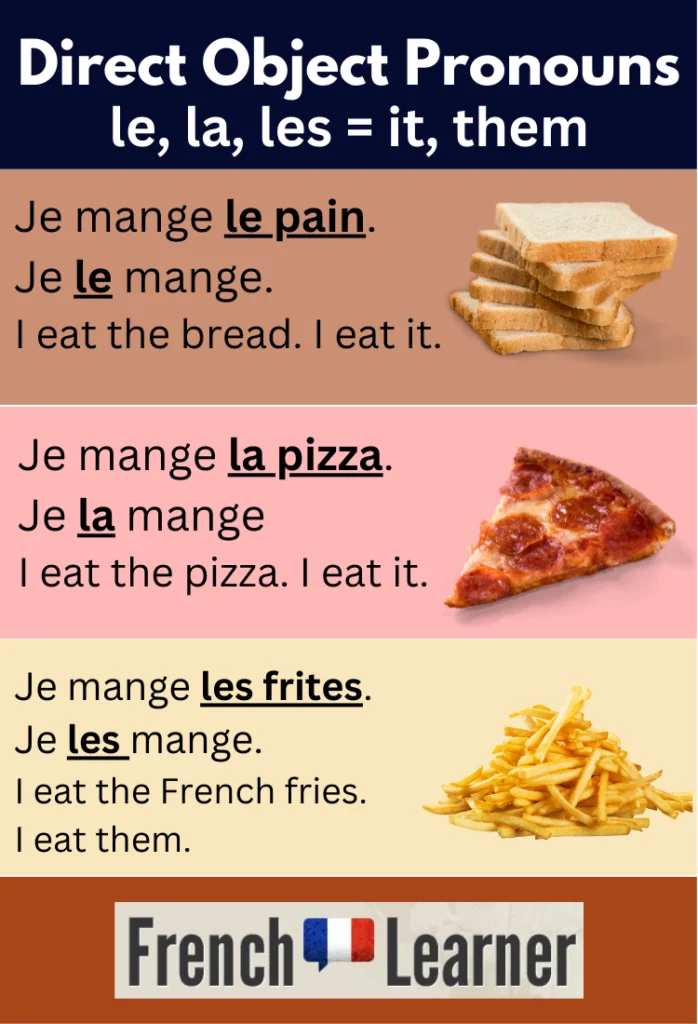
Notice the pattern:
Je mange **la pizza**.(I eat the pizza.) ->Je **la** mange.(I eat it.)Tu as **le pain**.(You have the bread.) ->Tu **l'**as.(You have it.)Il aime **les frites**.(He likes the fries.) ->Il **les** aime.(He likes them.)
The main thing to observe right away is that in French, the pronoun (la, l', les) comes before the verb, which is the opposite of English.
To formalize this concept, let's watch a quick explanation.
Understand Direct Object Pronouns in French | Complément d'objet direct (COD)
The YouTube channel 'Learn French With Alexa' provides a very clear, example-based introduction to what a direct object is and why we use pronouns to replace it.
Watch from 00:47 to 03:21. The presenter uses the sentence 'Je mange la pomme' (I eat the apple) to show how the direct object 'la pomme' is replaced by the pronoun 'la'.
The Full Set of Direct Object Pronouns
You've just seen le, la, l', and les. Now, let's look at the complete list, which also includes pronouns for "me," "you," and "us."
Here they are:
| English Pronoun | French Pronoun | Example (Noun) | Example (Pronoun) |
|---|---|---|---|
| me | me / m' |
Il regarde moi. | Il me regarde. (He watches me.) |
| you (informal) | te / t' |
Il regarde toi. | Il te regarde. (He watches you.) |
| him / it (m.) | le / l' |
Il regarde le film. | Il le regarde. (He watches it.) |
| her / it (f.) | la / l' |
Il regarde la voiture. | Il la regarde. (He watches it.) |
| us | nous |
Il regarde nous. | Il nous regarde. (He watches us.) |
| you (formal/pl.) | vous |
Il regarde vous. | Il vous regarde. (He watches you.) |
| them (m./f.) | les |
Il regarde les films. | Il les regarde. (He watches them.) |
As you can see, le, la, me, and te change to l', m', and t' before a word starting with a vowel or a silent 'h'. This is the same elision rule you've seen before.
For a spoken walkthrough of this list, the next part of the video you started is perfect.
Understand Direct Object Pronouns in French | Complément d'objet direct (COD)
Let's continue with the video from 'Learn French With Alexa' to hear all the pronouns used in context.
Watch from 03:58 to 07:06 to see the full list of pronouns. Then, watch the short segment from 09:53 to 11:14, which specifically explains the elision (e.g., 'Je l'aime' instead of 'Je le aime').
The Golden Rule: Pronoun Placement
The most important pattern to recognize is word order. As we've seen, unlike in English, the French direct object pronoun almost always comes before the verb that affects it.
Let's break this down into the three most common sentence structures. The following video explains these rules clearly.
Understand Direct Object Pronouns in French | Complément d'objet direct (COD)
The placement of the pronoun can feel tricky at first, but it follows a consistent pattern. Let's watch the segment from 'Learn French With Alexa' that covers the three main placement rules.
Watch the section from 11:56 to 13:34. Pay close attention to the three different scenarios presented: before a simple conjugated verb, before an auxiliary verb (like in the passé composé), and before an infinitive.
Let's review those three patterns with our own examples.
1. Before the conjugated verb (in simple tenses)
The pronoun goes directly before the single conjugated verb.
Tu vois **Marie**.->Tu **la** vois.(You see her.)Je prends **le train**.->Je **le** prends.(I take it.)Ils aiment **nous**.->Ils **nous** aiment.(They like us.)
2. Before the auxiliary verb (in compound tenses like passé composé)
The pronoun goes before the auxiliary verb (avoir or être), not the past participle.
J'ai lu **le livre**.->Je **l'**ai lu.(I read it.)Nous avons vu **nos amis**.->Nous **les** avons vus.(We saw them.)Elle a attendu **toi**.->Elle **t'**a attendu.(She waited for you.)
3. Before the infinitive verb
When you have a conjugated verb followed by an infinitive (e.g., aller + verb, pouvoir + verb), the pronoun goes before the infinitive.
Je vais regarder **le match**.->Je vais **le** regarder.(I am going to watch it.)Tu peux aider **moi**?->Tu peux **m'**aider?(Can you help me?)Elle veut acheter **les chaussures**.->Elle veut **les** acheter.(She wants to buy them.)
To solidify your understanding, please read through the following clear, example-rich guide on pronoun placement.
French direct object pronouns: French word order
This article from LingoCulture, 'French direct object pronouns: A how-to guide', provides a great written summary of the placement rules we just saw. Reading the rules after seeing them in video format can help reinforce the patterns.
Please read the section titled 'Direct object pronouns: French word order'. Focus on the examples for 'Before conjugated verbs', 'In the passé composé', and 'Before infinitive verbs'.
Conclusion
Excellent work today! We've taken our first step into the world of pronouns, a topic that is essential for making your French more efficient and elegant.
Key Takeaways:
- A direct object pronoun (DOP) replaces the noun that directly receives a verb's action (the answer to "who?" or "what?").
- The French DOPs are
me/m',te/t',le/l',la/l',nous,vous, andles. - The pronoun must agree in gender and number with the noun it replaces (e.g.,
le livre->le,la table->la). - The Golden Rule: The DOP is placed before the verb it is the object of. This means before a simple verb, before the auxiliary in a compound tense, or before an infinitive.
Preview of the Next Lesson:
Now that you can handle direct objects, what happens when the action is done to or for someone? In our next lesson, we will explore indirect object pronouns (lui, leur, etc.) to answer the question "to whom?". You'll learn to distinguish between "I see him" (Je le vois) and "I talk to him" (Je lui parle).