Recommended resources
The freely available resources this lesson will direct you to.
Introduction
Bonjour ! In our last lesson, we learned how to use direct object pronouns (le, la, les, etc.) to make sentences more fluid by replacing the direct recipient of an action. You'll recall that these pronouns answer the question "who?" or "what?". For example, "I see the book" becomes "I see it" (Je vois le livre -> Je le vois).
Today, we'll build directly on that foundation by exploring indirect object pronouns. These pronouns answer a different question: "to whom?" or "for whom?" is the action done. This lesson is key to distinguishing between sentences like "I see her" and "I talk to her".
Our goal is to identify and place indirect object pronouns (lui, leur, me, te, nous, vous`) in example sentences. This will bring you another step closer to understanding the natural flow of authentic French.
What is an Indirect Object?
While a direct object gets the action of the verb directly, an indirect object is the person (or thing) that receives the action indirectly. In French, you can almost always spot it because it's introduced by the preposition à (to).
Consider this sentence:Je donne un cadeau à Marie. (I give a gift to Marie.)
- Subject:
Je(I) - Verb:
donne(give) - Direct Object (what am I giving?):
un cadeau(a gift) - Indirect Object (to whom am I giving it?):
à Marie(to Marie)
To see this concept explained with clear examples, please watch the first part of the following video.
Understanding POI and COI in French! 🇫🇷
The video 'Understanding POI and COI in French!' from the 'Learn French With Alexa' channel gives a great breakdown of how to identify an indirect object, which they call a COI (Complément d'Objet Indirect).
Watch from 00:53 to 03:17. Focus on how the question 'à qui?' (to whom?) is used to find the indirect object in the example 'Safia donne une pomme à Julie'.
Just like with direct objects, we use pronouns to avoid repeating the indirect object noun. Instead of saying, "I am talking to Marie. I am giving a book to Marie," we can simply say, "I am talking to her. I am giving a book to her."
The Indirect Object Pronouns: lui, leur, and the rest
The set of indirect object pronouns (IOPs) will look very familiar, with two important new additions.
| English | French IOP | Replaces |
|---|---|---|
| to me | me / m' |
à moi |
| to you (inf.) | te / t' |
à toi |
| to him / to her | lui |
à + a single person (e.g., à Paul, à Sophie) |
| to us | nous |
à nous |
| to you (form./pl.) | vous |
à vous |
| to them | leur |
à + multiple people (e.g., aux parents, à mes amis) |
The pronouns me, te, nous, and vous are identical to the direct object pronouns you learned last time. The context (specifically, the verb) tells you whether they mean "me" or "to me".
The most significant new pattern involves lui and leur.
Key Pattern:
luireplacesà+ any single person, masculine or feminine.leurreplacesà+ any group of people, masculine or feminine.
This is different from direct object pronouns, where you had to distinguish between le (him) and la (her). For indirect objects, lui covers both.
This infographic provides a perfect visual summary.
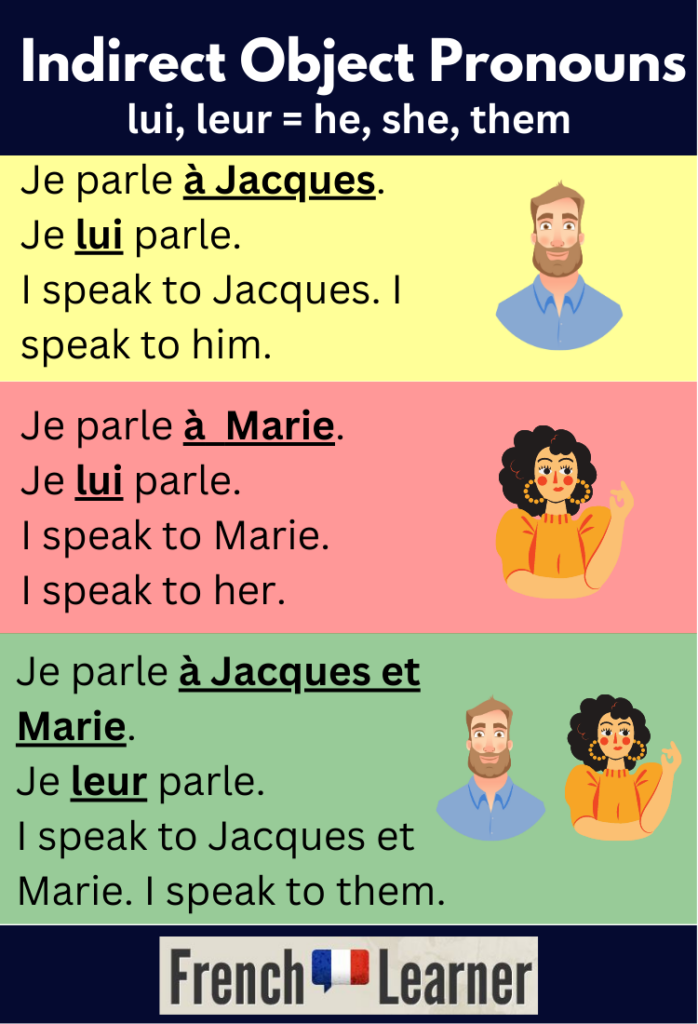
Now, let's see these pronouns used in context.
Understanding POI and COI in French! 🇫🇷
Let's continue with the 'Learn French With Alexa' video. The presenter will walk through each of the pronouns with spoken examples.
Please watch the following segments: me and te: 04:53 - 07:05 lui: 07:05 - 08:07 nous and vous: 08:07 - 09:59 leur: 09:59 - 10:36 \nNotice how the pronoun always replaces a phrase starting with 'à' (e.g., 'à moi', 'à Julie', 'à Tom et Safia').
To reinforce the crucial distinction between lui and le/la, please read the following short text.
French Pronouns: Beginner Guide with Examples
The article 'French Pronouns: Beginner Guide with Examples' from Optilingo has a very useful section that directly contrasts direct and indirect object pronouns.
Read the section '7) Indirect Object Pronouns: me, te, lui, nous, vous, leur'. Pay special attention to the part titled 'The key difference from direct objects' and the FAQ at the end of the article that answers 'When do I use lui versus le or la?'.
The Placement Rule: Reassuringly Familiar
Here's the good news: the placement rules for indirect object pronouns are the same as for direct object pronouns. The pronoun goes before the verb.
Let's review the main scenarios:
1. Before the conjugated verb (in simple tenses):
Je parle **à ma sœur**.->Je **lui** parle.(I speak to her.)Ils téléphonent **à leurs amis**.->Ils **leur** téléphonent.(They call them.)
2. Before the auxiliary verb (in passé composé):
J'ai donné le livre **à Paul**.->Je **lui** ai donné le livre.(I gave the book to him.)
3. Before the infinitive verb:
Je vais écrire **à mes parents**.->Je vais **leur** écrire.(I am going to write to them.)
This pattern is consistent and reliable. For a set of clear written examples covering these placement rules, please refer to the following guide.
French Indirect Object Pronouns: A Quick Guide
The article 'French Indirect Object Pronouns: A Quick Guide' from Busuu offers a concise summary of the placement rules.
Read the section titled 'Rules about the position of indirect object pronouns'. Focus on the examples for the basic rule, compound tenses, and sentences with infinitives.
Quick Practice
Let's test your pattern-recognition skills. How would you replace the indirect object with a pronoun in these sentences?
Il écrit une lettre **à son amie**.->Il ___ écrit une lettre.Nous demandons **à nos professeurs**.->Nous ___ demandons.Tu as parlé **à ta mère**?->Tu ___ as parlé?
(Think about it... The answers are below)
.
.
.
Solutions:
Il **lui** écrit une lettre.(à son amieis a single person)Nous **leur** demandons.(à nos professeursis a plural group)Tu **lui** as parlé?(à ta mèreis a single person)
Conclusion
You've done excellent work today, building on your knowledge of pronouns. You can now recognize not only what an object pronoun is, but also whether it's direct or indirect, which is a fundamental concept in French grammar.
Key Takeaways:
- An indirect object answers the question "to whom?" or "for whom?" and is usually marked by the preposition
à. - The indirect object pronouns are
me,te,lui,nous,vous, andleur. luireplacesà+ a single person (masculine or feminine).leurreplacesà+ multiple people.- The placement rule is the same as for direct object pronouns: the pronoun comes before the relevant verb (the conjugated verb, the auxiliary, or the infinitive).
Preview of the Next Lesson:
We will continue our journey through pronouns by looking at the pronoun y. This versatile little word is most often used to replace places (answering the question "where?"), helping you say things like "I'm going there" (J'y vais).