Recommended resources
The freely available resources this lesson will direct you to.
- How To Master Time Management – ADHD Skills Part 1www.youtube.com
- 🆓 FREE Functional Planning Tool You Might Not Believe Exists! | Goblin Tools Tutorial | ADHDwww.youtube.com
- ADHD Procrastination: 6 Strategies That Work - Scott Shapiro, MDwww.scottshapiromd.com
- How to Break Big Tasks Down into Smaller Steps to Avoid Overwhelmwww.beyondbooksmart.com
Introduction
Hello, and welcome back. In our last lesson, you took the crucial first step of building your "external brain" by performing a Mind Sweep—capturing all the tasks, ideas, and commitments occupying your mental space into a single, trusted system. Your "inbox" is likely full of this raw material. This is an excellent start, but a long list of unrefined items can itself become a source of overwhelm.
Today, we'll tackle the next essential step. The learning outcome for this lesson is to break down complex projects into concrete, actionable steps.
This skill is the bridge between capturing an idea and actually making progress on it. For the ADHD brain, large, ambiguous tasks like "prepare Q4 investor report" or "record new song" can trigger "initiation friction," that feeling of being paralyzed and not knowing where to start. By breaking these mountains down into a series of small, clear hills, you make them approachable and create momentum. As a CIO, you constantly deal with large-scale projects; this technique will not only bring clarity to your professional work but can be applied to your musical and personal goals as well.
Why We Get Stuck and How to Get Unstuck
Before diving into the "how," it's important to understand why breaking down tasks can feel so difficult, especially for high-achievers. Often, it's a combination of executive function challenges, perfectionism, and simple task avoidance.
How to Break Big Tasks Down into Smaller Steps to Avoid Overwhelm
This article, 'How to Break Big Tasks Down,' does an excellent job of explaining the psychological barriers and the benefits of overcoming them. It validates the feeling of resistance while clearly stating the payoff.
Please read the first two sections: 'Why Breaking Down Tasks Matters': Focus on how this process helps identify the true first step. 'Why Breaking Down Tasks Feels Hard': See if any of these reasons, like perfectionism or executive dysfunction, resonate with your own experience.
The core problem is that our brains often misinterpret the size of a task. What seems like a single item on a to-do list is actually a multi-step project in disguise. Recognizing this is the first step toward clarity.
Dr. Tracey Marks provides a brilliant clinical perspective on this, using a simple, relatable example to show how an overwhelming chore becomes manageable once its components are identified and timed.
How To Master Time Management – ADHD Skills Part 1
In this video, psychiatrist Dr. Tracey Marks explains the importance of task breakdown for time management in ADHD. Her example with Judy and the laundry is a perfect illustration of how our perception of a task's duration and complexity is often inaccurate.
Please watch from 02:04 to 07:08. Pay close attention to how she dissects the 'laundry' task into gathering, washing, drying, folding, and putting away. Notice how this reveals the true time commitment and allows for realistic planning.
As Dr. Marks demonstrates, breaking a task down isn't just about making a list; it's about revealing the hidden steps and understanding the true scope of the work. This process transforms a vague source of anxiety into a clear, plannable sequence of operations.
Frameworks for Deconstruction
Now that we understand the 'why,' let's focus on the 'how.' Having a structured approach is key.
The STM Framework
A simple yet powerful framework is STM: Steps, Sequence, Time, and Mapping. It provides a logical flow from a vague idea to a concrete plan.
How to Break Big Tasks Down into Smaller Steps to Avoid Overwhelm
The same article we looked at earlier introduces this framework. It's an excellent, systematic way to approach any project.
Read the section 'How to Get Started When You Don’t Know Where to Start'. Focus on the four components of the STM framework.
Practical Strategies for Finding the 'Steps'
The most challenging part of the STM framework is often the first one: identifying the steps. Here are several techniques you can experiment with. Your engineering background might favor a systematic approach like "Working Backward," while your creative side as a musician might prefer a "Brain Dump."
How to Break Big Tasks Down into Smaller Steps to Avoid Overwhelm
This section of the article provides four distinct strategies for generating your list of steps. Having multiple tools in your toolkit is essential, as different projects may call for different approaches.
Now, please read the section 'Practical Strategies for Breaking Down Tasks'. Pay particular attention to: The Brain Dump: Getting everything out without judgment. Working Backward: A powerful project management technique that starts from the end goal. Chunking by Category: A higher-level approach that offers more flexibility.
Making Steps Truly Actionable
Once you have a list of steps, the final refinement is to ensure each one is a concrete, physical action. A common pitfall is creating a sub-list that is still too vague.
The key is to phrase every task starting with a verb. This turns your list from a set of concepts into an instruction manual for your future self.
ADHD Procrastination: 6 Strategies That Work - Scott Shapiro, MD
Dr. Scott Shapiro provides a concise, powerful guide on this. He frames it as creating a 'quasi-instruction manual' for yourself, which is a perfect way to think about it.
Please read the first strategy, '1. Break projects into actionable microtasks.' The central idea here is to start each task with a verb.
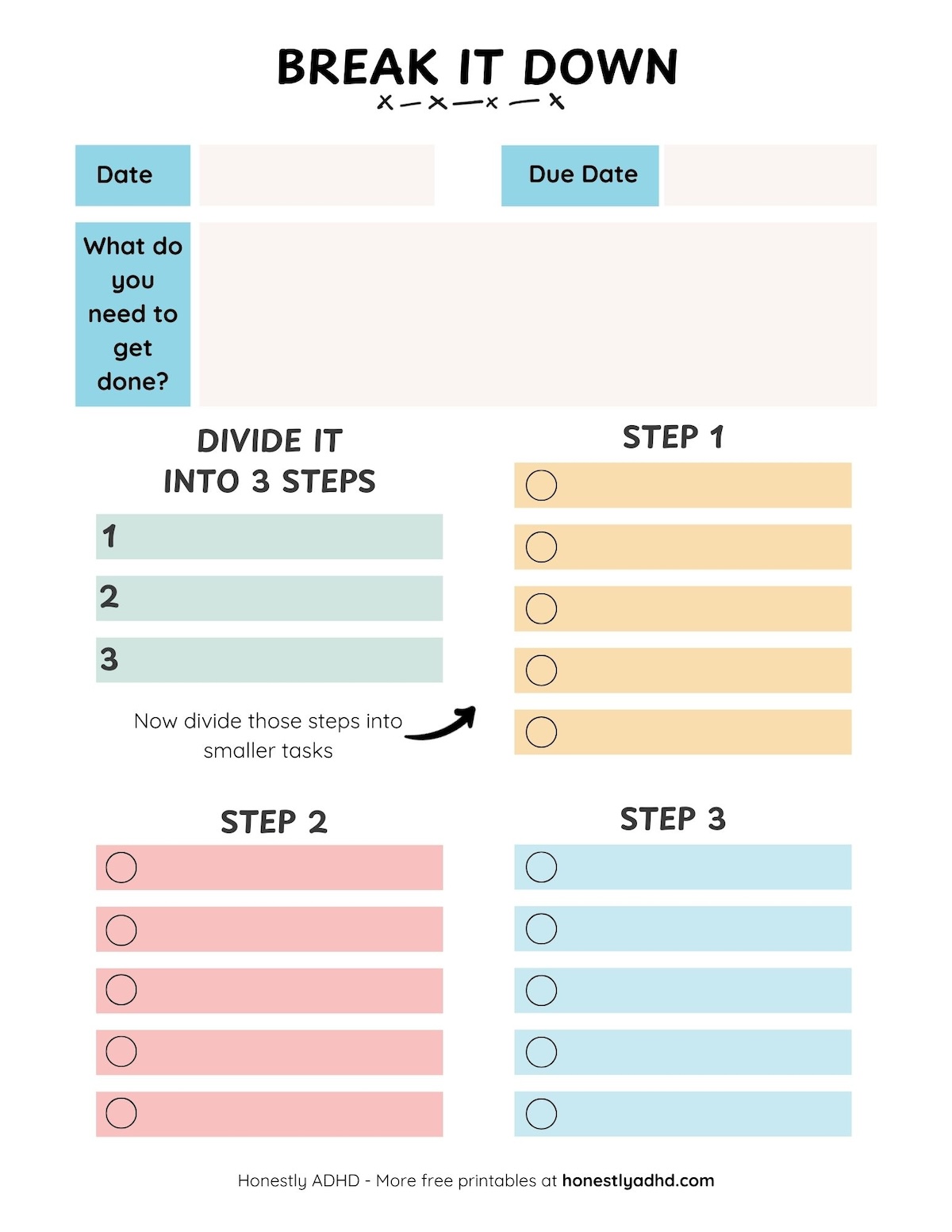
To put it all together, here is a simple worksheet that visually represents this process of deconstruction.
Leveraging Technology: Your AI Assistant
Manually breaking down tasks is a powerful skill, but sometimes the initial inertia is too high. Given your interest in AI, you'll appreciate that technology can assist here. Tools like Goblin.tools can do the initial "brain dump" and structuring for you, giving you a starting point to refine.
🆓 FREE Functional Planning Tool You Might Not Believe Exists! | Goblin Tools Tutorial | ADHD
This short video provides a tutorial for a free tool called Goblin Tools. It's specifically designed to help with executive functioning challenges by using AI to break down tasks.
Watch from the beginning to 03:52. Focus on how the 'Magic To Do' list works and how the 'spiciness' setting (chili peppers) allows you to control the level of detail in the breakdown. This is a great way to quickly generate a first draft of your task list.
This kind of tech assistance is not a replacement for thinking, but it's an excellent tool for overcoming the initial hurdle of a blank page.
Your Turn: Practice Deconstruction
Now, let's put this into practice.
- Open the task manager you set up in the last lesson.
- Choose one large or intimidating project from your Mind Sweep list (e.g., "Plan family vacation," "Develop new investment thesis," "Finish mixing the band's song").
- Using your preferred method—the STM framework, Working Backward, or Goblin Tools—break that project down into a list of concrete, verb-first actions.
- Aim for steps that feel like they would take anywhere from 5 to 60 minutes to complete. If a step feels larger than that, see if you can break it down further.
For example, "Prepare Q4 Investor Report" might become:
Q4 report- Draft the report's executive summary.
- Compile performance data for all managed portfolios.
- Create a chart visualizing asset allocation changes.
- Write the macroeconomic outlook section.
- Ask Jane for compliance review.
- Incorporate Jane's feedback.
- Finalize and save the PDF for distribution.
Conclusion
Today, you've learned the critical skill of deconstruction: turning overwhelming projects into manageable action steps. This is the primary strategy for combating initiation friction and building momentum on your most important work.
Key Takeaways:
- Vague projects cause overwhelm. Breaking them down into small, concrete steps is the antidote.
- Identify the true first step. It's often much smaller and less intimidating than you think (e.g., "clear off desk" before "record podcast").
- Use a structured approach. Frameworks like STM (Steps, Sequence, Time, Mapping) and strategies like "Working Backward" provide a reliable path.
- Make it actionable. Start every task with a verb to create a clear instruction manual for yourself.
- Leverage technology. AI tools like Goblin Tools can help you get unstuck by generating an initial task list for you to refine.
Preview of the Next Lesson:
You now have captured items and the ability to break them into actionable steps. But your inbox is still a mix of everything. In our next lesson, we will complete the initial setup of your "external brain" by learning to organize captured items into actionable categories (e.g., projects, next actions, calendar) using a defined workflow. This will bring order to the chaos and set the stage for effective planning and execution.